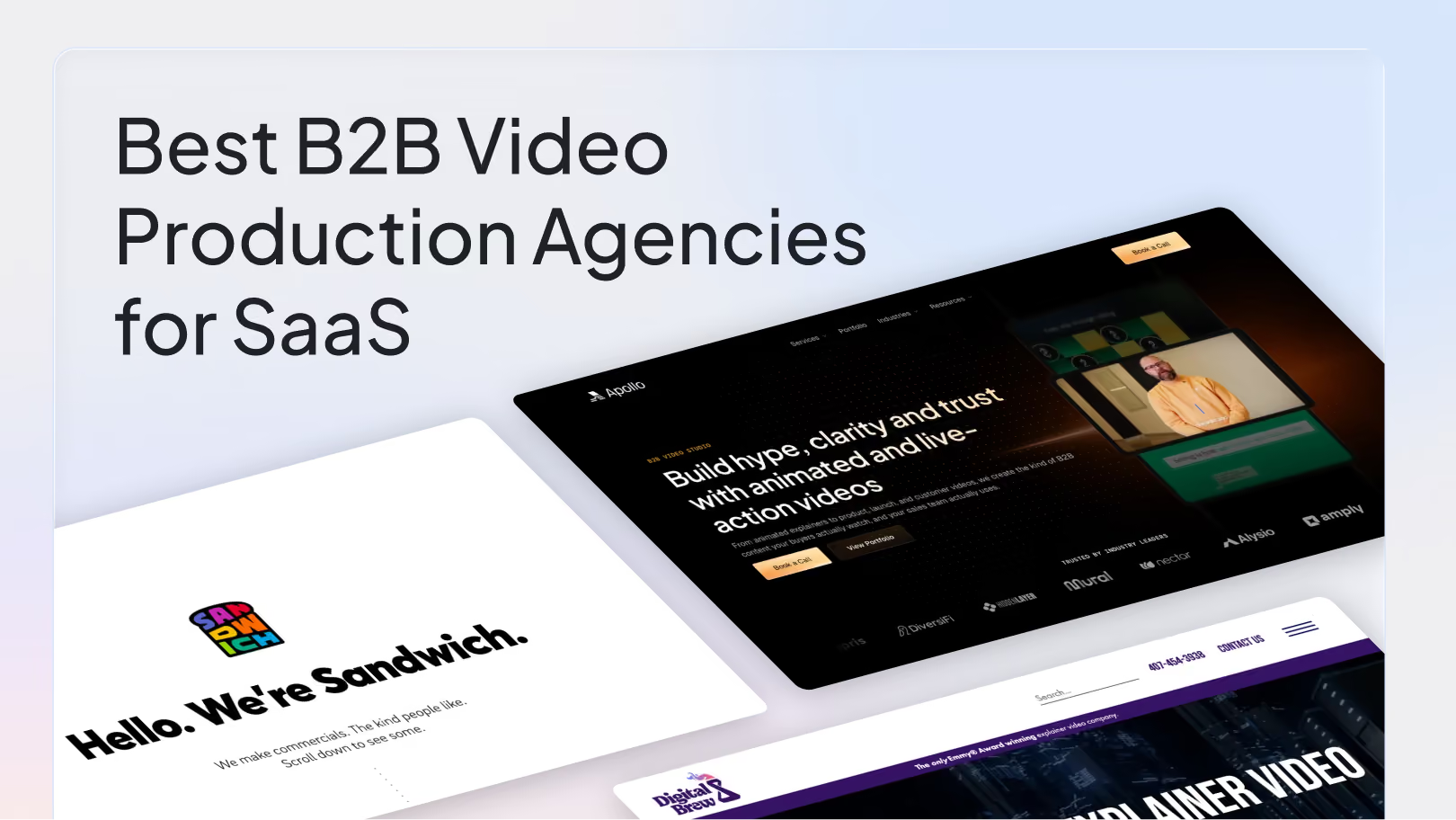
Best B2B Video Production Agencies for SaaS Companies in 2026

Key Takeaways
- Apollo Studio — Best for complex SaaS and AI products
- Vidico — Best for SaaS video at scale
- Content Beta — Best for continuous content velocity
- Venture Videos — Best for SaaS-only specialisation
- Demo Duck — Best for custom product films with creative range
- Explainify — Best for animation-first software simplification
- Moonb — Best for an embedded creative team
- Wyzowl — Best for fixed-price predictability
- Superside — Best for enterprise SaaS at volume
- Yum Yum Videos — Best for early-stage SaaS storytelling
Your product changes every two weeks. Your video doesn't.
That's the problem nobody warns SaaS teams about. You commission a beautiful product video, it takes ten weeks, and by the time it ships the interface in it is already three releases out of date. The agency did good work. The work just wasn't built for how software companies actually operate.
SaaS video is a different discipline from B2B video generally, and the gap is wider than most buyers expect. Your product is abstract. Your interface is the hero, and filming a screen well is a genuine craft. Your buyer wants to see the thing working before they'll book a call. And you need new video continuously, not once a year.
This guide ranks the agencies that understand that — what each does well, what it costs, and who each one actually suits.
How We Ranked These Agencies (Methodology)
We ranked for teams shipping software continuously — not for companies commissioning a single brand film. If you need one flagship video every couple of years, weight these criteria differently, because ours are built around the reality that SaaS marketing is a production line rather than an event.
Demonstrated SaaS portfolio
Not tech-adjacent. Not "we've done some software." We looked for agencies whose portfolios contain actual software products, because the difference shows immediately in scripting. An agency that has explained twenty SaaS products knows which forty seconds to cut. One that hasn't will try to cover your feature list.
Product demo and UI-in-motion capability
This is the sharpest craft split in the category, and most buyers don't know to look for it. There's a large quality gap between an agency that screen-records your interface and one that rebuilds it as designed motion — clean, controlled, with the cursor moving deliberately and the UI animating to direct attention. The second approach costs more and converts better, because it shows the product working the way you wish it worked rather than the way a laggy staging environment behaves on the day of the shoot.
Ability to keep pace with release cycles
SaaS ships constantly. An agency that takes ten weeks per video and treats each one as a fresh engagement will always be behind your roadmap. We credited teams with fast turnarounds, retained models, or reusable creative systems that let video keep up with the product.
Pricing model fit for continuous production
Project pricing works for a launch film. It's expensive and slow for a company that needs eleven videos a year. We weighted whether the commercial model matches continuous production — subscriptions, retainers, and volume arrangements score well here in a way they wouldn't on a general B2B list.
Independent reviews and SaaS community reputation
Clutch and G2 profiles, named SaaS references, and visible standing among software marketers.
The Best SaaS Video Agencies Compared
| Agency | Best For | Pricing | Model | Better Suited For… Than… |
|---|---|---|---|---|
| Apollo Studio | Complex SaaS + AI | Project-based | Full-service studio | Products that need explaining, than many videos at once |
| Vidico | SaaS video at scale | From ~$5,000/mo | Subscription + project | Continuous production, than one-off commissions |
| Content Beta | Content velocity | From ~$3,000/mo | Creative-as-a-service | High throughput, than a single flagship piece |
| Venture Videos | SaaS-only focus | Fixed, published | Project-based | Buyers wanting price certainty, than those needing sub-two-week delivery |
| Demo Duck | Custom product films | ~$8,000–$25,000+ | Project-based | Planning a quarter ahead, than tight release deadlines |
| Explainify | Animation-first clarity | Custom | Project-based | Teams committed to animation, than multi-format programmes |
| Moonb | Embedded creative team | Subscription | Retained creative partner | Ongoing lifecycle content, than a one-off demo |
| Wyzowl | Fixed-price certainty | $2,500–$9,000 | Fixed packages | Predictable scope, than bespoke creative |
| Superside | Enterprise SaaS volume | Flex from ~$15,000/mo | Subscription | Multi-discipline consolidation, than video-only depth |
| Yum Yum Videos | Early-stage storytelling | Custom | Project-based | Brand personality, than deeply technical products |
The 10 Best SaaS Video Production Agencies in 2026
1. Apollo Studio
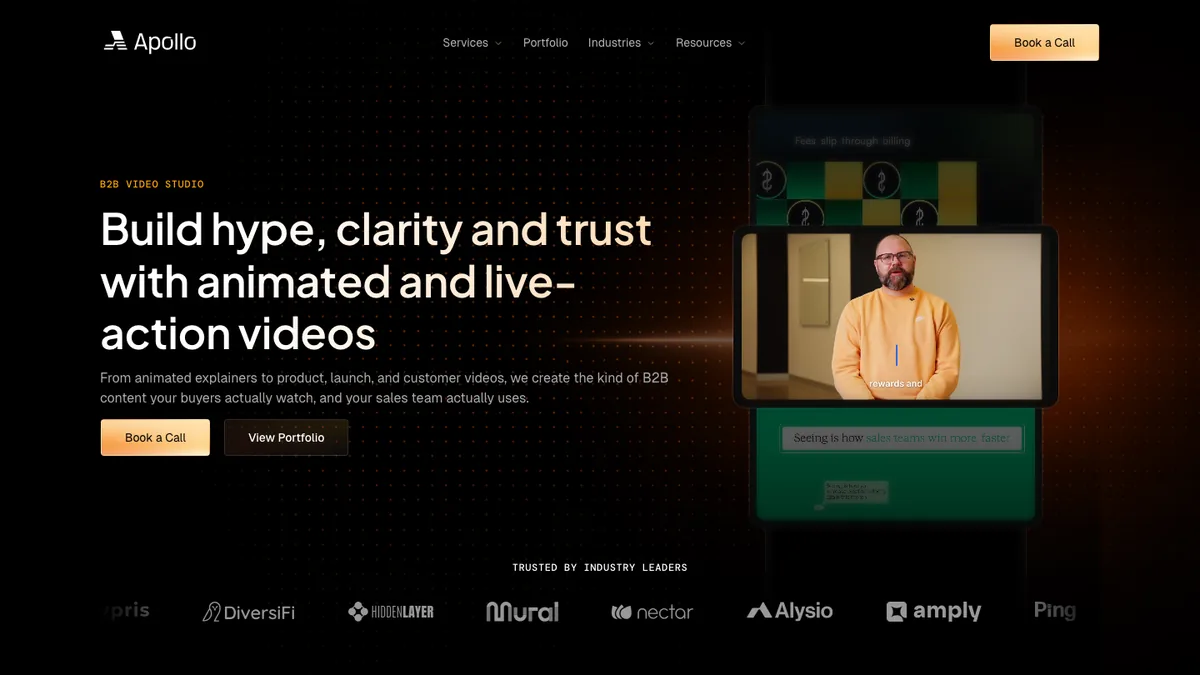
Best for: SaaS and AI companies whose product is genuinely hard to explain.
Apollo works exclusively with B2B tech — SaaS, AI, fintech, cybersecurity, healthcare — and that narrowness is why it ranks first against criteria built around software fluency.
The portfolio is the evidence. Apollo has produced work for Mural, the collaboration platform, Cypris AI for R&D teams, Markopolo AI, Mindsmith, and Ping, including both a product tour and a launch cut for the latter. That Ping pairing is instructive: a deeper feature-rich walkthrough for lower-funnel buyers, and a punchy launch piece for reach — the same product, two different jobs, correctly distinguished. A lot of agencies make one video and try to use it everywhere.
On the UI-in-motion criterion, Apollo's motion design is produced in-house rather than outsourced, which is unusual at this size and shows in how interfaces are handled across the work.
Speed is the differentiator that matters most for SaaS. Post turns around in roughly a week and full productions in about three, against the six-to-ten-week schedules common in this category. For a team trying to support a release cadence, that gap decides whether video can keep up with the roadmap at all. Co-founder Cade Biegel runs strategy calls directly.
Who it's less suited for: Better suited to a few product videos that have to land with a software buyer than to companies shipping many videos simultaneously, which is where a larger network or a subscription team fits better.
2. Vidico
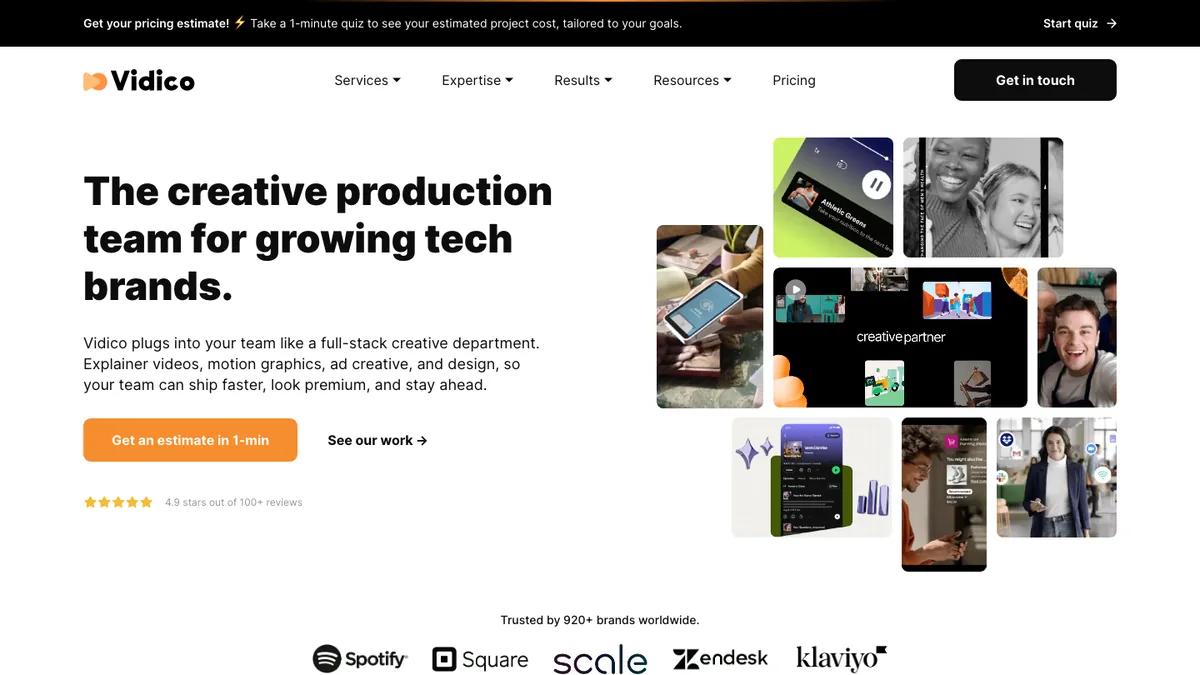
Best for: SaaS companies producing video at scale across formats.
Vidico is among the most recognised names in SaaS video, and the reason is as much operational as creative. Founded in Melbourne and now working across New York, Dubai, and Singapore, it built a model for companies needing video continuously.
Subscriptions start around $5,000 per month and cover multiple formats under one fee — demos, explainers, ads, social cuts. The economics improve as the engagement runs, because product understanding and creative systems carry forward instead of being rebuilt each quarter. For a SaaS team with a real content calendar, that compounding is the whole argument.
The portfolio skews toward high-growth software, and the work is consistently polished and on-brief.
Who it's less suited for: Better suited to teams producing continuously than to those commissioning occasionally. If you need one exceptional launch film a year, you'll pay for capacity you don't use, and a project studio will serve that better.
3. Content Beta
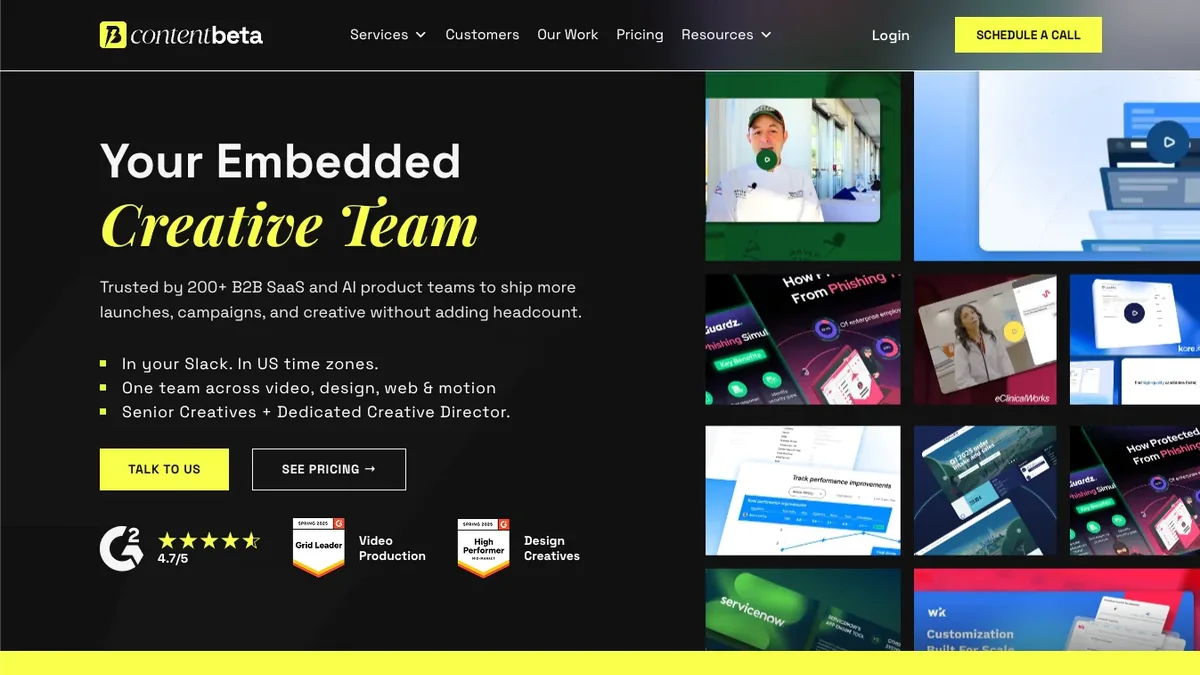
Best for: SaaS teams that need volume without an in-house video team.
Content Beta runs creative-as-a-service built specifically for SaaS — video, motion, and design on subscription, from around $3,000 per month. It ranks considerably higher here than on a general B2B list, because the model is designed for exactly the problem this guide is about.
That problem is structural. Product-led companies ship constantly, and every release needs supporting creative. Handling it through project agencies means permanent scoping overhead. Handling it in-house means hiring a video team before the volume justifies one. A subscription sits between the two, and per-video costs drop substantially against traditional agency rates once throughput is steady.
The team also publishes extensively on B2B and SaaS video, which is reasonable evidence of how seriously it takes the category.
Who it's less suited for: Better suited to steady throughput than to a single ambitious piece — subscription creative optimises for volume and consistency, and a project studio will go further on one flagship video. The model assumes enough continuous demand to justify the retainer.
4. Venture Videos
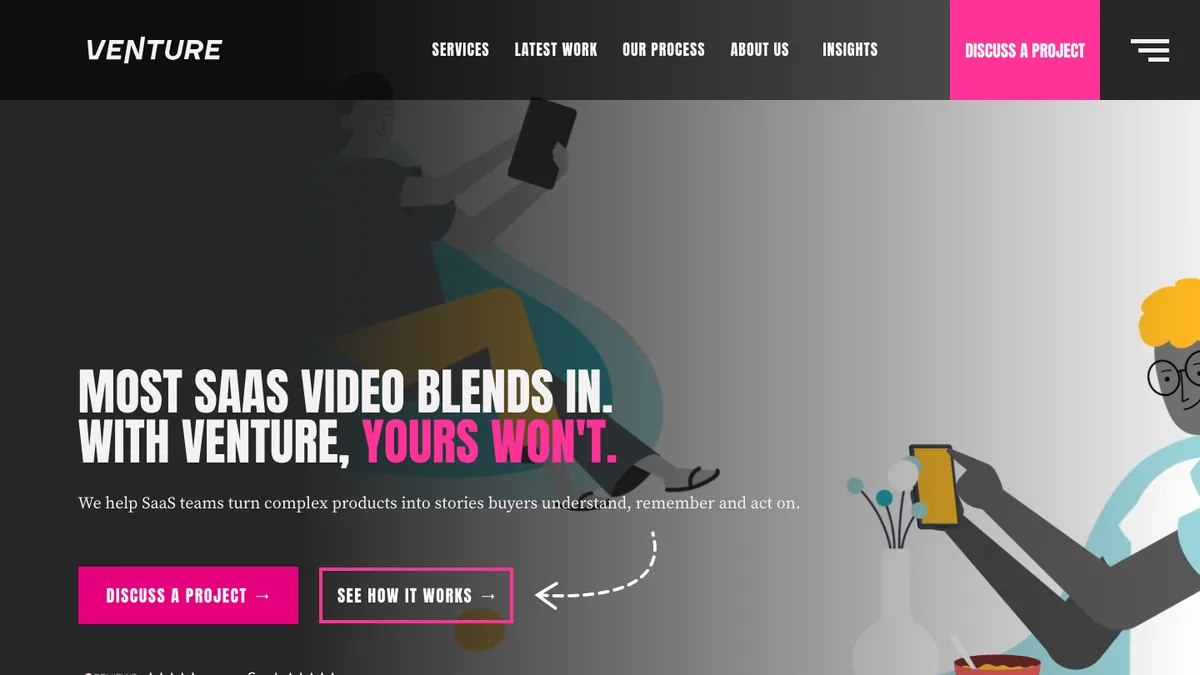
Best for: Teams wanting an agency that does nothing but SaaS.
Venture Videos is a UK studio focused exclusively on SaaS and tech, with a client list including Amazon, Box, and Experian. The service range is unusually complete for a specialist — explainers, launches, demos, onboarding, and case study video — meaning a single partner can cover most of a SaaS video programme.
Two things stand out. Pricing is fixed and published rather than quoted case by case, which removes the procurement friction that slows most video buying. And alongside standard four-to-eight-week timelines, the studio offers accelerated production delivering in ten to twenty-one days — useful when a launch date moves, as launch dates do.
The team also works on investor pitch and presentation animation, which overlaps neatly with what venture-backed SaaS companies need beyond marketing.
Who it's less suited for: Better suited to buyers who value price certainty and a SaaS-only partner than to those needing sub-two-week delivery as standard — the accelerated option is available but scope-dependent. Being UK-based may also mean timezone friction for US teams wanting heavy real-time collaboration.
5. Demo Duck
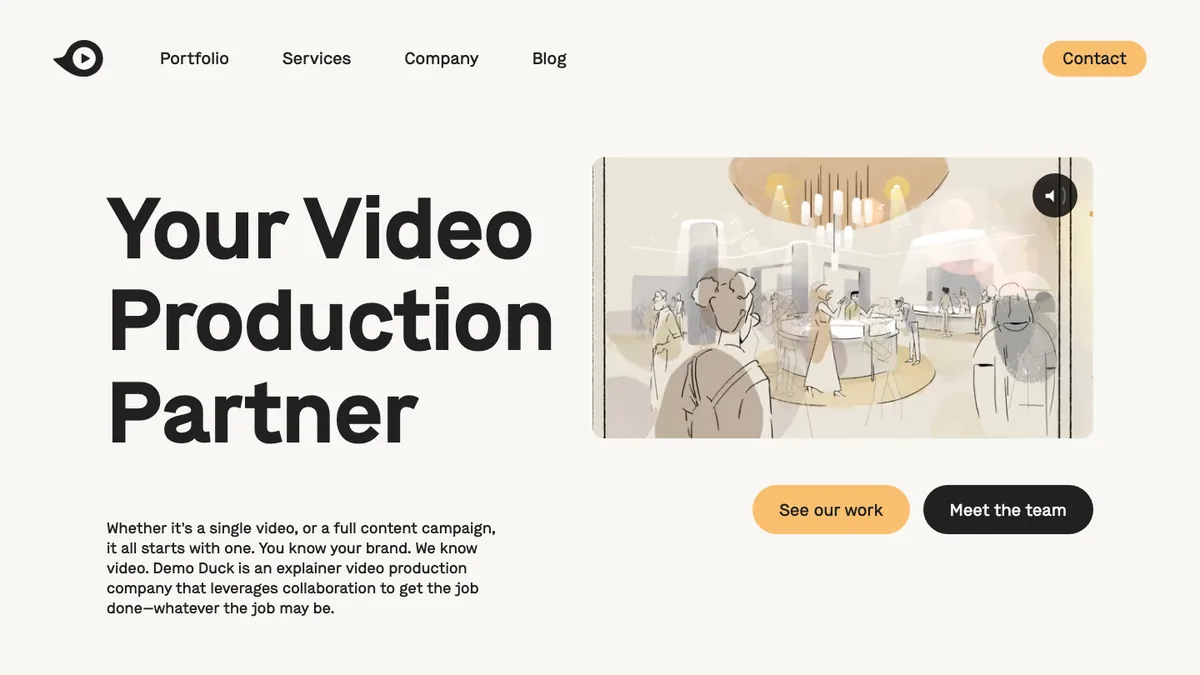
Best for: SaaS companies wanting a custom product film with real creative range.
Demo Duck is a Chicago studio with work for Netflix, Google, and Geico, and genuine range across animation and live-action. For a SaaS company whose programme needs an animated explainer one quarter and a live-action customer film the next, that breadth removes a re-sourcing cycle.
The work is consistently strong and creatively ambitious. Where most SaaS video plays it safe, Demo Duck's portfolio shows genuine creative risk-taking — useful if your category is crowded and sounding like everyone else is the actual problem.
Pricing reports vary — some sources place projects at $8,000–$20,000, others report custom work starting nearer $25,000 with six-to-ten-week timelines — so treat those as indicative and scope directly. The spread most likely reflects the range between an animated explainer and a full live-action production rather than inconsistent quoting.
Who it's less suited for: Better suited to teams planning a quarter ahead than to those supporting a fast release cadence. Timelines run long for a company shipping features monthly, and the pricing spread means you'll want a firm quote early.
6. Explainify
Best for: SaaS products that are genuinely difficult to describe.
Explainify has focused since 2012 on turning complicated B2B ideas into clear animated video, producing close to 1,000 custom animations for clients from startups to Fortune 500.
The narrowness is the strength, and it shows most in scripting. The hardest part of a SaaS explainer is deciding what to leave out — inexperienced teams try to cover the product rather than land one idea. Explainify is consistently disciplined about scope, which is why the work holds up for complex software rather than only for simple propositions.
Thirteen years on one problem also means the team has seen most of the ways a SaaS explainer goes wrong: the script that becomes a feature tour, the metaphor that confuses more than it clarifies, the opening that assumes the viewer already understands the category. Avoiding known failure modes is underrated, and it's mostly what you're buying from a long-running specialist.
Who it's less suited for: Better suited to teams committed to animation than to those building a multi-format programme. If your plan includes live-action demos, testimonials, or founder content, you're buying one component and sourcing the rest elsewhere.
7. Moonb
Best for: SaaS teams wanting an embedded creative partner rather than a vendor.
Moonb positions itself as an extension of your team rather than an agency you brief — a senior creative director stays across the work, keeping product demos consistent with everything else you publish. It's a genuine structural difference from project-based studios, and it matters for SaaS companies where video, motion, and design all need to look like one brand.
Practically, it operates like an in-house team without the hiring. Work runs through Slack, Trello, or Teams, there are weekly strategy calls, and the arrangement is contract-free. For a marketing lead who'd otherwise be managing three suppliers, that consolidation is the appeal.
Moonb covers SaaS, fintech, ecommerce, and healthcare, with product demo walkthroughs as a stated specialism.
Who it's less suited for: Better suited to teams wanting ongoing lifecycle content than to those buying a single demo — the embedded model assumes a continuing relationship, and one-off buyers won't see the benefit that justifies it.
8. Wyzowl
Best for: Early-stage SaaS that needs budget certainty.
Wyzowl pioneered fixed-price explainer production in 2011 and reports over 4,000 videos for more than 2,000 companies across 40 countries, with clients including Amazon, PayPal, Slack, HSBC, and Deloitte. Packages run roughly $2,500 to $9,000.
For a seed or Series A company that needs a competent explainer live without a procurement cycle or a surprise invoice, it's the lowest-risk option here. You know the price and roughly the outcome before you start.
That predictability is worth more to early-stage teams than it sounds. At seed stage the real risk isn't that the video is merely good rather than exceptional — it's that a project overruns by six weeks and two budget revisions while you're trying to launch. Wyzowl's scale means the process is heavily systematised, and systematised processes are the ones that hold when your side of the project slips.
The volume also means the team has explained a very large number of software products, so the scripting starting point is rarely from zero.
Who it's less suited for: Better suited to teams valuing predictable scope than to those wanting bespoke creative. The package model is built for repeatable quality, so an unusual narrative approach or a distinctive visual language will strain it.
9. Superside
Best for: Enterprise SaaS buying creative across disciplines.
Superside is a globally distributed creative company covering design, brand, ad creative, and video on subscription. For large software organisations, the consolidation is the point — one vendor across creative functions that would otherwise mean several.
Pricing sits at the enterprise end. Reported figures vary, but the Flex plan starts around $15,000 per month on an annual term, with dedicated-team plans materially higher. For a company running significant paid media and needing constant creative refresh, the maths works.
The case is strongest when video isn't your only creative bottleneck. Enterprise SaaS marketing teams typically need ad creative, event collateral, sales enablement, and web design alongside video — and managing five specialist suppliers carries a real coordination cost that rarely appears in any budget line. Superside's argument is that consolidating them is worth more than the marginal depth you give up in any one discipline.
Who it's less suited for: Better suited to multi-discipline consolidation than to video-only depth. Because video is one capability among many, you're not buying the concentrated specialisation a dedicated studio brings — and complex technical products usually need more product immersion than a broad creative partner is structured to provide.
10. Yum Yum Videos
Best for: Early-stage SaaS needing a top-of-funnel piece with personality.
Yum Yum Videos has a strong reputation for narrative-led animated explainers, with clients including Amazon, Google, McKesson, FOX, Roblox, Walmart, American Express, and Huawei.
The work performs well in awareness placements, where the job is making someone care in the first few seconds rather than walking through a feature set. The animation carries more personality than most B2B work — useful when the video has to survive a social feed. For early-stage companies, it also tends to produce pieces that travel across contexts: explaining the product, signalling credibility to investors, and giving the founder something to send.
Who it's less suited for: Better suited to products helped by brand personality than to deeply technical ones. For infrastructure or developer tools where the buyer is an engineer, a specialist will reach a working script faster.
Honorable Mentions
- Lemonlight — High-volume, fast-turnaround branded video, strong on social-first formats.
- Even Media — Mid-market option combining SaaS video production with content strategy.
- Advids — Very large production network; useful when you need breadth of style options fast.
- MyPromoVideos — 2,000+ B2B videos and a 4.9 Clutch rating across broad B2B tech.
Which SaaS Video Agency Is Best For You?
Pre-seed to seed. Wyzowl or Yum Yum Videos. You need one good explainer that makes the product make sense, at a price that doesn't consume the quarter. Don't over-invest before you know the positioning holds.
Series A–B, scaling. Apollo Studio or Venture Videos. You've proven the market and now need video that matches the sophistication of the buyer — and probably a partner who can cover several formats.
Product-led with continuous releases. Content Beta, Vidico, or Moonb. Your constraint is throughput, not craft ceiling. A subscription or embedded model will serve you better than the best project studio.
Complex or technical product. Apollo Studio or Explainify. The bottleneck is comprehension, not production value, and that's a specialisation question.
Enterprise SaaS. Superside. Once you're managing multiple creative disciplines, consolidation is worth real money.
A single flagship launch film. Demo Duck. Give it a quarter and a proper budget.
What Kind of Video Does Your SaaS Actually Need?
Most teams ask which agency to hire before they've decided what to make. These are the five formats that matter, and what each is for.
Explainer — top of funnel. Sixty to ninety seconds answering "what is this and why should I care." Built for people who don't yet know they have the problem. Animation usually wins here, because you're explaining a concept rather than a screen.
Product demo — evaluation. Two to four minutes showing the software actually working. This is the one buyers watch before booking a call, and the one where UI-in-motion craft pays for itself. Vague demos lose deals to competitors with clearer ones.
Feature launch — retention and expansion. Short, frequent, tied to your release cycle. The job is telling existing customers something changed, and giving sales a reason to re-engage. Volume matters more than polish.
Onboarding — activation. In-product or emailed, showing users how to get value fast. Rarely glamorous, often the highest-ROI video a SaaS company makes, because it moves activation directly.
Customer story — proof. Real customers on camera saying the thing worked. Nothing you say about your product carries the weight of someone else saying it. Make these once you have referenceable clients and results worth showing.
Most SaaS companies need the explainer and the demo first. Everything else follows once those two are working.
How Much Does SaaS Video Production Cost in 2026?
- $2,500–$5,000 — Fixed-package explainers. Defined scope, proven process, limited customisation.
- $6,000–$15,000 — A quality one-minute product demo from a traditional agency. This is the realistic band for custom demo work with original motion design.
- $3,000–$15,000+ per month — Subscription and embedded models. Per-video cost drops substantially once throughput is steady, which is why continuous producers land here.
- $25,000+ — Flagship launch films and multi-format campaigns.
Factors That Influence SaaS Video Pricing
UI treatment. Screen recording is cheap. Rebuilt, designed interface motion costs considerably more and looks materially better. This is usually the single largest swing factor in a SaaS video quote.
Length and depth. A 60-second explainer and a four-minute walkthrough are different orders of work. Complexity drives cost harder than duration.
Animation versus live-action. Live-action carries crew, location, and talent costs; animation front-loads into design and motion. Neither is reliably cheaper.
Release cadence. One video costs more per unit than eleven. If you know you'll need volume, price the year rather than the video.
Script and strategy. Some agencies include discovery and scripting, others bill it separately. This is where most of the value actually sits — find out early which you're buying.
Turnaround. Compressed timelines usually carry a premium, though studios structured for speed price it as standard rather than as a rush fee.
Final Thoughts
The instinct when hiring a SaaS video agency is to sort by portfolio quality. It's the wrong first filter, because at this level almost everyone's reel looks good.
Sort by fit instead. Ask whether the agency has explained software as complex as yours, whether their commercial model matches how often you'll need video, and whether they can move at the speed your roadmap moves. Those three questions eliminate most of a shortlist quickly.
Then run one test. Watch a full product demo from each agency you're considering — not the showreel, the actual deliverable — and check whether you understood the product at the end. If you didn't, and you're a motivated viewer who chose to watch, your buyer certainly won't.
Frequently Asked Questions
SaaS video has to show an interface, explain an abstract product, and stay current as the software changes. That means agencies need UI motion skills, the ability to simplify complex functionality, and a working model that keeps pace with release cycles — requirements that don't apply to most other B2B video.
A quality one-minute product demo costs $6,000 to $15,000 from a traditional agency in 2026. Subscription-based partners start around $3,000 per month and bring per-video costs materially lower once you're producing consistently. Fixed-package explainers start near $2,500.
Use animated or rebuilt UI for marketing videos where polish and message control matter, and screen recordings for onboarding and support content where accuracy and speed matter more. Rebuilt interface motion costs more but converts better, because it shows the product working ideally rather than however the staging environment behaved that day.
Product demos work best at two to four minutes for evaluation-stage buyers. Top-of-funnel explainers should stay under 90 seconds. Feature launch videos work at 30 to 60 seconds. Watch completion rate rather than guessing — it tells you where you lost people.
No. Make full videos for releases that change how customers perceive the product, and short clips or screen captures for everything else. Most teams over-produce minor releases and under-produce major ones.
An explainer introduces the problem and why your product matters, usually under 90 seconds, for people who don't know you yet. A demo shows the software actually working for buyers already evaluating you. Explainers sell the idea; demos sell the product.
Yes, but narrowly. One good explainer that makes the product understandable is usually worth it as soon as you're driving traffic. Hold off on customer stories until you have referenceable clients, and on volume production until you have a repeatable release cadence.
Design for it. Ask agencies to build modular videos where UI sections can be replaced without a full re-edit, keep source files, and favour partners with fast turnaround or a retained model. Videos built as single monolithic pieces are expensive to update and usually get abandoned instead.
Hire an agency until video demand is predictable and continuous. In-house makes sense once you need more than roughly two videos a month, because that's the point where salary costs less than project fees. Subscription and embedded models sit between the two and suit most scaling SaaS companies.
Start with completion rate — it tells you whether the video holds attention at all. Then measure downstream: demo requests, landing page conversion with and without the video, and activation rate for onboarding content. The strongest informal signal is whether your sales team sends it unprompted.