Best Financial Services Video Production Companies in 2026


Key Takeaways
- Financial services is two markets wearing one compliance department. A software company explaining a product to a financial buyer and a bank explaining a product to a customer share a reviewer and almost nothing else. The routing section below splits them.
- Apollo Studio ranks first on commercial structure, publishing an all-in per-project figure of $5,000 to $50,000+ with revisions inside the number rather than a starting price with passes billed on top. In a category where a compliance reader reliably produces a third round, that is the term that decides what the project costs.
- Lightswitch Video has the deepest named institutional track record, publishing Raymond James, UBS and Janney Montgomery Scott, and it puts script and shot list in front of compliance before the shoot rather than after.
- Motif Motion publishes the most specific review method in the category, built explicitly around SEC and FINRA, alongside a per-minute rate card.
- Published prices here are not comparable to each other. One agency publishes per project, one per minute, one per month and one per 60 seconds. Read the unit before the number.
- No agency can approve your content. Only your compliance team, or your broker-dealer if you are a member firm, can do that. Treat "pre-approved" or "compliance-ready" as a reason to ask more questions rather than fewer.
How we ranked these agencies
This is a review desk, so the method comes before the list.
We ranked for one buyer: a company whose video has to clear a compliance review it does not control, in financial services. That covers financial software and fintech companies explaining a product, banks, insurers and advisory firms explaining one to customers, and the lending, wealth, accounting, benefits and insurance technology companies in between. Five criteria, weighted in this order.
Commercial terms that survive extra review rounds
Weighted heaviest, for a reason specific to this category rather than a general preference. A compliance reviewer reads the script and reads the cut, and each pass produces its own comments. An agency quoting a starting figure with revisions billed separately has moved that risk onto you in exactly the category where it is most likely to land. We gave the most weight to an all-in project figure, then to any published figure, then to a published rate card.
Published evidence of regulated financial work
Named clients or named work, published on the agency's own site. "Financial services" on an industries list is not evidence. A named bank, a named carrier or a named platform is. Directory listings and awards did not count.
A published account of how review is handled
Whether the agency has written down what it does about compliance rather than asserting that it understands it. The useful version names a mechanism: claims marked in the script, reviewers reading before anything is produced, approved wording locked once cleared. More agencies publish one here than in most categories, which made this a real differentiator rather than a tiebreak.
A schedule that says what it includes
Whether a published turnaround states whether your review sits inside it or outside it. The honest version excludes it, because that is the only version you can plan against. A figure that quietly includes someone else's approval queue is not a schedule.
Medium range
Whether the agency can do both animation and live action, or only one. Most financial work needs animation, because the product happens inside systems nobody can film. Some of it needs a person on camera. An agency that does one and brokers the other adds a supplier to a procurement process that is already long.
What we did not optimise for. Not the longest list of financial clients, not years in business, not awards, and not animation craft for its own sake. An agency with hundreds of bank films has proven something real, and where that is the credential you want, the list below names who has it. We also did not treat consumer financial advertising and B2B product explanation as the same brief, because they are not.
The agencies compared
| Agency | Published figure | Regulated evidence | Review process published | Media | Better suited for... than... |
|---|---|---|---|---|---|
| Apollo Studio | $5,000 to $50,000+, all in, per project | Jump for financial advisers, Pilot for accounting firms, Redo in benefits, all watchable on the page | Script and storyboard approved before anything is built | Animation and live action, both in house | Software companies explaining a financial product to a business buyer, than institutions buying consumer advertising |
| Lightswitch Video | Not published | Raymond James, UBS, Janney Montgomery Scott | Script and shot list before the shoot, so compliance sees it first | Live action led, multi-market crews | Programmes shooting across several markets, than teams wanting a figure before a call |
| Vidico | Plans from around $5,000 a month | A published finance practice across fintech and financial services | Not published | Animation led | Funded fintech shipping video continuously, than teams needing one project priced and closed |
| Motif Motion | $4,500 to $7,000 and $7,000 to $11,000 per minute | AccessLex, plus fintech platforms and advisers | Built for SEC and FINRA review, with the method stated | Animation and motion graphics | Teams whose reviewers cite a rule by number, than teams needing a filmed crew |
| Epipheo | $10,000 to $45,000 typical for a financial explainer | US Bank, Fifth Third Bank | Review planned into the schedule from day one | Animation and motion graphics | One carefully made financial explainer, than continuous output |
| Indigo Productions | Not published | A long-running New York financial practice across banks and institutions | Not published | Live action led, full service | Institutions wanting commercials and brand films, than software companies explaining a workflow |
| Magnet Media | Not published | Banks, asset managers, hedge funds, insurers and capital markets | Compliance and legal review built in from day one | Live action and animation | Institutions running an ongoing content programme, than teams buying a single asset |
| Lifetime Media | Not published | Banks, investment firms and independent advisers | Review checkpoints at script, edit and final cut, with disclosures | Live action led | Advertising that has to carry risk language, than teams wanting a published price |
| Broadcast2World | Not published | Citibank, OnDeck, Tricolor, F.H. Cann | Compliance-aware animation stated as a practice | Animation led | Lending, collections and benefits explained in animation, than live-action adviser video |
| Wyzowl | Fixed price per video, quoted on request | Paymentshield, plus carriers, insurtechs, brokers and MGAs | Not published | Animation led | Insurers and brokers wanting a fixed price per video, than teams needing live action |
The 10 best financial services video production companies in 2026
1. Apollo Studio
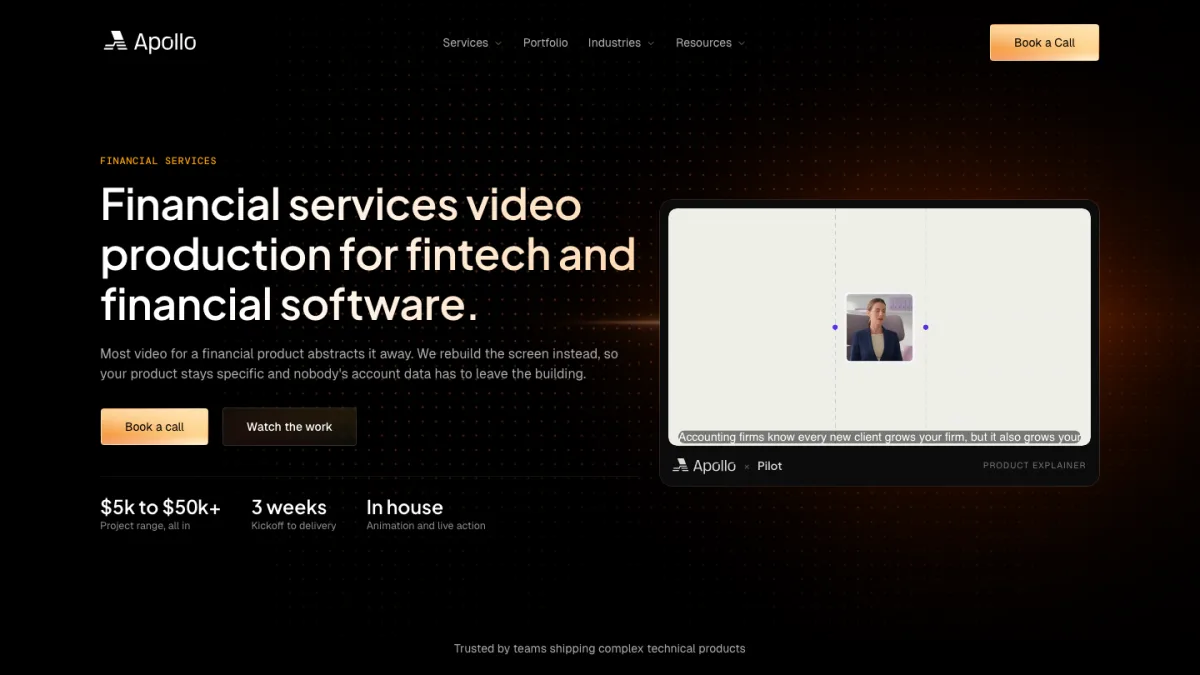
Apollo Studio makes video for companies whose product moves, manages or accounts for other people's money, and tops this list on the heaviest criterion. It publishes an all-in per-project figure of $5,000 to $50,000+ covering scripting, storyboard, production, revisions and final cuts, rather than a starting price with passes billed on top. In a category where a compliance reader reliably produces a third round, that is the term that decides what the project costs.
The regulated evidence is watchable rather than described. Jump for financial advisers, Pilot for accounting firms and a Redo benefits launch all play on the page.
Two method points suit this category specifically. The product interface is rebuilt and animated rather than screen recorded, so no real account data leaves the building. And animation and live action come from the same studio, so a project needing a founder on camera and a rebuilt payment flow does not add a second supplier.
Who it is less suited for. A bank or insurer buying consumer brand advertising, or an institution that wants a resident agency embedded in an ongoing content programme. Indigo Productions and Magnet Media are built around those briefs.
2. Lightswitch Video
Lightswitch Video has the deepest named institutional track record here, publishing Raymond James, UBS and Janney Montgomery Scott among its financial clients. For a buyer whose own compliance team will ask who else the agency has cleared, that list does more work than a showreel.
Its published process is the one worth copying. Script and shot list go to compliance before the shoot rather than after, so what will be said and shown is agreed while it is still words on a page. It also publishes response commitments most agencies avoid, and names approvals and permissions rather than filming as the thing that moves a schedule, which is an unusually honest account of where the time goes.
The multi-market capability matters where the obligation varies by jurisdiction. If your disclosure requirements change by market, so does your production, and crews across regions remove a coordination layer you would otherwise own.
Who it is less suited for. Teams that need a budget figure before the first conversation, since it quotes per project.
3. Vidico
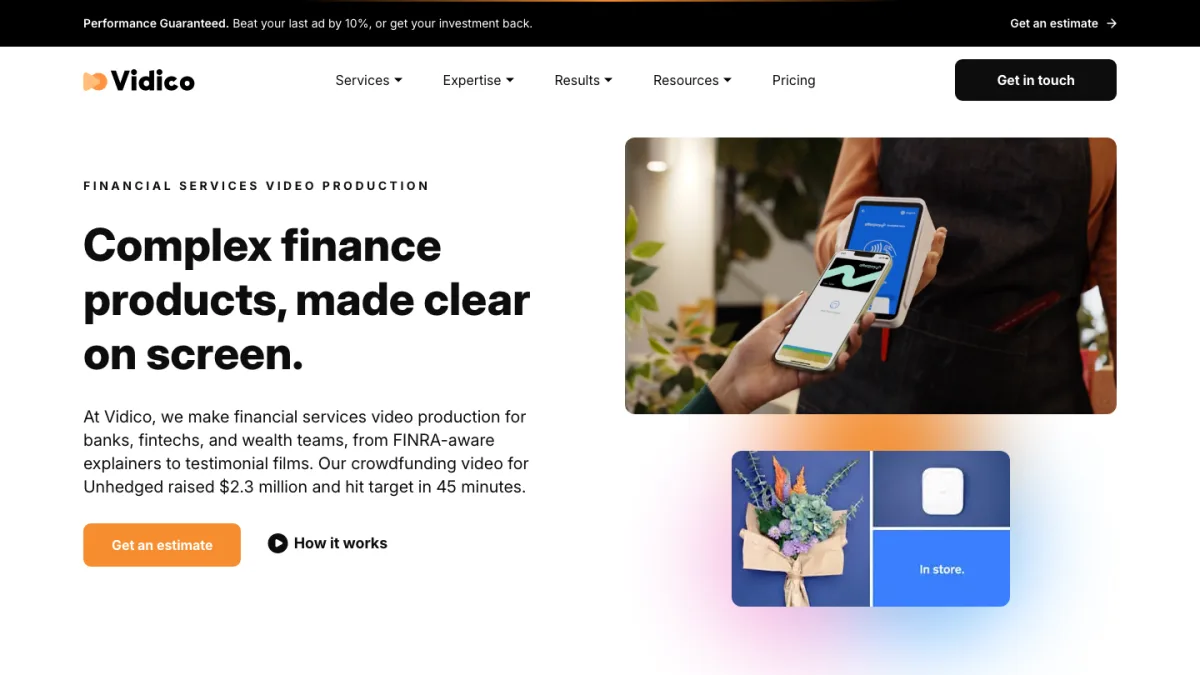
Vidico runs a published finance practice across fintech and financial services, and the product-narrative craft is consistently strong. For a funded fintech that wants a complicated product to feel inevitable, it is the most established name on this list.
It is one of the few agencies anywhere in the category to publish a figure, selling monthly plans from around $5,000 that cover strategy, scripting, animation, live action and editing, with unused budget rolling over. That makes it a continuous-output option rather than a per-project one, which is a different question from the one most buyers on this page are asking.
Who it is less suited for. A single commissioned film that needs a price quoted and closed. A monthly plan fits a steady stream, and a per-project all-in figure fits one piece against a fixed budget.
4. Motif Motion
Motif Motion publishes the most specific review method in this category, under a heading that names the regimes rather than gesturing at them. The method is concrete: keep scripts and on-screen claims easy to check, leave room for the disclosures your reviewers require, and lock approved wording once it clears.
It is also one of only a handful here with a published rate, and the only one publishing per minute, at $4,500 to $7,000 at one tier and $7,000 to $11,000 at another. The Philadelphia studio works in animation and motion graphics for fintech platforms, institutions and advisers, and publishes regulated work beyond finance, including AccessLex in legal and financial education.
Who it is less suited for. Projects needing a filmed crew and people on camera, since the bench here is animation and motion graphics.
5. Epipheo
Epipheo publishes both a price and a position, which is rare enough to be worth the ranking on its own. It states $10,000 to $45,000 as typical for a financial services explainer, split by technique, and it says plainly that compliance review should be planned into the schedule from day one rather than discovered at the end.
Its named financial work includes US Bank and Fifth Third Bank, so the institutional side of the market is proven rather than implied. The craft is explainer-first and narrative-led, which suits a product that has to be understood before it can be trusted.
Who it is less suited for. Continuous output. This is a studio for one carefully made piece rather than a pipeline, and Vidico or Wyzowl fit a steady stream better.
6. Indigo Productions
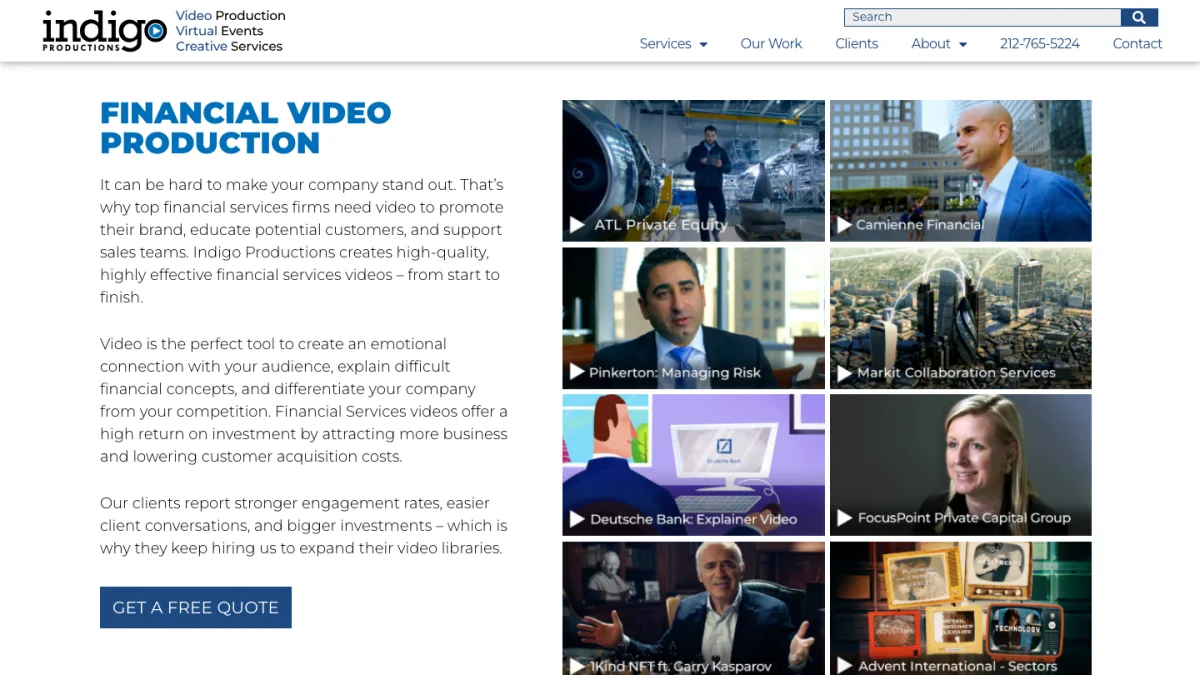
Indigo Productions runs a long-standing New York financial practice and is full service in the traditional sense: commercials, brand films, explainers and event content from one house. For an institution whose video programme spans a TV spot and an internal town hall, that breadth removes a lot of coordination.
Being in New York is not incidental for this category. A meaningful share of the buyers on this page sit within a short walk of its crews, and for institutional work where executives are the talent, proximity to the people who have twenty minutes between meetings is a practical advantage.
Who it is less suited for. Software companies explaining an abstract workflow. The strength here is filmed, people-led institutional work, and a rebuilt product interface is a different discipline.
7. Magnet Media
Magnet Media works across banks, asset managers, hedge funds, insurers and capital markets, which is the widest institutional spread on this list. It positions around content programmes rather than single assets, pairing production with strategy for firms publishing continuously.
It states that compliance and legal review are built in from day one. For a firm whose marketing calendar is set quarterly and whose reviewers are permanent fixtures rather than occasional visitors, an agency that plans around that rhythm is worth more than one that treats each project as a fresh negotiation.
Who it is less suited for. A team buying a single asset. Programme pricing and programme process are overhead on one video, and Epipheo or Apollo Studio price a single piece more cleanly.
8. Lifetime Media
Lifetime Media works with banks, investment firms and independent advisers, and publishes the most granular account of review checkpoints here: script, edit and final cut, with disclosures treated as a production decision rather than a legal afterthought.
That matters most where the video is advertising rather than explanation. Risk language, performance disclaimers and the question of how long a disclosure stays on screen are craft problems as much as compliance ones, and an agency that has thought about where they sit in the frame will produce something that reads as designed rather than as a legal patch.
Who it is less suited for. Teams that want a published price before a call. Nothing is published, so the first conversation is a scoping conversation.
9. Broadcast2World
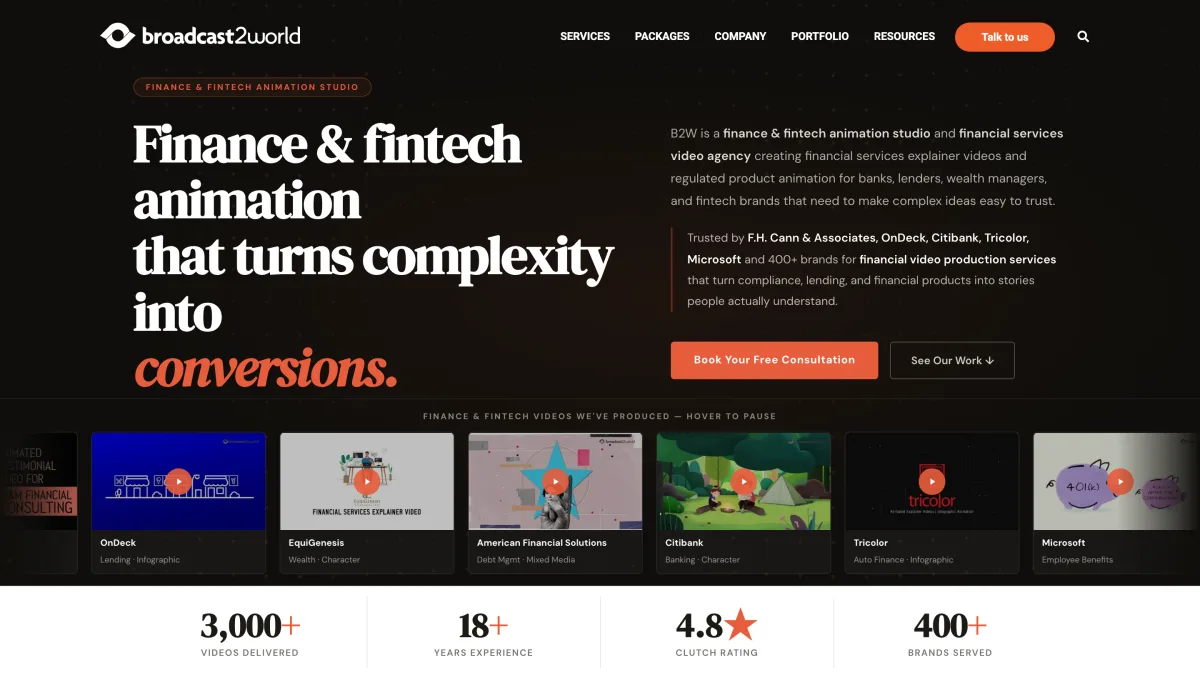
Broadcast2World is an animation studio with named finance work including Citibank, OnDeck, Tricolor and F.H. Cann, which skews usefully towards lending, collections and benefits rather than the payments-and-wealth centre of gravity most of this list shares.
Those are categories where the product is a decision or an entitlement rather than a visible transaction, and animation is often the only honest way to show them. It states compliance-aware animation as a practice, and the named lender work is the evidence behind it.
Who it is less suited for. Live-action adviser or testimonial video. The bench is animation, and a customer story filmed on site needs a crew.
10. Wyzowl
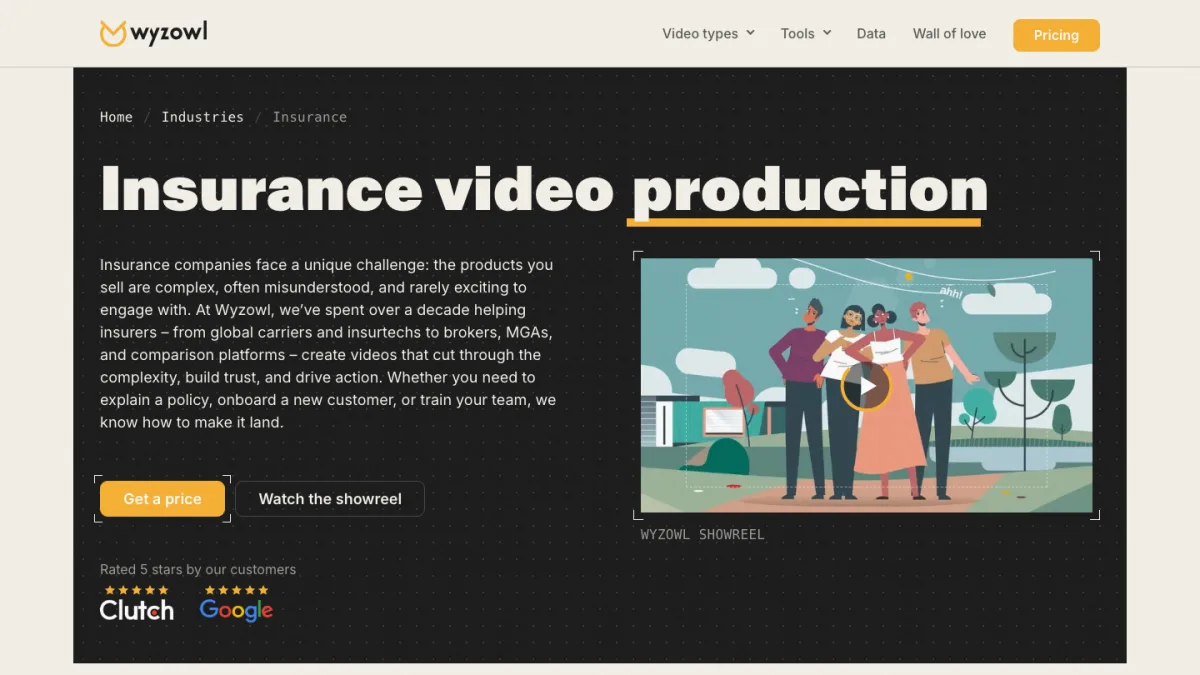
Wyzowl is the strongest insurance-side option here, working across carriers, insurtechs, brokers, MGAs and comparison platforms, with Paymentshield published as a named, long-running client across both customer-facing and adviser training video.
It sells on a fixed price per video quoted on request, which is a cleaner commercial structure than a day rate for a buyer who needs a number before an internal approval. The work is animation-led explainer and onboarding video, which is the right shape for explaining cover, claims and policy mechanics to people who did not choose to learn about them.
Who it is less suited for. Live action, and product explanation for a financial software buyer. The insurance depth is customer and adviser facing, and a platform story for a business buyer is a different brief.
Honorable mentions
Lava Media works across banks, asset managers, insurers and RIAs, positioning on compliance-ready explainers, brand films and investor video. A reasonable shortlist addition where the brief spans several institutional audiences at once.
Gisteo publishes both a price and a timeline for insurance and financial work, quoting from $3,500 per 60 seconds, or $4,000 with scriptwriting, at four to six weeks plus your review. That last phrase is the most honest schedule statement anyone in this category publishes, and the figure is quoted per 60 seconds rather than per project, so read the unit before comparing it to anything else here.
Busylike runs a finance industry production and marketing practice out of New York, pairing production with distribution, which suits a firm that wants the video promoted as well as made.
Which agency is best for you
If the budget has to be approved before review begins and must not move afterwards, start with Apollo Studio. An all-in per-project figure is the one commercial term that holds when a compliance reader adds a round nobody scheduled.
If your buyers are institutions and your own compliance team will ask who else the agency has cleared, Lightswitch Video has the deepest named list and a script-first process built for that approval chain.
If your reviewers cite rules by number, Motif Motion has written down how it works with SEC and FINRA review and publishes a rate card, which is a rare combination.
If you need both the cost and the schedule before you can get the project approved internally, Epipheo publishes both.
If you are producing continuously rather than commissioning one piece, Vidico and Magnet Media are built for a flow of video rather than a single asset.
If the product is a lending decision, a collections process or a benefits entitlement, Broadcast2World has the closest named work.
If you are a bank, insurer or adviser rather than a software company
Worth separating, because the two briefs share a compliance department and almost nothing else.
A financial software company is explaining a platform to a business buyer. The work is product explanation, the difficulty is making an abstract workflow legible, and the review is largely about the accuracy of product claims and what appears on screen.
A bank, insurer, broker or advisory firm is explaining cover, a product or a brand to a customer or an adviser. The review is about advertising rules, disclosures and what may be promised, and the rules come from somewhere else entirely.
On this list, the agencies with the most institution-side evidence are Lightswitch Video, Indigo Productions, Magnet Media, Lifetime Media and, on the insurance side specifically, Wyzowl. The agencies closest to the software brief are Apollo Studio, Vidico, Motif Motion and Broadcast2World.
Ask either kind the same question first: who on your side has produced work under the rules that apply to us, and can we watch it.
Which regime applies to you
Broker-dealers
FINRA Rule 2210 governs member firms' communications with the public and classifies them by audience. Certain retail communications must be filed with FINRA, in some cases before first use, which turns a launch date into a dependency on a queue nobody in the project controls. Build the schedule backwards from the filing requirement rather than forwards from the shoot.
Registered investment advisers
The SEC marketing rule sets conditions on testimonials, endorsements and performance claims, including clear and prominent disclosure of whether a person is a client and whether they were paid. A customer story is the format this bites hardest, and the disclosure is a production decision as much as a legal one, because it has to be readable on screen.
Non-bank fintechs with a partner bank
Deposit insurance wording is the recurring problem. A non-bank describing deposit insurance must name the insured bank, disclose that it is not itself an FDIC-insured bank and say that insurance covers the failure of that bank. Write the wording with your partner bank before production, not after.
Insurance
Insurance advertising is regulated state by state, with rules on claims and disclosures that vary, and anything touching health plans picks up federal rules too. A product sold through advisers into several states can attract state advertising rules, communication requirements and the firm's own policy in a single review.
Software companies selling into all of the above
Your own company may not be regulated, but your buyer is, so the video has to survive their security and procurement review. Claims about encryption, data residency, certifications and audit posture all get checked, and a certification stated loosely is the fastest way to lose a technical reviewer.
What financial services video costs
Published figures in this category are rarer than in general B2B, and they are not quoted on the same basis. Compare the structure before the number.
Per project. Apollo Studio publishes $5,000 to $50,000+, all in, covering scripting, storyboard, production, revisions and final cuts. Epipheo publishes $10,000 to $45,000 as typical for a financial services explainer, split by technique.
Per minute. Motif Motion publishes $4,500 to $7,000 and $7,000 to $11,000 depending on tier.
Per month. Vidico publishes plans from around $5,000, with unused budget rolling over.
Per 60 seconds. Gisteo publishes from $3,500, or $4,000 with scriptwriting.
These four units answer four different questions and cannot be lined up against each other. A per-minute figure prices a length. A monthly plan prices a flow. A per-project all-in figure prices the whole thing including the revisions a reviewer will cause. Work out which question you are asking before you compare anyone.
What drives the cost up
Shoot days, locations and crew size are the familiar ones. Three more matter as much here. How much of the product has to be rebuilt and animated, because a multi-step flow at full fidelity takes longer than a single screen. How many versions you need, since each length, aspect ratio and language is a separate edit. And subject matter expert time, since a script that has to be accurate needs someone qualified to check it.
Where the compliance premium actually sits
Not in the camera. It sits in scripting and in the extra revision cycles. A claim that survives the first review but not the second means the script changes after the voiceover is cut, and in animation that means re-timing the sequence the text sat over. That is why the pricing structure matters more than the headline number: an agency quoting a low base with revisions billed separately has moved that risk to you, in precisely the category where it is most likely to land.
Final thoughts
The agencies that do well in this category are not the ones that say they understand compliance. They are the ones that have written down what they do about it, because the writing is itself evidence that review is a planned stage rather than a surprise.
So shortlist on three published things: what the number includes and in what unit, what has actually been produced under regulatory constraint and for whom, and whether the published schedule counts your review inside it or outside it. An agency with clear answers to all three will cost less in the end than a lower quote that treats your compliance department as your problem.
And be wary of the opposite promise. An agency offering pre-approved or compliance-ready output is describing a feeling rather than a process, because approval was never theirs to give.
Related articles
- Best video production agencies for fintech companies, the payments and money movement slice, ranked on its own.
- B2B video production cost guide, the wider category with the pricing units explained.
- Best B2B video production companies, the general ranking this list narrows.
Frequently Asked Questions
The field splits by which side of the market you sit on. For institutions, Lightswitch Video publishes Raymond James, UBS and Janney Montgomery Scott, Indigo Productions runs a long-standing New York financial practice, and Magnet Media works across banks, asset managers, hedge funds and capital markets. For financial software and fintech companies explaining a product, Apollo Studio publishes an all-in per-project price and watchable work for financial advisers, accounting firms and a benefits launch, Vidico runs a published finance practice, and Motif Motion publishes a method built for SEC and FINRA review.
Several publish an actual process rather than a claim. Motif Motion publishes a method built for SEC and FINRA review: claims kept easy to check, room left for disclosures, approved wording locked once cleared. Lifetime Media builds checkpoints at script, edit and final cut. Lightswitch Video puts script and shot list in front of compliance before the shoot. Magnet Media builds legal and regulatory review in from day one. Epipheo states that review should be planned into the schedule from day one. Apollo Studio settles script and storyboard before anything is produced.
No, and an agency that offers to should be treated with caution. Approval sits with your own compliance team, and in filing regimes partly with a regulator. What a good agency can do is raise the odds of passing early, by writing claims that are supportable from the start, putting reviewers on the script before anything is shot or animated, and being clear about what the quoted number covers when a second or third pass arrives.
It depends on the unit, and the published figures here are not quoted on the same one. Apollo Studio publishes $5,000 to $50,000+ all in per project, with most projects landing between $15,000 and $30,000. Epipheo publishes $10,000 to $45,000 as typical for a financial explainer. Motif Motion publishes $4,500 to $11,000 per minute across two tiers. Vidico publishes monthly plans from around $5,000. Gisteo publishes from $3,500 per 60 seconds. Ask what is included, and in what unit, before comparing any two of them.
Production is commonly three to eight weeks depending on technique and length, and your compliance review sits on top of that. Apollo Studio publishes about three weeks from kickoff to delivery and states that as production time, with your own approvals running on your schedule. Gisteo publishes four to six weeks plus your review. The variable is rarely production: it is how many reviewers read the script and whether they read it before or after something has been built.
Almost always, and the obligation depends on who you are. Broker-dealer communications fall under FINRA rules on communications with the public, some of which must be filed before first use. Registered investment advisers are governed by the SEC marketing rule. Insurance advertising is regulated at state level. For most software companies selling into finance it is company policy rather than a rule, but a partner bank will want to see anything describing accounts, rates or deposit insurance.
Fintech is a slice of financial services, not a synonym for it. Fintech usually means payments and money movement, and the video problem is showing money moving between systems nobody can film. Financial services is wider: lending and credit, wealth and adviser software, accounting and close, benefits and spending accounts, insurance technology, and the institutions buying from all of them. The compliance question is similar across them. The buyer, the regime and the thing on screen are not.
Match it to what the video has to explain. If it explains a policy, a product or your brand to customers or advisers, institutional experience shortens the brief and reduces the risk of an advertising misstep. If it explains a platform to a financial buyer, product complexity experience matters more, because the common failure there is not misreading the industry, it is failing to make the software make sense. Weigh a strong regulated software portfolio above a thin institutional one in that case.
More than the two common in general B2B work. Script and cut each attract their own comments, and a compliance reviewer will stop on wording a marketing reviewer would pass. Get the included number in writing along with the cost of an additional round, because that figure tells you whether the agency has priced review in or expects to bill it. An all-in quote covering revisions removes the question, which is why it is weighted heaviest above.
It depends on whether you are the carrier or the software. For carriers, brokers, MGAs and comparison platforms, Wyzowl works across all of them with Paymentshield as a named long-running client, and Gisteo addresses carriers, agencies and brokers with a published price and timeline. For insurance technology companies explaining a platform to an insurance business, the brief is product explanation rather than advertising, and Apollo Studio, Motif Motion and Broadcast2World are closer to that work.