Best Healthcare and Medical Device Video Production Companies in 2026


Key Takeaways
- Apollo Studio: Best for health tech and device companies that need animation and live action from one team
- Random42: Best for high end mechanism of action animation with scientific review built in
- Ghost Medical: Best for surgical animation tied to device sales and surgeon training
- Scientific Animations: Best for pharma and device mechanism work across marketing and training
- Icovy: Best for a device company that needs a whole commercial programme, not one video
- Buzzbox Media: Best for medtech marketing run end to end by one principal
- Infuse Medical: Best for training a sales force or clinicians on a complex device
- Nucleus Medical Media: Best for patient education and hospital marketing
- F. Learning Studio: Best for training and procedure comprehension on a smaller budget
- BusyBoy Productions: Best for broadcast grade live action crews in the Upper Midwest
Healthcare video has a signature look, and it is doing the industry no favours. A molecule glows and rotates. A blue grid of cells parts to admit something. An implant turns slowly against a dark background while strings build underneath. Ninety seconds later the viewer knows the company makes something medical and cannot say what it does, who uses it, or when.
The problem is not the craft. The 3D is often superb, and it costs what superb 3D costs. The problem is that the piece never reaches the part the buyer is deciding about: where the device sits in a procedure, what the clinician does differently on Tuesday, what the workflow replaces.
Healthcare video is genuinely harder than most categories, for reasons worth naming. Every claim goes through medical, legal and regulatory review, and the usual result is a script that retreats into abstraction, because abstraction is what survives a reviewer. The thing being sold is frequently invisible, sealed inside a housing or happening at cellular scale, so there is nothing to point a camera at. Filming the real environment means getting a crew into a hospital or a lab, which is a permissions problem rather than a production one. And the decision is rarely made by the person who is enthusiastic about your product: it travels through clinical, procurement and administrative approval, so the video has to work in a room you are not in.
This guide ranks the companies that handle those constraints. It covers animation studios, production companies and medtech marketing agencies, and it is written for the vendor side, meaning health tech, digital health and medical device companies selling a product. Several of the studios here are built for hospitals and patient education instead, which is a different buyer entirely, and the entries say which is which.
How We Ranked These Companies (Methodology)
Every list like this is ranked on something, and most do not say what. We would rather be explicit, because the axis decides who wins, and ours will suit some buyers and not others.
We ranked for fit to a health tech or medical device company that has to make its own product understood by a room of people, not for studio size, age or award count. A studio with a decade of pharma work behind it is genuinely formidable, and if you need a mechanism of action rendered cell by cell, that depth matters more than anything else on this page. It tells you very little about whether the same team can put your clinical lead on camera. Those are different competencies, and we weighted for the combination.
Here is what went into it.
Whether one studio can animate and shoot
Weighted heaviest, because it is the question this category is actually organised around. Some products need the inside of the body rendered. Some need a real clinician, a real device and a real room. Plenty need both, in the same campaign. Most of the companies on this page can do one of those things extremely well and the other not at all, which means the medium gets chosen by who you hired rather than by what the product needs. We gave the most credit to teams that cover both without subcontracting one of them.
Who the studio actually sells to
Half the companies ranking for these searches sell to hospitals and health systems, and their work is patient education and provider marketing. That is skilled work for a different buyer. If you are a device manufacturer or a health tech vendor, a studio whose portfolio is built around reducing readmissions is solving someone else's problem. We separated the two and said which is which in every entry.
Work you can watch
Not a reel. Finished pieces, start to end, with the product in them. This is harder in this category than in most, because a lot of medtech work sits under NDA and never reaches a public portfolio. We credited studios that have cleared real work for publication and named the client, and we say so where a studio's work is largely confidential, because that changes what you can evaluate before you commit.
What gets published about price, and in what unit
Some of these companies publish something about cost. Most publish nothing. We did not penalise custom quoting, which is reasonable for work that varies this much. We did pay attention to the unit being priced, because the category almost always prices a minute of finished animation, and a minute of animation is not a project. Scripting, review cycles, a shoot day and the revisions after it either sit inside the number or they arrive later.
How review and clinical access are handled
Regulated review is the step that turns a four week project into a twelve week one. We looked at whether a studio describes how it works inside a client's review process, and whether it is clear about who arranges access when a shoot needs a lab, a clinical environment or an operating room. Both are process questions. Neither is a certificate, and no studio on this page should be presenting one.
The Best Healthcare and Medical Device Video Production Companies Compared
| Company | Best For | Pricing | Model | Better Suited For… Than… |
|---|---|---|---|---|
| Apollo Studio | Animation and live action together | $5,000 to $50,000+, all in | Full service studio | Explaining a product to a buying room, than rendering a surgical procedure from the inside |
| Random42 | Mechanism of action animation | No figure published | Project based | Science that has to be visualised accurately, than work needing a camera crew |
| Ghost Medical | Surgical animation and VR training | No figure published | Project based | Device sales and surgeon training, than a brand or launch film |
| Scientific Animations | Pharma and device animation | No figure published | Project based | Mechanism work across marketing and training, than live action storytelling |
| Icovy | Whole commercial programmes | Calculator published, no rate | Agency retainer | Running a device launch end to end, than commissioning a single video |
| Buzzbox Media | Medtech marketing, one principal | No figure published | Agency retainer | Long marketing relationships in medtech, than a one off production |
| Infuse Medical | Immersive training and simulation | No figure published | Project based | Training reps and clinicians, than marketing to them |
| Nucleus Medical Media | Patient education | No figure published | Project and library | Hospitals and patient education, than a device company's launch |
| F. Learning Studio | Training animation, smaller budgets | Cost guide published, no rate | Project based | Procedure comprehension and onboarding, than high end 3D mechanism work |
| BusyBoy Productions | Broadcast live action | Day rates published | Project based | Crews and cameras in the Upper Midwest, than animated mechanism work |
The 10 Best Healthcare and Medical Device Video Production Companies in 2026
1. Apollo Studio
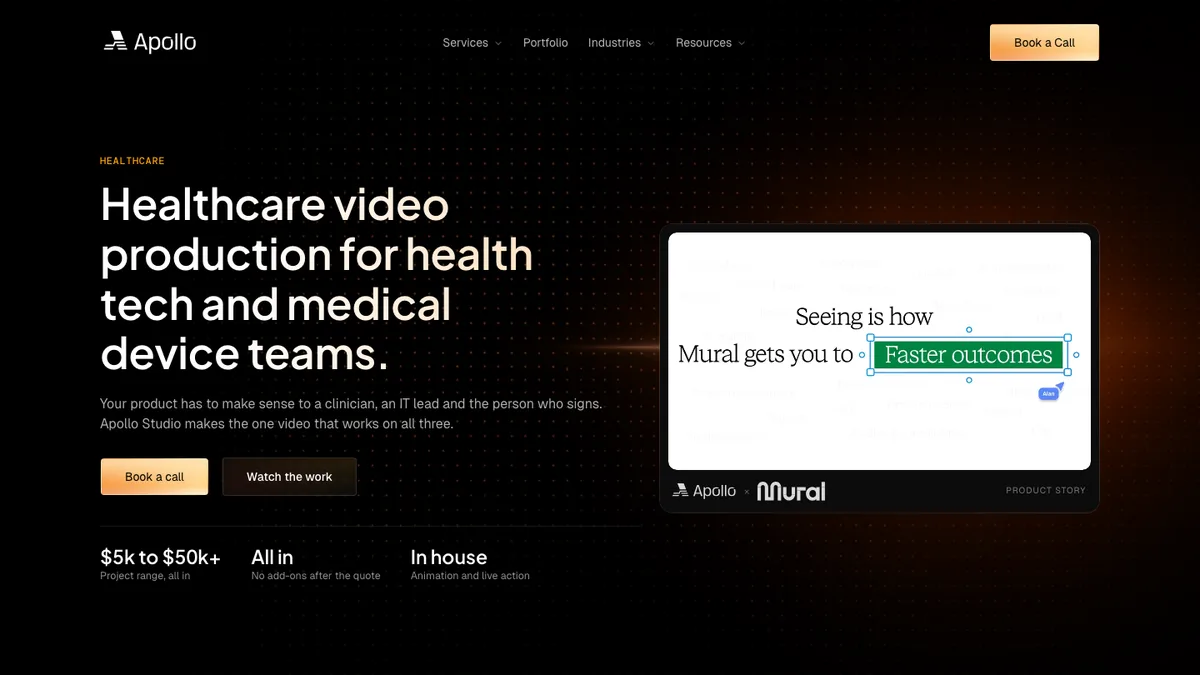
Best for: Health tech and medical device companies that need animation and live action from the same team.
Apollo is a B2B video studio in Utah that produces animation and live action in house, which is the reason it ranks first on our criteria. Most of the companies on this page animate. A few shoot. Apollo does both, so the choice of medium stays a question about the product rather than a consequence of the hire.
That matters more in this category than in any other we have looked at. A pump or a catheter needs its mechanism rendered, because no camera can get inside it. The clinical workflow around that same device needs a room, a person and a camera. A launch usually needs both cuts, and splitting them across two vendors means two scripts, two review cycles and two versions of the product story.
Its portfolio is B2B software rather than medicine: Vanta in compliance automation, HiddenLayer in AI security, Mural in collaboration software, Awardco, Anvilogic in security operations. The common problem across that work is a product whose value is not visible on screen and a buyer who has to sell it internally to several other people, which is the same problem a health tech vendor walks in with.
Apollo is also the only company on this page that publishes what a whole project costs: $5,000 to $50,000+, with scripting, production, revisions and final cuts inside the number. Live action runs at its own studio, on location, or with the team travelling to the client, using hired actors or the client's own people.
Who it's less suited for: Better suited to a company whose problem is explaining a product to a buying room than to one that needs a surgical procedure rendered from the inside at the fidelity a surgeon would judge, which is what a dedicated medical animation studio is built for. A hospital or health system marketing to patients is also a different buyer, and better served by the provider side studios further down this list.
2. Random42
Best for: Science that has to be visualised accurately, and reviewed by people who can check it.
Random42 is a London studio built around high end medical animation and scientific storytelling, and it names medical device animation as one of six specialisms alongside pharmaceutical, biotechnology, consumer health, animal health and agency partnerships.
The thing that separates it from a general 3D shop is the science team. Random42 assigns PhD qualified scientists from an in house team to every project, and states that it has worked inside legal and medical review processes and platforms. For a mechanism of action piece, that is the difference between an animation that looks convincing and one that survives a medical reviewer reading it frame by frame.
The range goes well past video. Random42 produces 2D and 3D animation, mixed reality using headsets, virtual reality that takes a viewer inside the body, augmented reality apps and purpose built interactive sites, which makes it a fit for a congress stand or a sales enablement tool as much as a marketing film.
Who it's less suited for: Better suited to a company whose hardest asset is the science, than to one whose next video needs a clinician, a customer or a founder in front of a camera, which is live action work a production company will carry further.
3. Ghost Medical
Best for: Surgical animation that has to work for device sales and surgeon training at once.
Ghost Medical, a division of Ghost Productions in Saint Paul, Minnesota, produces medical animation, illustration, VR surgery simulation and interactive software, and it is unusually direct about what the work is for: marketing a device, training the surgeons who will use it, and educating the patients who receive it.
It is also the clearest portfolio on this page. The homepage names its own projects, which is rare in a category where a lot of work never clears review. There is a micro-gel implant animation for a left atrial appendage occlusion device with MIT, the Rotium bioresorbable wick for rotator cuff repair with Atreon Orthopedics, the SmartShot marrow access device with Marrow Access Technologies, and a fully implanted LVAD for Corvion. Those are specific devices with specific mechanisms, which is the only way to judge whether a studio can render yours.
The client base spans device manufacturers, pharmaceutical companies, hospitals and medical schools, and the studio also builds medical websites, so a device company can route visualisation and the page it sits on through one team.
Who it's less suited for: Better suited to a device company whose product has a procedure attached, than to a health tech or digital health vendor selling software, where the thing to explain is a workflow on a screen rather than an implant inside a body.
4. Scientific Animations
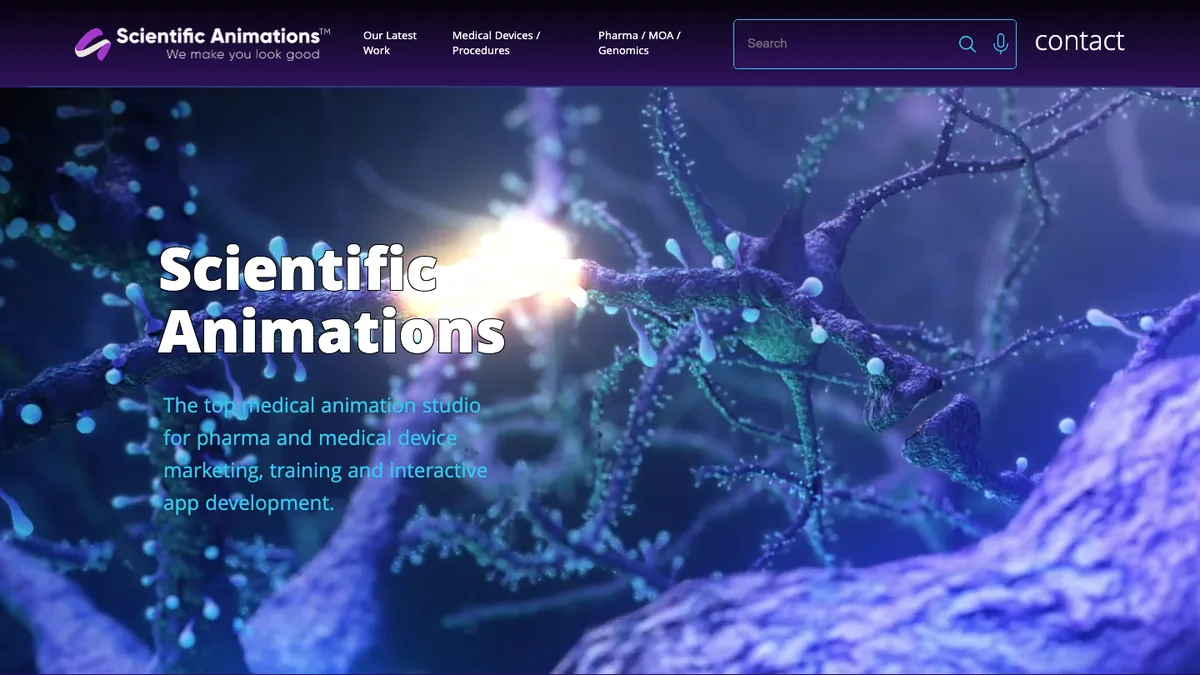
Best for: Mechanism work that has to serve marketing and training from the same asset.
Scientific Animations describes itself as a medical animation studio for pharma and medical device marketing, training and interactive app development, and it keeps separate demo reels for pharma and for device work, which tells you the two are run as distinct practices rather than one portfolio with a filter on it.
The published work is mechanism of action animation at the level a regulated audience expects. There is an immunotherapy piece built as a patient facing overview for a cancer treatment organisation, and a pulmonary embolism treatment system animation covering a minimally invasive device that combines ultrasonic waves with clot dissolving drugs. Both are examples of the same useful trait: one animation written to work for a clinician, a patient and a marketing page without being remade three times.
Interactive app development sits alongside the animation, which matters for a device company that needs the same mechanism in a congress demo and a rep's tablet.
Who it's less suited for: Better suited to a company whose product story is a biological or mechanical process, than to one that needs a customer story, a testimonial or a launch film, which calls for a crew rather than a render farm.
5. Icovy
Best for: A device company that needs a commercial programme rather than a video.
Icovy is a medical device and MedTech marketing agency in Clearfield, Utah, built around commercialisation in regulated markets. Video production and medical animation are two services on a list that also runs brand, performance marketing, product launch, HCP and physician marketing, demand generation, sales enablement, US market entry and fractional marketing leadership.
That breadth is the point of hiring them, and it is also the reason they sit here rather than higher on an axis that weights production craft. If your problem is that a Class II device is cleared and nobody internally owns the launch, a studio will hand you a film and leave. Icovy will take the launch.
It supports an unusually wide set of roles for the sector, including OEMs, contract and component manufacturers, startups, digital health, distributors, private equity and investors. It also publishes a pricing and ROI calculator that prices building a team in house against hiring an agency against doing both, using published 2026 salary and market data. That is a published framework rather than a published rate, and it is still more than most of this category offers.
Who it's less suited for: Better suited to a company that wants its whole commercial programme run, than to one that has a marketing team and needs a single piece of work produced to a very high standard, where a specialist studio is the better value.
6. Buzzbox Media
Best for: Medtech marketing handled end to end by the person who does the work.
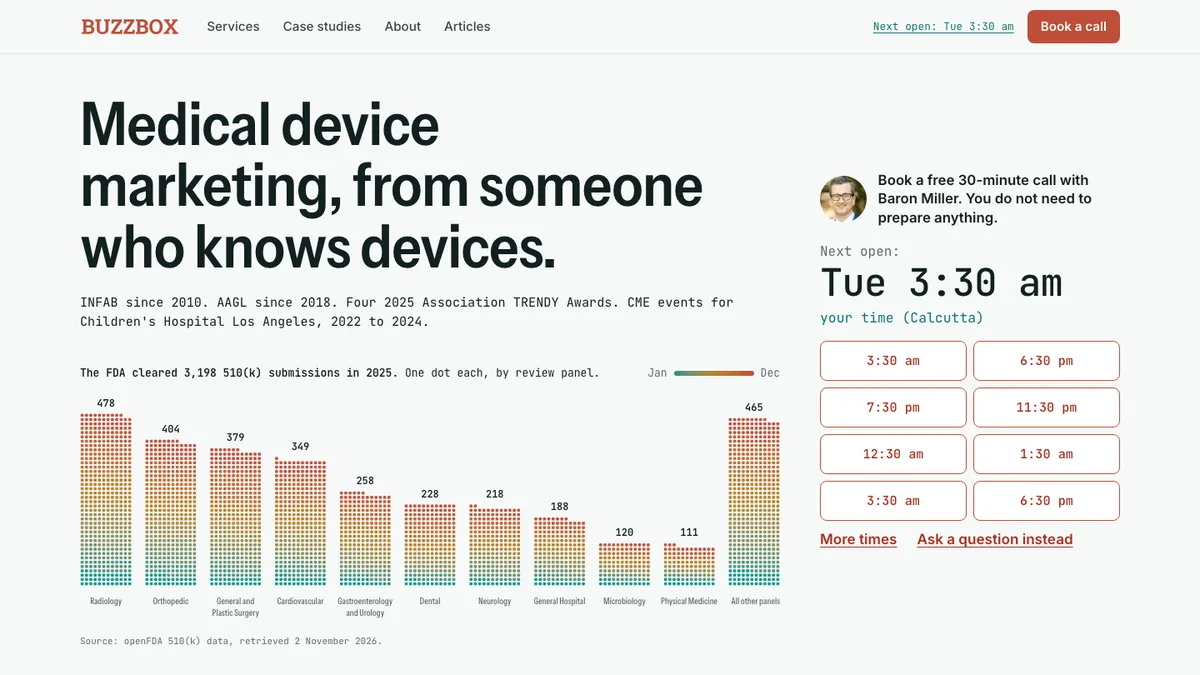
Buzzbox Media is a medical device marketing agency in Franklin, Tennessee, founded in 2010 by Baron Miller, and it works exclusively with medtech. Its homepage makes the case in the most direct way available: a chart of all 3,198 510(k) submissions the FDA cleared in 2025, broken out by review panel and by month, sourced to openFDA. An agency that leads with the clearance data rather than a showreel is telling you which half of the job it thinks is hard.
The relationships are the other evidence. Buzzbox has run INFAB's marketing every year since 2010, covering brand, the annual printed catalogue, the online store, search, Google Ads and a leadership reporting dashboard for a manufacturer of radiation protection apparel. It has worked with AAGL since 2018, took four Association TRENDY Awards in 2025, and ran CME events for Children's Hospital Los Angeles from 2022 to 2024.
The engagement model is unusually plain. A free thirty minute call goes to Baron Miller directly, with no handoff to an account manager, no written audit and nothing to sign.
Who it's less suited for: Better suited to a device company looking for a long marketing relationship with one accountable principal, than to one that needs a high volume of video produced in parallel, which is a studio's job rather than an agency's.
7. Infuse Medical
Best for: Getting a sales force or a clinical team genuinely competent on a complex device.
Infuse Medical builds immersive training and simulation for MedTech and life sciences teams, using VR, AR and 3D, and it frames the work around outcomes a training lead recognises: ramping clinicians and reps quickly, building real understanding before real world use, and tracking engagement and training effectiveness.
This is a different job from the one most companies on this page do, and worth separating clearly. A marketing animation has to make someone want to find out more. A simulation has to make someone able to do something, under the variation and time pressure of an actual procedure. Infuse is built for the second.
It is candid that much of its work is confidential by design, which is the honest position for a studio whose output is often a client's internal training system rather than a public asset.
Who it's less suited for: Better suited to a company whose problem is competency and adoption after a device ships, than to one that needs public marketing assets it can evaluate in advance, since a largely confidential portfolio gives you less to judge before you commit.
8. Nucleus Medical Media
Best for: Patient education, and hospital marketing that has to explain a condition.
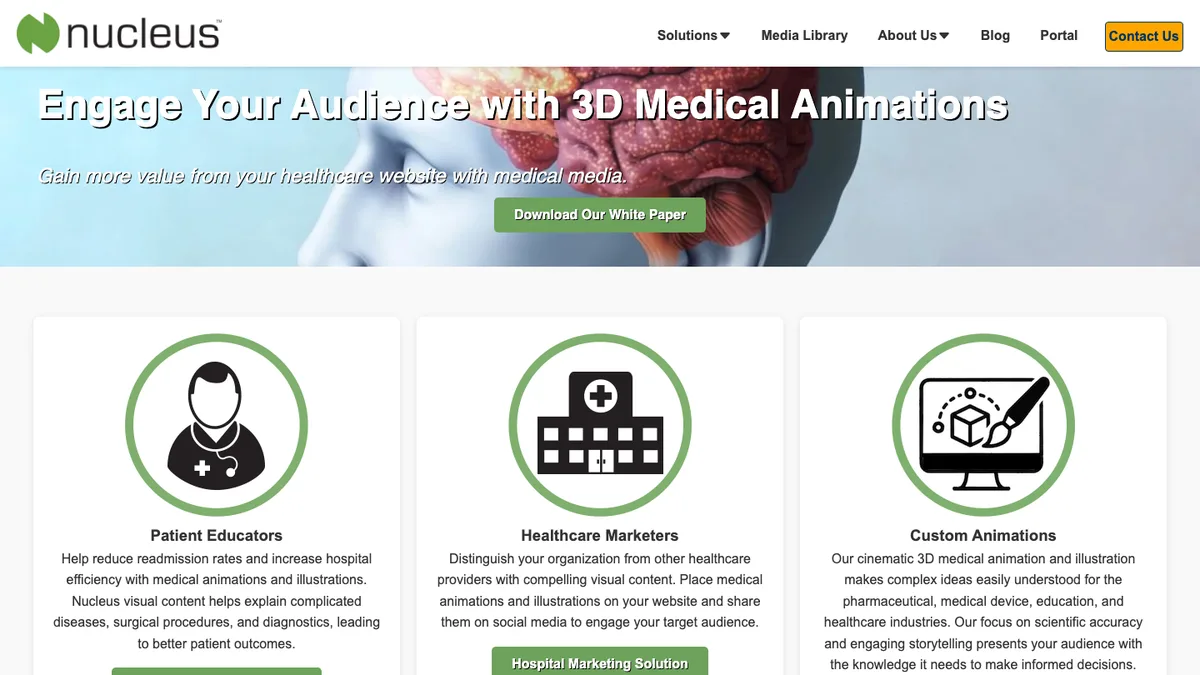
Nucleus Medical Media produces 3D medical animation and illustration, and it is explicit about its two audiences. Patient educators use the work to explain diseases, surgical procedures and diagnostics, with the stated aim of reducing readmission rates and improving hospital efficiency. Healthcare marketers use it to distinguish a provider from the hospital down the road.
It is on this list because it is genuinely strong at that work and because it ranks for these searches, so a device marketer will meet it on the way to a decision. It is at this position because the buyer it is built for is a provider rather than a vendor. Its custom animation practice does serve pharmaceutical and medical device clients, and the cinematic 3D work there is of a piece with the rest, so a device company is not out of place, it is just not the centre of gravity.
A named client testimonial from Kate Shropshire at SaluMedica sits on the homepage, which is more attribution than most of this category offers.
Who it's less suited for: Better suited to a hospital, health system or patient education team, than to a device manufacturer running a commercial launch, where a studio whose whole portfolio is vendor side will arrive with sharper instincts about the buying room.
9. F. Learning Studio
Best for: Training and procedure comprehension when the budget will not stretch to high end 3D.
F. Learning Studio is an animation led visual learning and communication studio with nine years behind it and a 5.0 Clutch rating, working across healthcare, education, technology, manufacturing, professional services and public sector communication.
Its framing is the most specific on this page about what it is trying to fix. The studio works on situations where misunderstanding has real consequences, and its own diagnosis is that information fails to transfer when procedures are taught without the system behind them, when too much arrives at once, when knowledge comes in disconnected pieces, or when learning happens without the pressure of a real environment. For a device company whose training material is being followed but not understood, that is a more useful starting point than a list of animation styles.
The work is 2D animation rather than photoreal 3D, which is a budget and a fit decision rather than a quality one. It publishes a detailed cost guide for explainer video covering the factors that move a price and the fees that get added late, which is more transparency about the category than most studios offer, though not a rate of its own.
Who it's less suited for: Better suited to training, onboarding and procedure explanation at a moderate budget, than to a mechanism of action piece that has to withstand a specialist's scrutiny, where a 3D medical animation studio is the right call.
10. BusyBoy Productions

Best for: Broadcast grade live action, with crews and kit in the Upper Midwest.
BusyBoy Productions is a full service video production company in Minneapolis covering television, commercials, infomercials, corporate, nonprofit, training and aerial work, with in house crews and its own production packages.
It is on a healthcare list for one reason, and it is a good one: it is a camera company in a medical device corridor. Medtronic sits on a client list alongside Discovery, TLC, Animal Planet, FOX, CBS, McDonald's, Best Buy, Cargill, Cummins and ReMax. For a device company in Minnesota that needs a facility shoot, a training series or a founder on camera, local crews who have worked at broadcast standard are a practical advantage, and aerial capability covers the manufacturing and facility footage that device marketing tends to need.
It is also one of the few here that publishes any rate at all, listing crew day rates and hourly rates for scripting, creative direction and editing. That tells you what a shooting day costs, which is more than most of this page offers, and nothing about what a finished film costs.
What it is not is a medical specialist. The strength here is production, across a very broad range of formats, rather than a practice built around regulated healthcare.
Who it's less suited for: Better suited to live action production with experienced crews, than to animated mechanism work or a programme that has to move through medical review, where a medical animation studio or a medtech agency is better placed.
Honorable Mentions
Two more worth a look, kept out of the ranking because each covers a narrower slice of the brief than the ten above.
- Demo Duck: A versatile explainer partner with a deliberately broad industry base. Strong for a digital health or health tech company that needs a clear software explainer and has no clinical or mechanism requirement. Not a healthcare specialist, and does not present itself as one.
- Trinsic Animation: A medical animation studio specialising in biotech, pharmaceutical and medical device animation, the same practice area as Random42 and Scientific Animations. It publishes less about its process and its work than either, so there is less to evaluate before a call.
Which Healthcare Video Production Company Is Best For You?
The useful question is not which of these is best. It is which of four situations you are in.
You need the inside of the product rendered. A mechanism, an implant, a molecule, a procedure. No camera reaches any of it. This is a medical animation studio's job, and Random42, Ghost Medical and Scientific Animations are the three deepest options here. Pick on review rigour if the piece has to clear a medical reviewer, and on published device work if you want to see your class of product before you commit.
You need a person on camera. A clinical lead, a customer, a founder, a procedure in a real room. Animation cannot do this, and most of this category cannot shoot. Apollo Studio and BusyBoy Productions are the live action options, with Apollo covering animation in the same engagement and BusyBoy offering local broadcast crews.
You need both, for one launch. This is more common than the category's structure suggests, and it is the case where hiring two vendors costs the most, because the product story gets written twice. Apollo Studio is the one company here that covers both in house.
You do not need a video, you need a launch. The device is cleared, the deadline is real, and nobody internally owns the commercial side. Icovy and Buzzbox Media take that work, with Icovy built for breadth across a programme and Buzzbox for a long relationship with one accountable principal.
And two cases that are not marketing at all. If the job is making a sales force or a clinical team competent on a device, Infuse Medical is built for it. If the job is explaining a condition to patients, Nucleus Medical Media is.
Find the Right Video Partner by Industry
Healthcare is not one buyer, and the right studio changes with the product.
Medical device manufacturers need mechanism animation and, usually, facility or procedure footage to go with it. The mechanism is the hard part, and the shoot is the part that stalls, because access to a clinical environment belongs to the institution rather than the studio. Settle whose job that is before the quote.
Health tech and digital health vendors are closer to a software company than to a device company. The product is a screen, the value is a workflow, and the risk is a video that tours features instead of proving one. The studios that do well here are the ones with B2B software in the portfolio.
Pharmaceutical and biotech teams have the heaviest review burden on this list and the most to gain from a studio with scientists on staff, because every claim in the script is a claim someone will check.
Hospitals and health systems are a provider side buyer, and the whole shape of the work is different: patient comprehension, condition explanation, service line marketing.
Medtech component and contract manufacturers are selling into a supply chain rather than to a clinician, which is a B2B industrial problem wearing a medical label, and often better served by a general B2B studio with manufacturing work behind it.
How Much Does Healthcare Video Production Cost in 2026?
The honest answer is that this category publishes almost nothing, and the one number it does publish is usually not the one you need.
Of the ten companies on this page, exactly one publishes what a whole project costs, and the distinction is worth drawing carefully, because three others publish numbers that are not project prices.
Apollo Studio puts its range at $5,000 to $50,000+, all in, with scripting, production, revisions and final cuts inside the figure. BusyBoy Productions publishes crew day rates, plus hourly rates for scripting, creative direction and editing, which tells you precisely what a shooting day costs and nothing at all about what a finished film costs. Icovy publishes a calculator that prices building a team in house against hiring an agency. F. Learning Studio publishes a cost guide for the category, quoted per finished minute. The remaining six publish nothing and quote on a call.
The more useful thing to understand is the unit. When a studio in this category does quote a figure, it is almost always a price per finished minute of animation, and a minute of animation is not a project. The script, the storyboard, the scientific review, the revision rounds, the voiceover, the localisation and any filming either sit inside that number or arrive afterwards as separate lines. Two quotes that look thousands of dollars apart routinely describe different amounts of work, and the one that looks cheaper is often the one with more still to come.
Factors That Influence Healthcare Video Pricing
Animation fidelity. Photoreal 3D of tissue, fluid or a mechanism costs multiples of clean 2D explaining the same idea. Both can be correct. They answer different briefs.
Scientific review. Every reviewer in the chain adds a cycle, and a cycle is days. A studio with scientists in house absorbs some of this before it reaches your reviewers. One without it will send you work that fails review and bill for the fix.
Whether anything gets filmed. A shoot brings crew, kit, travel, talent and a day that cannot be redone cheaply. It is also the only way to get a real person in the frame.
Clinical access. Filming in a lab, a facility or an operating room is a scheduling and permissions problem that belongs to the institution, not the studio. It is the single most common reason a healthcare video timeline doubles.
Regulatory context. A cleared device, a product in trials and a wellness app carry very different constraints on what the script may claim, and that shapes how much gets rewritten.
How many pieces come out of it. One shoot or one animation build can yield a hero film, cutdowns, a congress loop and sales enablement clips. Commissioning them separately later is the expensive way to get there.
Final Thoughts
The companies on this page are good at genuinely different things, and the ranking above is only as useful as the axis it was built on, which is why we put the axis first.
If there is one thing worth taking from it, it is that the medium question comes before the vendor question. Most of this category can animate or it can shoot, not both, and a studio that can only do one will tell you, in good faith, that the thing it does is the thing your product needs. Work out whether the product's hard part is inside the device or in the room around it, decide whether you need one or both, and only then start shortlisting. Then ask what the quoted number includes, because in this category it usually includes less than it looks like.
Frequently Asked Questions
Most healthcare and medical device studios do not publish a price at all, so what you are quoted will vary widely for work that sounds the same. At Apollo Studio, the one company on this list that publishes a price for a whole project, projects currently run most often in the $15,000 to $30,000 band, with scripting, production, revisions and final cuts inside that. Where anyone else in this category quotes publicly, the figure is usually a price per finished minute of animation rather than a price for a project, so check whether scripting, scientific review, revisions and any filming sit inside it or arrive afterwards.
A medical animation studio renders what a camera cannot reach: a mechanism of action, an implant in situ, a biological process. A video production company shoots what exists: a clinician, a customer, a procedure in a real room, a facility. Most companies in this category do one of the two. A few do both, and that is worth establishing early, because the answer decides which shortlist you should be working from.
It depends on where the hard part of the product is. If the thing you need to explain happens inside the body or inside a sealed device, animation is the only option. If the thing you need to prove is that a real clinician uses it in a real workflow, live action carries more credibility than any render. A launch usually needs both, which is why hiring a team that can do each without subcontracting saves a second script and a second review cycle.
No, and a studio offering that guarantee is overstating what it controls. Compliance in a regulated market rests with your regulatory and legal reviewers and with the claims your company is prepared to defend. What a good studio does is work inside your review process rather than around it: scripts written to be reviewed, claims traceable to a source you supplied, and revision rounds planned in from the start instead of treated as a surprise.
Plan in terms of review cycles rather than production days, because that is what sets the timeline. A straightforward animation can be a few weeks of production; each additional reviewer in the chain adds days to a cycle, and clinical shoot access can add weeks on its own. The two timelines that slip hardest are a mechanism animation with several scientific reviewers, and anything that needs a crew inside a hospital or a lab.
Your institution, in almost every case. A studio can plan a shoot around the access you secure, brief the crew on what is permitted, and work to short windows, but permission to film in a lab, a facility or an operating room comes through the hospital or manufacturer, with its own approvals, consent requirements and scheduling. Treat it as a project dependency with an owner and a date, not as something the production company will sort out.
Hire a studio when you have a marketing team and need a specific piece of work produced well. Hire a medtech agency when the device is cleared, the launch has a date and nobody internally owns the commercial side. The distinction is scope rather than quality: an agency will take the programme and treat video as one deliverable inside it, while a studio will go deeper on the craft of the video itself and hand it back to you.
One thing, proved properly. The most common failure in this category is a tour of every feature and every indication, which leaves a viewer with no single reason to act. Pick the workflow or the mechanism that carries the product's argument, show it end to end, and let the rest live in the materials that follow. A device video also has a second audience beyond the clinician, usually procurement or a committee, and the piece has to survive being watched without you in the room.
Sometimes, if it is planned that way from the script. The same mechanism build can yield a marketing cut, a training module and a patient facing overview, and that is far cheaper than three separate commissions. It only works when the three uses are named before the storyboard is locked, because the alternative is a marketing film that has to be rebuilt twice. If training is the primary goal, a studio built around simulation and competency is a better fit than a marketing studio.
There is no single best, because the buyers differ more than the studios do. For a health tech or device company that needs animation and live action from one team, Apollo Studio ranks first on our criteria. For mechanism of action work with scientific review built in, Random42 and Scientific Animations are the deepest options, and Ghost Medical is the strongest on published device work. For patient education and hospital marketing, Nucleus Medical Media is built for that buyer.