Best Video Production Agencies for Fintech Companies in 2026


Key Takeaways
- Wyzowl: Best for depth of fintech client experience at a fixed price
- Apollo Studio: Best for financial software sold to a risk-aware B2B buyer
- Vidico: Best for fintech brands that need animation and live action at scale
- Broadcast2World: Best for published finance pricing with compliance sign-off built in
- Videodeck: Best for presenter-led fintech content at monthly volume
- MotionGility: Best for banking and payments explainers on a fast turnaround
- What a Story: Best for SaaS-style fintech explainers with a published range
- Gisteo: Best for a fixed-price explainer from a US studio with fintech logos
- Motionvillee: Best for a dedicated financial-services practice with published ranges
- Venture Videos: Best for enterprise fintech launches with bank-grade references
Fintech video has a house style, and it is the problem. A phone floats over a gradient. Coins arc into a wallet. A dashboard scrolls past too fast to read while a voice says the future of money is here. Ninety seconds later the viewer knows the company is in payments, or lending, or something with a card, and has no idea what the product does or why anyone would trust it with money.
The buyer notices, because the buyer is deciding whether to trust you with money. A head of finance, a payments lead or a risk officer has watched a hundred of these, and the moment a video reaches for the floating coins they file the vendor under "marketing" and move on. In a category where the product is abstract and the decision is regulated, vagueness is not neutral. It reads as having something to hide.
Fintech video is hard for specific reasons. The product moves money, data or risk, none of which is easy to film. Every claim gets read by legal and compliance before it ships, so a script that promises returns or guarantees approval dies in review. And the audience ranges from a CFO to a consumer, which means the same product often needs two very different films.
This guide ranks the agencies that handle those constraints well. It covers agencies, not video software and not corporate communications shops for banks. What each one is good at, which fintech and financial-software companies it has actually worked for, what it costs, and who it genuinely suits.
How We Ranked These Agencies (Methodology)
We ranked for B2B fintech and financial-software companies whose buyer is risk-aware (a CFO, a payments or treasury lead, a compliance officer, an accounting-firm partner) and whose product moves money, data or risk. If you mainly need a consumer brand campaign for a banking app, or a corporate film for an established institution, weight these criteria differently, because ours start from the product.
Verified fintech and financial-services client work
Weighted heaviest. We looked for named fintech, payments, lending, insurance or financial-software clients we could confirm on the agency's own site or portfolio, not a "fintech" tab added to an industries menu. Video for a payments platform is a different job from video for a project-management tool, and the difference shows in the first week of scripting.
Trust and compliance in the workflow
Can the agency write a script that a compliance officer will sign? That means no unsupported guarantees, no return figures without basis, regulated language handled correctly, and review gates at script and storyboard stage rather than at final delivery. We favoured agencies that describe this process on their own pages rather than promising to "work with your legal team" as an afterthought.
Showing money moving
Fintech products are abstract, and agencies solve that very differently: a faithful interface walkthrough, data-flow motion graphics, a customer on camera describing the outcome, or the floating coins. We favoured work where the visual carried real information about what the product does, because that is what a risk-aware buyer is looking for and what a compliance reviewer can check.
Range across the fintech funnel
Most fintech teams need a sequence: an explainer to earn the click, a product or demo video to show the thing working, customer stories to de-risk the decision, and a launch film when there is news. We gave credit to agencies that can produce more than one of those to a consistent standard, and noted where an agency is strongest in one format.
Pricing transparency and turnaround
Whether the agency publishes figures before a call, and how fast it can deliver. Fintech marketing runs on launch dates, funding announcements and conference seasons, and a video that lands two weeks after the news is worth much less than one that lands with it.
The Best Fintech Video Production Agencies Compared
| Agency | Best For | Pricing | Turnaround | Better Suited For… Than… |
|---|---|---|---|---|
| Wyzowl | Depth of fintech experience | From £2,000 (about $2,700) | 4 to 6 weeks | Volume of fintech work at a fixed price, than a small dedicated team |
| Apollo Studio | Risk-aware B2B buyers | From $10,000 | Full productions in about 3 weeks | Financial software that needs explaining, than consumer brand campaigns |
| Vidico | Animation and live action at scale | Plans from about $5,000/mo; projects $1,500 to $50,000 | A few weeks per piece | Multi-format programmes for a growing fintech, than a single hero film |
| Broadcast2World | Fixed-fee finance animation | From $2,000 to $9,500 by tier | 4 to 6 weeks | Animated explainers with compliance gates, than founder-led films |
| Videodeck | Presenter-led volume | From $5,000 per video | Under 10 days | Steady educational and social output, than one cinematic launch |
| MotionGility | Banking and payments explainers | $2,000 to $7,000-plus | 2 to 3 weeks | Fast animated explainers for finance, than live action or customer stories |
| What a Story | Published project range | $2,500 to $25,000 per asset | 4 to 8 weeks | SaaS-style fintech explainers, than enterprise brand films |
| Gisteo | Fixed-price US explainers | From $3,500 for 60 seconds | 2 to 6 weeks by tier | One explainer at a known price, than a full funnel programme |
| Motionvillee | Dedicated financial practice | $5,000 to $15,000 | 3 to 6 weeks | Explainer plus distribution planning, than a single hero piece |
| Venture Videos | Enterprise fintech launches | Quoted per project | Launches in 4 weeks, explainers in 6 | Bank-grade launch and customer films, than a monthly content cadence |
The 10 Best Video Production Agencies for Fintech Companies in 2026
1. Wyzowl
Best for: Fintech companies that want an agency which has made this kind of video many times, at a price known before the call.
Wyzowl leads on the criterion we weighted heaviest. The UK studio reports more than 300 videos for over 150 fintech and financial-services companies, and it publishes the work on a dedicated page: explainers for Conferma Pay's virtual card payments, Bitsafe's cross-border payments, Level FT's financial data platform, EazyBooks' small-business accounting and AppToPay's mobile payments, alongside pieces for HSBC and Barclays and a character-led series for Deluxe's payment exchange product. A Capital One testimonial sits on the homepage.
The reason it ranks first rather than merely appearing is the process. Wyzowl builds a dedicated review stage into fintech projects so that a compliance or legal team signs off the messaging before design begins, and its writers work from the product rather than from category language. It also matches style to audience, from UI walkthroughs for CFOs to character animation for consumer apps, which is our fourth criterion in practice.
Pricing is fixed and published from £2,000 (about $2,700) for an animated video, including scripting, voiceover, animation and unlimited revisions, with subscription packages for teams producing regularly. Most projects complete in four to six weeks.
Who it's less suited for: Better suited to teams who value a deep category track record and a fixed price than to those who want live action, founders on camera or a small senior team on every call. Wyzowl's fintech work is animation-led, so a company that wants real customers and a real office on screen should look at a studio built for that.
2. Apollo Studio
Best for: Financial software sold to a business buyer, where the video has to earn trust before it earns a demo.
Apollo Studio is a specialist studio for B2B tech, with fintech a core category alongside SaaS, AI, cybersecurity and healthcare. It ranks second on the depth reading of our axis rather than the volume one: its work is aimed squarely at the B2B buyer this guide is built around.
The evidence is in the portfolio. For Ping, an AI client assistant for accounting firms, Apollo Studio produced a feature-rich product tour for lower-funnel buyers and a separate launch cut, the two-film sequence our funnel criterion rewards. Redo, the checkout and post-purchase platform for e-commerce brands, has a top-of-funnel explainer on the studio's fintech page. Vanta, the compliance and trust-management platform, gets a monthly product-update series shot in the studio, relevant to any regulated product that ships on a cadence. Mural and Awardco round out the roster.
The studio treats security, compliance and credibility as narrative pillars rather than legal footnotes, and keeps regulated language accurate with the client's team. Motion design is produced in-house, so the money-movement sequences are animated by the team that wrote the script. A lean senior team turns post around in about a week and full productions in about three. Pricing starts at $10,000, and co-founder Cade Biegel runs strategy calls directly.
Who it's less suited for: Better suited to B2B financial software that needs explaining to a risk-aware buyer than to consumer fintech brands planning a broadcast campaign, which is where a brand-spot studio with a casting practice fits better.
3. Vidico
Best for: Fintech brands that need animation, live action and customer films from one partner, with a subscription option for teams producing continuously.
Vidico is the strongest all-format studio on this list for financial brands, and its named finance clients are the most recognisable after Wyzowl's: Square, Airwallex, NAB, Wisr, Pie Insurance and Unhedged. The studio runs a dedicated financial-services page with results attached, including the Unhedged crowdfunding film that helped hit its target in under an hour and the Wisr campaign it credits with more than 10,000 app downloads.
The range is the point. Vidico produces animated and live-action explainers, testimonial films, product and app demos, brand videos and crowdfunding pieces, from offices in Melbourne, Sydney and New York, and it publishes per-minute guidance by style so buyers can budget before a call. For a fintech whose plan is a homepage explainer this quarter, a customer story next quarter and a launch film after that, it is one of the few studios here that can hold the whole sequence to one standard.
Pricing on the financial page runs from $1,500 to $50,000 per project, with plans from about $5,000 a month for teams producing regularly. A straightforward finance explainer takes a few weeks; animation-heavy or multi-location work takes longer.
Who it's less suited for: Better suited to fintech companies planning a multi-format programme than to those who want a single, senior, product-obsessed team on one hard explainer. Vidico's strongest finance results are consumer campaigns, so a B2B vendor selling to a CFO should ask specifically for that kind of work in the reel.
4. Broadcast2World
Best for: Finance and lending companies that want published fixed-fee animation with legal and compliance sign-off built into the timeline.
Broadcast2World runs a dedicated finance video practice and is the most explicit agency on this list about how regulated review fits into production. Script and storyboard sign-off happens with the client's legal and compliance team before a single frame is animated, and the published six-week plan puts that review in weeks one and two rather than at the end. That is exactly the workflow our second criterion tests for.
The finance roster is broad: Citibank, Interactive Brokers, OnDeck, LendingUSA, M&M Financial, EquiGenesis and American Financial Solutions, plus Microsoft in the wider client list. The work is animation, from character-led explainers to 3D data visualisation, and the studio also lists a compliance and multi-region package for products that ship in more than one jurisdiction.
Pricing is published by tier on the finance page: from $2,000 for a social-length explainer of up to 30 seconds, from $4,500 for a 60 to 90 second financial explainer, and from $9,500 for 3D or data-visualisation pieces of 60 to 120 seconds, with the compliance package priced on request. Standard delivery is four to six weeks plus compliance cycles. The studio shows a Clutch rating of 4.9.
Who it's less suited for: Better suited to animated explainers and training content with a formal approval chain than to founder-led films, customer testimonials or anything shot on location. A fintech that wants real people on camera should look at a studio with a live-action practice.
5. Videodeck
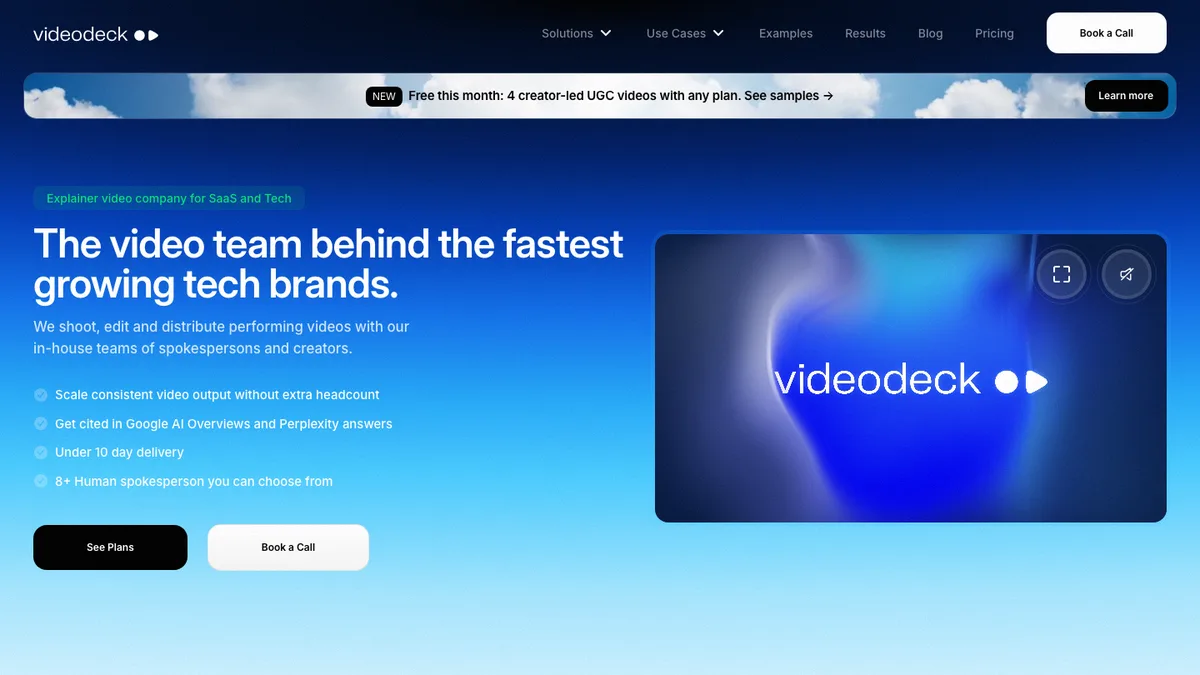
Best for: Fintech marketing teams that need a steady stream of presenter-led product and educational videos rather than one flagship film.
Videodeck makes live-action, presenter-led video for B2B software companies, with a dedicated fintech page and a delivery model built for cadence. Its fintech clients include Hometap, the home-equity investment platform, and Solvexia, the finance automation platform, alongside Ahrefs, CloudZero and Nightfall AI in the wider roster. The format is a spokesperson on a custom-designed set, cut with product footage, which suits fintech education, feature updates and social content well.
Turnaround is the differentiator. Videodeck quotes under ten days per video, with five to ten business days for production and around two more for revisions, and the process is a three-step spokesperson, set and production flow rather than a bespoke creative engagement. For a fintech shipping features monthly and needing each one explained on LinkedIn and in the product, that speed is worth more than a cinematic reel.
Pricing is published in full: $5,000 for a single video, $3,500 each for five and $3,000 each for ten, or monthly plans at $2,500 per video for four a month down to $2,000 per video for twelve. Distribution, design and UGC add-ons are priced separately by month.
Who it's less suited for: Better suited to volume, speed and a consistent presenter format than to a company whose one explainer has to carry the homepage for two years. The set-based format is recognisably Videodeck's, so brands that need a distinct visual world should look elsewhere for the flagship.
6. MotionGility
Best for: Banks, payments and insurance companies that want an animated explainer quickly and at a published price.
MotionGility is an animation studio with a dedicated financial-services page and the most bank-heavy client list on this list: ICICI Bank, HDFC Life, HDFC Mutual Fund and iA Financial Group on the institutional side, Skrill, Taulia, Portfolio+ and ZScore on the fintech side. The ICICI Bank work is published as a case study, which is the kind of on-site evidence our first criterion looks for.
The studio's pitch to finance teams is speed: it claims delivery in two to three weeks against a category norm of four to eight, and the work is 2D animation and motion graphics built for explaining a product, a process or a regulation change. The page references regulatory and compliance requirements without describing a formal gate, so a buyer should agree the review schedule at briefing.
Pricing is published in bands from $2,000 to $7,000-plus for animated explainers, which puts a finance explainer at the accessible end of this list.
Who it's less suited for: Better suited to fast animated explainers for financial institutions than to live action, customer stories or a product-fidelity walkthrough for a technical B2B buyer. A fintech whose video has to show the actual software working should confirm the studio's interface-animation approach first.
7. What a Story
Best for: Fintech SaaS companies that want a SaaS-native explainer studio with a published price range and a stated approach to compliant scripting.
What a Story is a SaaS-focused video studio with a fintech service page and named financial clients: HighRadius, the accounts-receivable automation platform, FSS Payment Gateway, Pennant Technologies, Kitaabh and Pulse. The work is animated explainers and product videos in the SaaS idiom, which is the right fit for a fintech that sells to finance teams the way a SaaS company sells to operations teams.
The compliance language is more specific than most. The studio says it structures scripts to avoid exaggerated claims, unsupported guarantees and risky language, and works with the client's legal and compliance teams to keep accuracy without diluting impact. That is a real answer to our second criterion rather than a promise to be flexible.
Pricing is published as a range of $2,500 to $25,000 per asset, with a quote tool on the site. Timelines run four to eight weeks depending on complexity, stakeholder approvals and compliance reviews.
Who it's less suited for: Better suited to SaaS-style fintech explainers and product videos than to enterprise brand films or live-action customer stories with a large crew. A company that needs the founder and three customers on camera in two cities should look at a live-action studio.
8. Gisteo
Best for: Fintech companies that want one animated explainer from a US studio, at a fixed price, with a choice of turnaround.
Gisteo is a Miami explainer studio founded in 2011 with a dedicated fintech page and named finance clients: Veem, the cross-border payments platform, Bill.com, Cortex, r8fin, 9th Gear, Axioma and Brightscope Beacon. The work is animated explainers, and the studio has added an AI-assisted production line alongside its custom work for buyers who want lower cost per piece.
The pricing model is the reason it makes the list. Gisteo publishes three custom packages priced on the first 60 seconds, with each additional 30 seconds at a flat $500: $3,500 for animation only with a three to four week turnaround, $4,000 for full service including scripting at five to six weeks, and $5,000 for a fast-pass delivery in two to three weeks. A yearly unlimited subscription is listed at $20,000. Few studios on this list let a fintech marketer budget an explainer without a call.
Who it's less suited for: Better suited to a single animated explainer at a known price than to a multi-format programme, a live-action shoot or a product walkthrough that has to mirror a complex interface. A fintech with a full funnel to fill should treat Gisteo as the explainer supplier, not the whole programme.
9. Motionvillee
Best for: Fintech and crypto companies that want a dedicated financial-services practice with published ranges and a distribution plan attached.
Motionvillee is a B2B-specialised animation studio with separate service pages for financial services and for crypto and blockchain, and named fintech clients including Neokred, published as a case study, Scitus Fintech and Crane Payment Innovations. The studio positions financial video around trust and transparency, and its format list covers the full journey: product demos, educational explainers, onboarding guides, workflow walkthroughs and use-case studies.
The studio reports more than 4,370 videos produced, an 86% repeat-client rate and a Clutch rating of 5.0, and it pairs production with distribution planning, which matters for a fintech that has budget for one video and no plan for where it will run. The page mentions compliance checks in its timeline discussion without describing a formal gate, so agree the reviewers and stages at briefing.
Pricing is published as $5,000 to $15,000 for a typical financial explainer, with complex pieces at $20,000 or more. Most videos take three to six weeks.
Who it's less suited for: Better suited to animated explainers with a distribution plan than to live action or a single cinematic launch film. A fintech that wants real customers on camera should look at a studio with a crew.
10. Venture Videos
Best for: Enterprise fintech and financial-institution launches that need bank-grade references and a fixed delivery window.
Venture Videos is a UK and New York studio focused on SaaS and tech, with a fintech sector page and the most institutional reference list on this list: the launch film for NatWest's Bankline app, work for Bill.com, Experian and the European Investment Bank, and customer-story films for BDO. Box, Amazon and Microsoft sit in the wider roster. The studio takes responsibility for strategy, story, creative and production from brief to delivery, which suits a bank or an enterprise fintech with a procurement process and a launch date.
The format list is complete for a specialist: product launch videos, explainers, product walkthroughs, customer story films and event content, with delivery windows stated per format. Launch videos run four weeks from strategy to final delivery and explainers six, which is a useful commitment when a release date is fixed.
Pricing is quoted per project rather than published.
Who it's less suited for: Better suited to a high-stakes launch or customer film for an enterprise fintech than to a startup that needs a monthly cadence of product content. Being based in the UK may also mean timezone friction for a US team that wants heavy real-time collaboration.
Honorable Mentions
- Sandwich Video: The Los Angeles studio behind brand spots for Square, Robinhood, Brex, Capital One, Quantfury and Paychex. Premium and selective, and the right call when a consumer fintech needs a campaign rather than a product explainer.
- Demo Duck: Chicago animation studio with financial-services work for Northwestern Mutual and AIG Travel in its portfolio; a strong option for flagship creative on an abstract insurance or wealth product with a longer lead time.
- Zelios: Animation studio with a financial-services video page and a Clutch profile, though its published case studies are SaaS rather than fintech; worth a look for a straightforward animated explainer.
- Explainify: Lists finance and banking among its industries with a trust-and-value framing that suits regulated products; ask for the finance reel specifically.
Why Fintech Video Is Different
Three things make fintech video harder than software video generally, and they explain most of the ranking above.
The product is abstract. A collaboration tool has a screen worth showing. A payments platform's best moment is a transfer that settled without anyone noticing. Agencies solve this with a faithful interface walkthrough, data-flow motion graphics, or a customer describing the outcome. The wrong solution is the floating coin, which fills the screen without saying anything.
The claims get checked. Fintech scripts pass through legal and compliance, and a single unsupported guarantee, an implied return or a misused regulated term sends the whole piece back. That is why compliance workflow is our second criterion, and why the agencies that schedule review at script and storyboard stage deliver on time while the others deliver a rewrite.
The buyer is deciding whether to trust you with money. Features do not settle that question. Credibility does, which is why customer stories, real people on camera and precise language about security and compliance carry more weight in fintech than in most B2B categories.
There is also a split in what "fintech video" means, and it is worth being clear which one you need before you brief anyone.
Consumer fintech brand video sells a banking, investing or payments app to the public. The audience is everyone, the medium is broadcast and paid social, and the job is brand feeling. Sandwich Video's work for Robinhood and Square is this kind, and Vidico's strongest finance results are too.
Financial-institution corporate video is what banks and insurers commission for internal communications, recruitment and events. It is a different market, served by regional corporate production companies, and it dominates directory listings for "financial services video production".
B2B fintech product video explains a financial product to the business that might buy it. The audience is a finance, payments or risk professional, the tone has to earn trust, and one excellent piece beats ten adequate ones. This guide is ranked for the third kind. If you need the first, weight brand craft and casting heavily; if you need the second, a local corporate studio will usually serve you better than anyone here.
Which Fintech Video Agency Is Best For You?
Your buyer is a CFO, a controller or a payments lead and the product needs explaining. Apollo Studio or Wyzowl. The constraint is trust with a technical financial buyer, and both are built for it, one through a dedicated senior team, the other through volume of fintech work and a formal review stage.
You want a published price before the first call. Broadcast2World, Wyzowl, Gisteo, Videodeck, MotionGility, Motionvillee or What a Story, all of which publish figures. Apollo Studio publishes a starting point of $10,000.
You need a steady stream of product and educational videos, not one film. Videodeck for presenter-led output in days; Apollo Studio if the cadence is a monthly product-update series with in-house motion design; Vidico if the programme spans animation, live action and customer films.
You're an enterprise fintech or a financial institution with a formal procurement process. Venture Videos, Broadcast2World or Demo Duck, all used to multi-stakeholder review and long approval cycles.
Your compliance team rewrites every script. Broadcast2World or What a Story, both of which describe the compliance gate on their own pages, or Wyzowl, which builds a dedicated review stage into fintech projects.
You're a consumer fintech planning a campaign. Sandwich Video or Vidico. Brand craft and casting matter more than product fidelity, and both have the finance work to prove it.
You need one explainer, fast, at a fixed price. Gisteo's fast-pass tier or MotionGility, both of which quote two to three weeks.
You're a bank or an insurer with a lot of process to explain. MotionGility or Broadcast2World, both of which have institutional clients and price explainers accessibly.
How Much Does Video Production for a Fintech Company Cost in 2026?
Fintech video is priced like B2B software video generally, with a premium where the concept is abstract or the compliance cycle is long. The bands below use published figures where they exist.
- From about $2,700: Wyzowl's published starting point (£2,000) for an animated video, all-inclusive with unlimited revisions.
- $2,000 to $9,500 by tier: Broadcast2World's published finance tiers, from a 30-second social explainer to 3D data visualisation, with a compliance package priced on request.
- $2,000 to $7,000-plus: MotionGility's published bands for animated explainers.
- $3,500 to $5,000 for the first 60 seconds: Gisteo's three published packages, plus $500 per additional 30 seconds.
- $3,000 to $5,000 per video: Videodeck's published one-off pricing, from $5,000 for a single video down to $3,000 each in a pack of ten.
- $2,500 to $25,000 per asset: What a Story's published project range.
- $5,000 to $15,000: Motionvillee's published range for a financial explainer, with complex work at $20,000 or more.
- $1,500 to $50,000 per project: Vidico's published range on its financial-services page, with plans from about $5,000 a month.
- From $10,000: Apollo Studio's published starting point for project work.
- Custom quote: Venture Videos, which prices per project.
Factors That Influence Pricing for Fintech Companies
- How abstract the product is. A product with a usable interface can be shown; a payments rail, a risk model or a lending decision engine has to be visualised from scratch, which means more design time and a higher price for the same runtime.
- How many review cycles compliance needs. Every round of legal review that changes a claim after storyboard means re-animation. Agencies that gate review early cost less in practice than their rate card suggests; agencies that don't cost more.
- Animation versus live action. Animated explainers are priced per runtime and style. Live action adds crew, location, casting and travel, and a customer story adds the customer's own schedule to yours.
- Multi-jurisdiction versions. A product that ships in three markets often needs three sets of regulated language and sometimes three sets of visuals, which is why Broadcast2World prices a multi-region package separately.
- Single video versus programme. Videodeck, Vidico, Wyzowl and Gisteo all discount for volume or subscription, and Apollo Studio bundles when a team plans several pieces at once.
- Speed. Rush delivery carries a premium almost everywhere. Gisteo prices its fast-pass tier $1,500 above its standard package for the same runtime.
Final Thoughts
The temptation when hiring a fintech video agency is to judge the reel. Reels are where the floating coins live. Watch a full video from each agency you're considering, for a financial product you have never heard of, and ask at the end whether you could explain to a colleague what it does with money and why anyone would trust it. If you can't, the agency made a mood piece.
Then ask about the compliance process before you ask about the price. Who reads the script, at what stage, and what happens when your legal team changes a claim in week five? The agencies that answer that quickly have done it before.
Finally, be honest about which problem you have. If your buyers don't understand what the product does, you need one excellent explainer and the studio that can make it. If they do understand and you need to stay in front of them, you need a cadence and a team that can hold it. Very few fintech companies need both from day one, and the ones that do should buy them in that order.
Related Articles
- Best B2B Video Production Companies in 2026 (the broader guide)
- Best B2B Video Production Agencies for SaaS Companies
- Best Video Production Agencies for Cybersecurity Companies
- Best Video Production Agencies for AI and ML Companies
- How Much Does B2B Video Production Cost in 2026?
- Best Product Demo Video Agencies
Frequently Asked Questions
A fintech explainer video is a short produced film, usually 60 to 120 seconds, that explains what a financial product does, for whom, and why it can be trusted, to a buyer who is deciding whether to move money, data or risk through it. It differs from a consumer brand spot, which sells a feeling about a banking or investing app, and from a screen-recorded demo, which shows an interface without explaining the mechanism. The best ones show money actually moving and say precisely what the product does rather than describing the future of finance.
Most professionally produced fintech explainers cost between $2,500 and $25,000 in 2026, based on published agency figures. Wyzowl publishes a starting point of about $2,700, Broadcast2World $2,000 to $9,500 by tier on its finance page, Gisteo $3,500 to $5,000 for the first 60 seconds, Motionvillee $5,000 to $15,000, What a Story $2,500 to $25,000 per asset, Videodeck $5,000 for a single presenter-led video, and Apollo Studio a starting point of $10,000 for project work. Abstract products and long compliance review cycles push costs toward the upper end.
Wyzowl reports more than 300 videos for over 150 fintech and financial-services companies and runs a dedicated fintech page. Apollo Studio names fintech as a core category with its own service page, with Ping and Redo in its portfolio. Vidico, Broadcast2World, Videodeck, MotionGility, What a Story, Gisteo, Motionvillee and Venture Videos each publish a financial-services or fintech page with named finance clients.
Animation for the mechanism, live action for the trust. Most financial products have no interface worth showing for long, so animation and motion graphics carry the explanation of how money, data or risk moves. A founder, a customer or a compliance lead on camera supplies the credibility that a category built on trust needs. Many of the strongest fintech videos combine the two: a person framing the problem, animated sequences explaining the product.
Choose an agency that gates review at script and storyboard stage, then give it the reviewers' names and calendar before the script is written. Avoid unsupported guarantees, implied returns and absolute claims, use regulated terms exactly as your compliance team uses them, and keep disclaimers in the script rather than bolting them on in post. Broadcast2World, What a Story and Wyzowl all describe this process on their own pages, and most project studios will follow it if asked at briefing.
Ten days to eight weeks depending on the agency and format. Videodeck delivers presenter-led videos in under ten days, MotionGility and Gisteo's fast-pass tier quote two to three weeks, Apollo Studio completes full productions in about three weeks, Motionvillee runs three to six, Wyzowl and Broadcast2World four to six, and What a Story four to eight. Legal and compliance review on your side is usually the biggest variable, so schedule it rather than hoping it will be quick.
Financial-services video, as directories use the term, usually means corporate production for banks and insurers: internal communications, recruitment films, event coverage. Fintech video means explaining a financial product to the people who might buy or use it, which is a marketing and product job with a compliance layer on top. They need different agencies, and this guide is ranked for the second.
On the homepage or product page first, then in outbound sequences, in the sales deck, on the booth screen at Money20/20 or Finovate, as a 30-second cut in paid campaigns, and on LinkedIn where B2B finance buyers actually spend time. Plan the cutdowns into the production so each placement gets the right length and aspect ratio rather than the same file everywhere.
Yes, with care. Use a demo environment or anonymised data so no real account, balance or identity appears on screen, keep the interface faithful to the shipped product so the video does not become a compliance liability when the UI changes, and have the reviewers who sign off the script also sign off the screens. Agencies with interface-animation experience will build the demo environment into the storyboard rather than screen-recording production.
Track completion rate first, then conversion on the page where the video sits against the same page without it. Downstream, watch whether prospects who saw it arrive at the first call already understanding the product, which your sales team will notice before your dashboard does. The most reliable informal signal is whether reps send the video without being asked, because they drop assets that embarrass them in front of a finance buyer.