Best Video Production Agencies for AI and ML Companies in 2026

Key Takeaways
- Advids — Best for depth of AI and ML client experience
- Apollo Studio — Best for technically demanding B2B AI products
- Explainify — Best for animation-first simplification
- Content Beta — Best for AI product teams needing continuous output
- Vidico — Best for scaling video across formats
- MotionGility — Best for mid-market AI positioning on a budget
- Demo Duck — Best for abstract products with nothing to film
- Superside — Best for enterprise creative at volume
- Broadcast2World — Best for enterprise technical complexity
- Blue Carrot — Best for transparent per-minute pricing
There is a particular kind of video that every AI company has seen and most have accidentally commissioned.
It opens on a dark background. Nodes connect to other nodes. A pulse of light travels along a line. A calm voice explains that data is everywhere, that businesses struggle to make sense of it, and that there is a better way. Ninety seconds later the viewer knows the company is powered by AI, and nothing else.
The problem is not the animation, which is usually competent. The problem is that the agency never understood the product well enough to say anything specific about it, so it fell back on the visual vocabulary of the category. Every AI company gets the same video because every agency is solving the same problem the same way: describe the vibe, skip the mechanism.
This matters more for AI than for other software, because the buyers are unusually good at detecting it. A machine learning engineer evaluating an inference platform will disqualify a vendor over one wrong claim about how the model is served. A CISO watching a security AI demo notices immediately when the video implies detection works in a way it cannot. Vagueness is not a neutral choice here — it reads as not knowing.
So this guide ranks video agencies on technical accuracy first: whether they can describe what the product actually does, to people who already know the field. What each one is good at, what it costs, and who it genuinely suits.
How We Ranked These Agencies (Methodology)
We ranked for companies whose product is technically hard to describe accurately — not for buyers who want the most striking AI aesthetic. If your product is straightforward and you mainly want it to look impressive, weight these criteria differently, because ours start from precision.
Demonstrated AI and ML client work
Weighted heaviest. Video for AI companies is not the same job as video for software generally, and the difference shows up in the questions an agency asks in week one. We looked for named AI and ML clients, evidence of repeat work in the category, and whether the agency treats AI as a specialisation or as one more industry page on the site.
Technical accuracy
The criterion almost no other list uses. Can the agency work from documentation, architecture diagrams, and a conversation with an engineer — or does it need everything pre-translated into marketing copy first? Agencies in the second group produce videos that are accurate only to the brief they were given, which is why so much AI video describes positioning rather than product.
Handling products with nothing to film
Much of AI has no interface worth showing. There is no hardware, the UI is a text box, and the output is a probability. This is a genuinely hard creative problem, distinct from explainer work generally, and agencies vary enormously in how well they solve it. We looked for work where the visual metaphor carried real information rather than decorating a voiceover.
Pricing transparency
Whether the agency publishes rates, ranges, or anything at all before a sales call. Published pricing is rare enough in this category that it counts as a meaningful signal of how the agency likes to work.
Independent reviews
Clutch and G2 profiles, review volume, and consistency. Weighted more heavily here than in a general video roundup, because AI buyers tend to shortlist on evidence rather than reels.
The Best AI Video Production Agencies Compared
The 10 Best Video Production Agencies for AI Companies in 2026
1. Advids
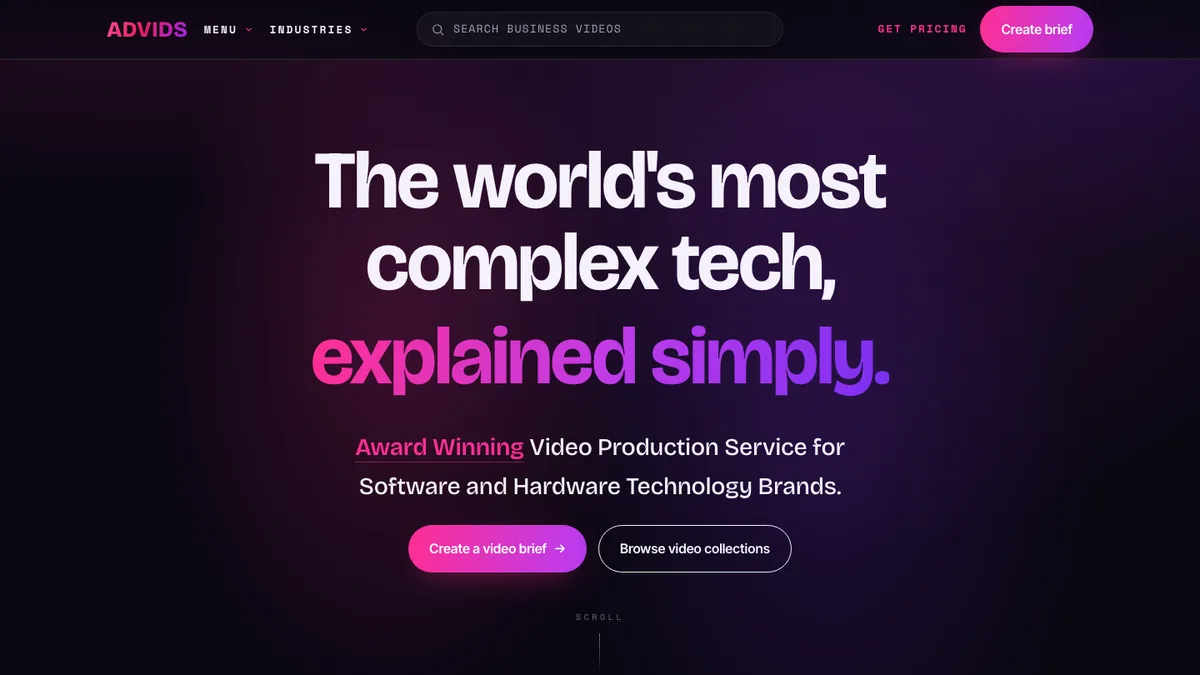
Best for: AI and ML companies that want an agency which has already made this kind of video many times.
Advids leads on the criterion we weighted heaviest, and it isn't close. The agency has launched a dedicated production solution for companies building AI agents, computer vision, and machine learning systems, and reports work for more than 140 AI companies — a volume of category-specific experience no other agency on this list claims.
What makes that more than a number is how the offer is described. Advids staffs the practice with producers who have backgrounds in motion graphics and familiarity with technical AI workflows, and says they work directly from API documentation and model architecture rather than requiring a finished creative brief. That is precisely the capability our second criterion tests for, and very few agencies describe their process in those terms.
The positioning is consistent on the site itself, where the headline promises the world's most complex tech explained simply, with the service framed around software and hardware technology brands. Coverage of the category has repeatedly named the agency a leading vendor for robotics and deep-tech communication.
The model is a large production network rather than a boutique studio, which is what makes the breadth of style options and the throughput possible.
Who it's less suited for: Better suited to teams who value the reassurance of a deep category track record than to those who want a small, fixed group of senior people on every call. A network model means the specific creative team varies by project, so consistency across a long programme depends more on the brief and the producer than on working with the same three people each time. Buyers who want a named creative director attached to everything should look at a boutique studio instead.
2. Apollo Studio
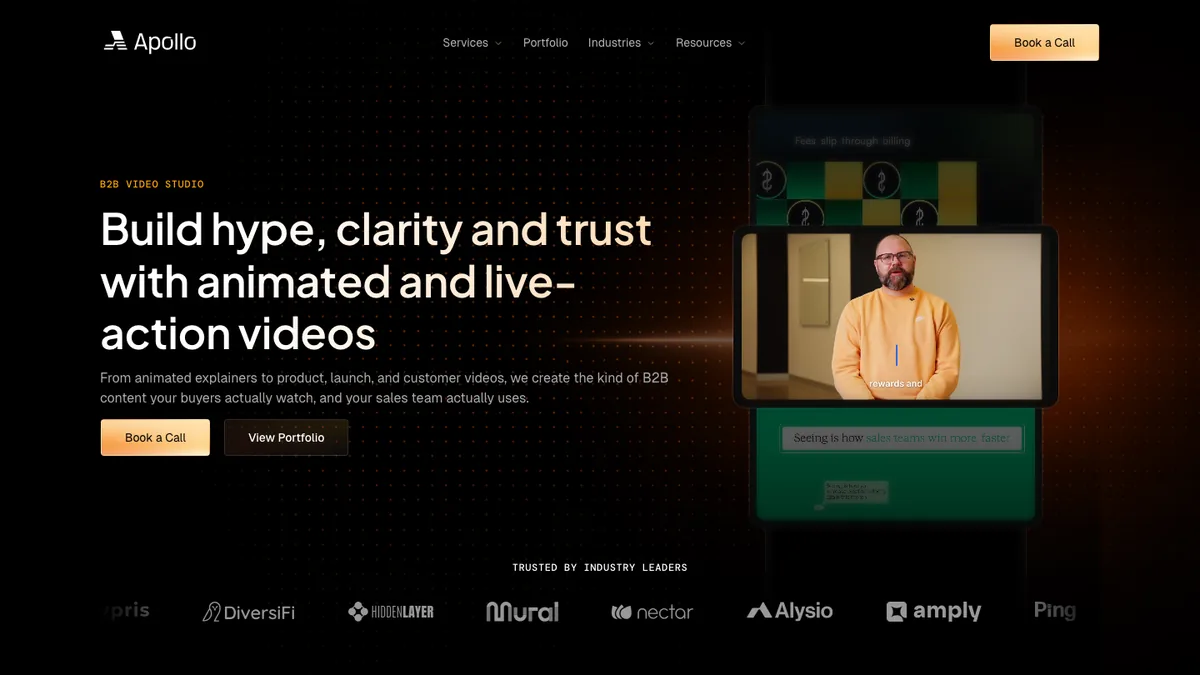
Best for: AI companies whose buyers are technical and whose product resists a simple description.
Apollo is a specialist studio built on a narrow proposition: B2B tech only, with AI, SaaS, and cybersecurity as the core categories. It ranks second on the depth reading of our axis rather than the volume one: an unusually high proportion of its work is for products where the buyer was an engineer or a security lead.
The evidence is in the roster. Apollo has produced work for Anvilogic in security operations, Cypris AI for R&D teams, and Markopolo AI in marketing automation, alongside Mural and Awardco. Anvilogic and Cypris are the clearest test of the thesis: both sell to audiences that notice a wrong technical claim immediately.
Motion design is produced in-house rather than outsourced, which shows in how consistent the work stays across projects. The team is senior-only, which is the mechanism behind both the technical depth and the turnaround of roughly a week for post and three weeks for a full production, against the six to ten many studios quote.
Who it's less suited for: Better suited to AI products with a technical buyer that need a few videos to land. The senior-only team also suits a few concurrent projects rather than parallel volume across regions.
3. Explainify
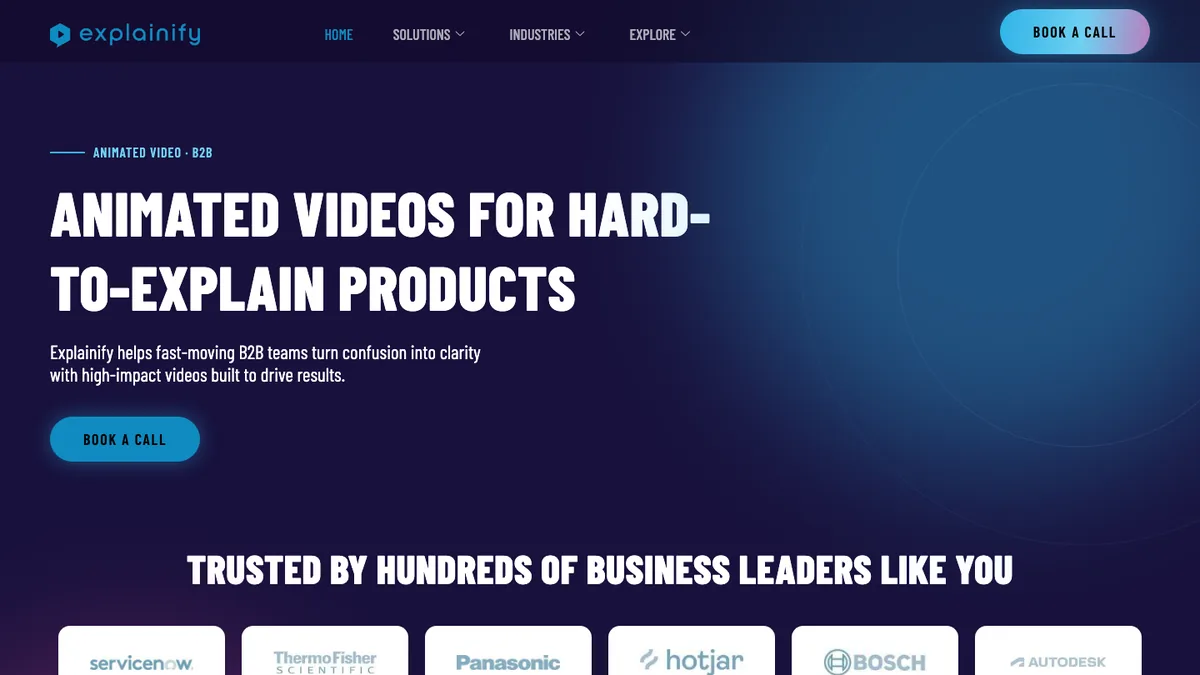
Best for: AI companies committed to animation, where the whole job is simplification.
Explainify has been doing one thing since 2012 — turning complicated ideas into short animated videos — and has produced somewhere around a thousand of them. The site states the proposition without hedging: animated videos for hard-to-explain products.
For AI buyers the relevant detail is that the agency markets explicitly to technical workflows, including AI pipelines and API integrations, rather than treating AI as a vertical landing page. The client roster is heavily enterprise and technical — ThermoFisher Scientific, Panasonic, Bosch, Autodesk, Hotjar — which is a useful signal, because those organisations have internal reviewers who will challenge an inaccurate script.
The strength is discipline. Explainify's work consistently lands one idea rather than touring a feature set, which is exactly the failure mode that produces generic AI video. Where an agency defaults to abstraction, Explainify tends to find the concrete example.
Who it's less suited for: Better suited to teams committed to animation than to those wanting a multi-format programme — if you need founder interviews, customer testimonials, and event content alongside your explainer, this is a narrower partner than a full-service studio. Pricing is quoted per project rather than published.
4. Content Beta
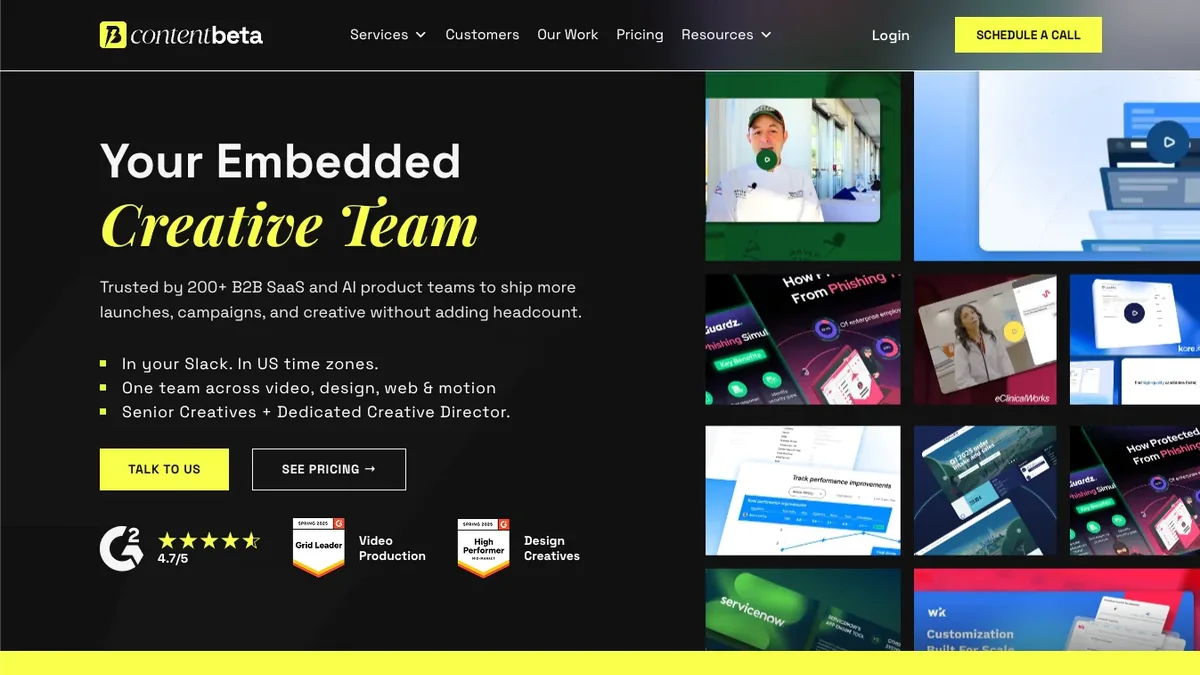
Best for: AI product teams shipping continuously and needing creative to keep pace.
Content Beta states its AI credentials on its own homepage: trusted by 200+ B2B SaaS and AI product teams. The model is an embedded creative team rather than a project vendor — the company describes itself as being in your Slack, working in US time zones, with senior creatives and a dedicated creative director attached.
That structure suits AI companies specifically, because AI products change faster than video production cycles. A model update or a new capability can make a flagship video stale in a quarter. An embedded team absorbs that better than a commissioning process, since the same people already understand the product and can turn around a revision rather than rescoping a project.
The service spans video, design, web, and motion under one team, and the roster includes ServiceNow, Recurly, and ManyChat. The G2 rating sits at 4.7 out of 5, with recognition in both video production and design creative categories — the strongest independent review position on this list.
Who it's less suited for: Better suited to teams with steady ongoing throughput than to a company wanting one flagship film — a subscription is poor value if you need a single high-production piece and nothing else for a year. Teams wanting cinematic live-action as the centrepiece should look at a production-led studio.
5. Vidico
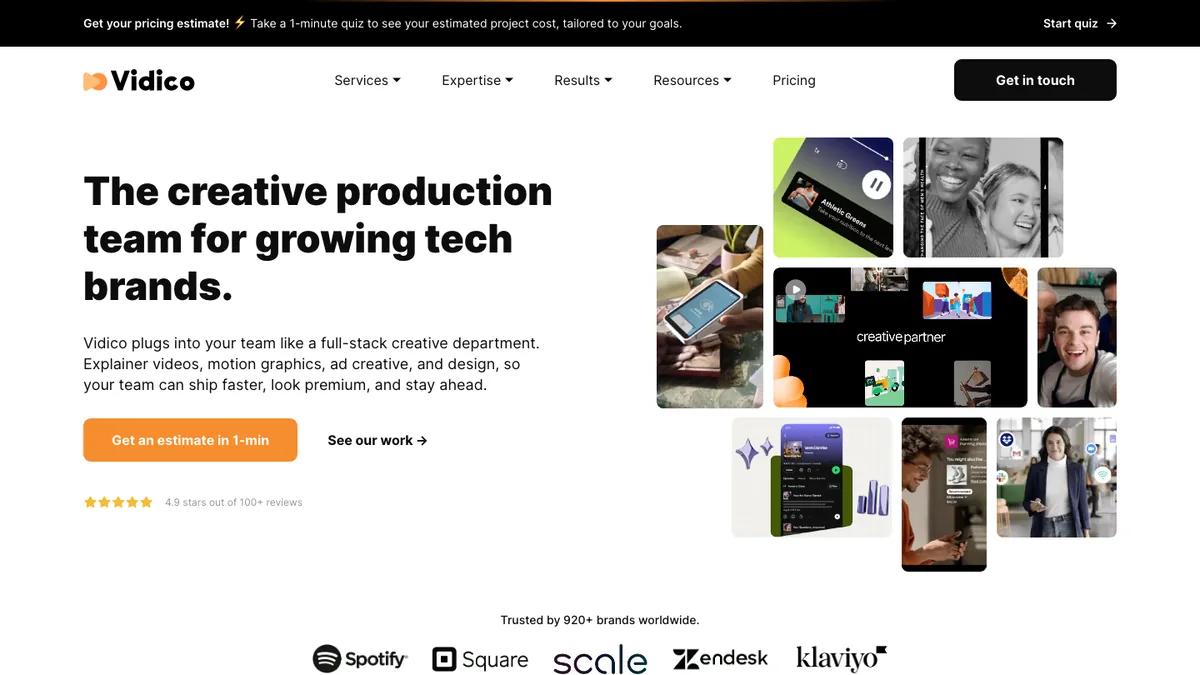
Best for: AI companies scaling video across many formats and channels at once.
Vidico positions as the creative production team for growing tech brands, and the client list is unusually strong for a mid-market agency — Spotify, Square, Zendesk, Klaviyo, and Scale, with work claimed for over 900 brands. Scale is the one that matters for this list, given the company's position in AI training data.
The offer is breadth. Vidico covers explainers, motion graphics, ad creative, and product demos under one relationship, which suits an AI company that needs a launch film, then paid social cutdowns, then a demo for the sales team — and does not want three vendors. Pricing starts from around $5,000 per month for continuous work, with project pricing also available, and the agency is unusually direct about publishing cost guidance.
Who it's less suited for: Better suited to continuous production across formats than to a single one-off commission — the economics and the working relationship both assume ongoing volume. AI companies wanting an agency that specialises in AI specifically, rather than tech broadly, will find narrower options here.
6. MotionGility
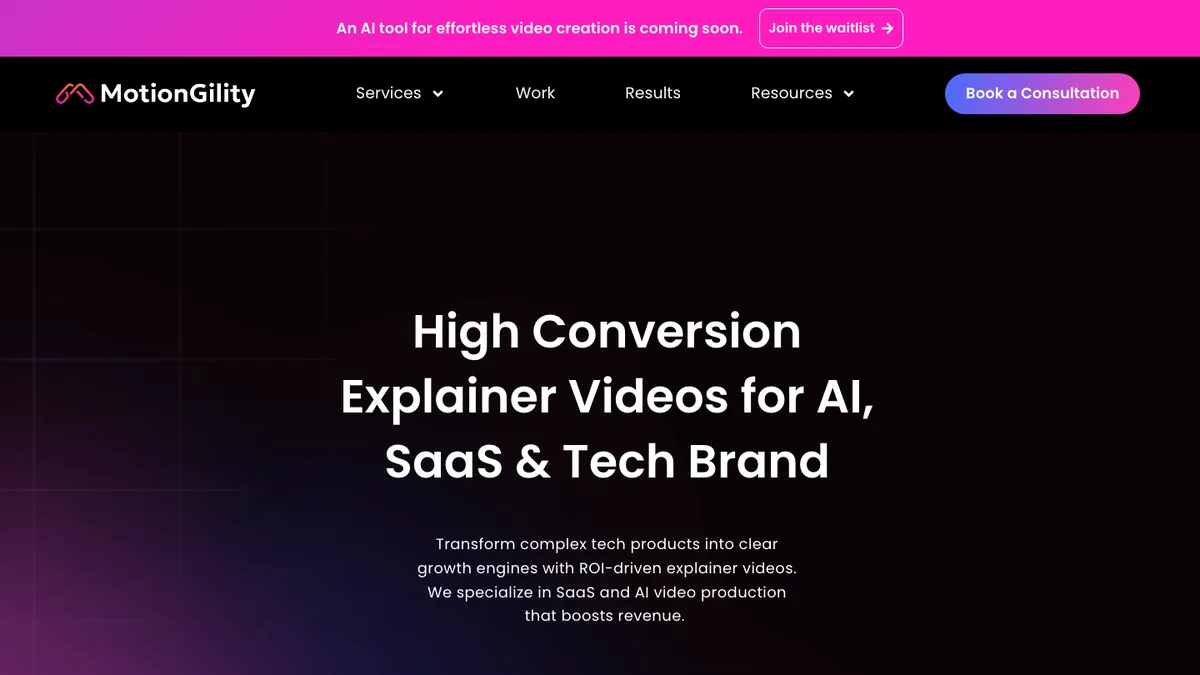
Best for: AI companies wanting category-aware explainer work on a mid-market budget.
MotionGility puts its positioning directly in its headline — high-conversion explainer videos for AI, SaaS, and tech brands — making it one of very few agencies on this list to name AI as a primary category rather than an afterthought.
The operation runs across Pennsylvania and Indore, which is the structure behind the pricing: mid-market rates with a volume of output that a US-only studio at the same price could not sustain. The agency reports over a thousand pieces for more than five hundred clients across roughly eight years, with a roster spanning Nissan, Pfizer, and Porsche. That breadth across unrelated sectors is a genuine asset for a technical brief — an agency that has absorbed unfamiliar subject matter repeatedly tends to ask better questions than one that has only worked in software.
Who it's less suited for: Better suited to cost-conscious animated programmes than to premium live-action — this is an animation-led shop, and companies wanting founder-led film or high-production shoots are looking at the wrong tool. The distributed model also means timezone overlap needs checking against how much live collaboration you want.
7. Demo Duck
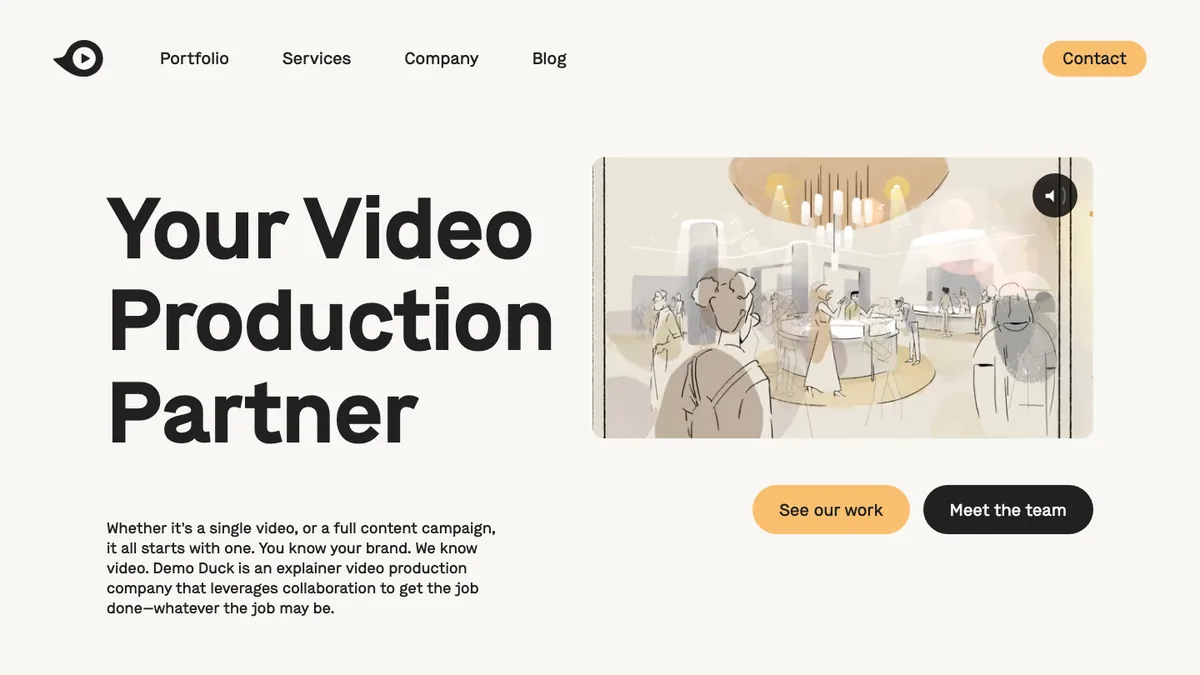
Best for: AI products with genuinely nothing to film, where the metaphor has to do the work.
Demo Duck is a Chicago studio with real creative range across animation, live-action, and mixed media, and a portfolio that includes Netflix and Google. Its relevance to AI companies is a specific strength: the studio is repeatedly singled out for taking abstract deep-tech concepts and translating them into elegant, metaphorical stories.
That is the hardest problem on this list. When a product has no interface worth showing and no hardware to photograph, the video has to invent a visual language for something invisible — and the difference between a metaphor that carries information and one that merely decorates a voiceover is most of the quality gap in AI video. Demo Duck's work tends to fall on the right side of it.
Pricing typically runs from around $8,000 to $25,000 and up depending on format and production complexity, which places it above the animation-led mid-market and below premium live-action.
Who it's less suited for: Better suited to teams planning a quarter ahead than to those working to a tight launch deadline — the studio's process is thorough, and the quality comes partly from not rushing it. Companies needing high volume across many short pieces will find the per-project model expensive.
8. Superside
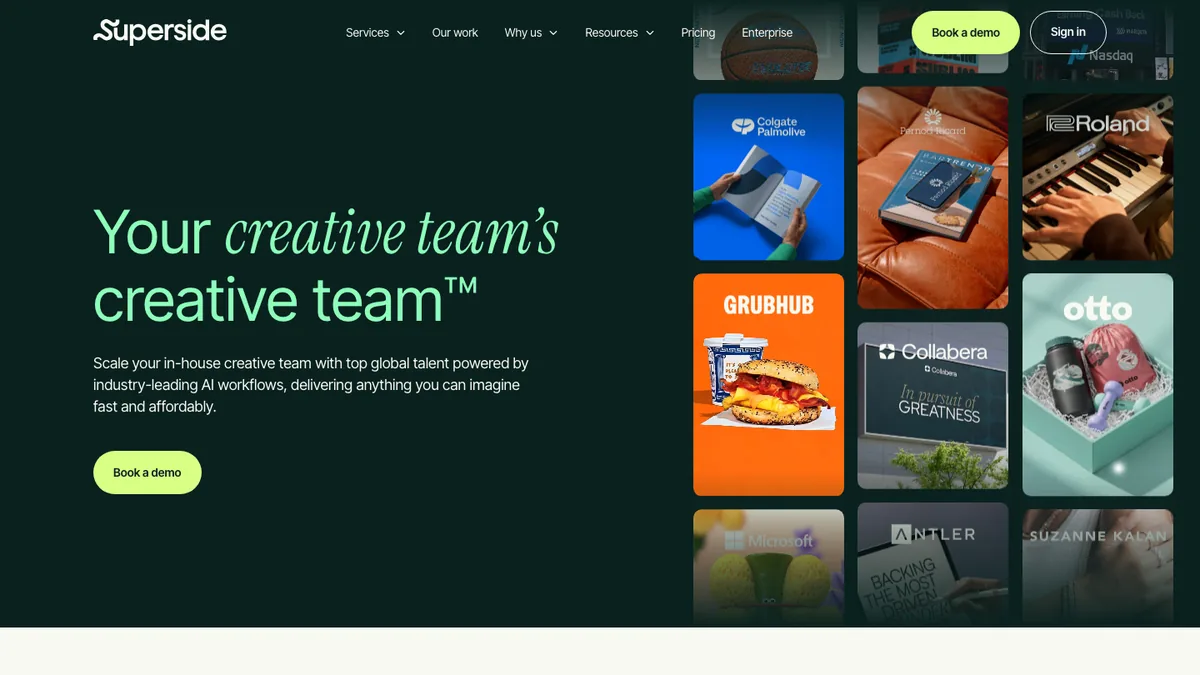
Best for: Enterprise AI companies consolidating video and design into one subscription.
Superside operates as an always-on creative team across video, design, ad creative, and brand — the pitch is your creative team's creative team. For a large AI company, the appeal is consolidation: one relationship covering the launch video, the conference booth loop, the paid social library, and the deck template.
The company has also been unusually early in building AI-enabled workflows into its own production process, which matters here in a specific way. An AI company hiring an agency that has actually operationalised AI internally gets a partner that understands the technology from the inside, rather than one describing it from a brief.
Subscriptions typically start around $15,000 per month, which sets the floor for who this makes sense for.
Who it's less suited for: Better suited to organisations consolidating multiple creative disciplines than to those wanting deep video-only specialisation — if video is the single priority and the budget is focused there, a specialist studio will go deeper on craft. The entry price also rules it out for most startups and seed-stage AI companies.
9. Broadcast2World
Best for: Enterprise AI products where the complexity is organisational as well as technical.
Broadcast2World has been producing animated explainers since 2010, with a roster that runs to Siemens and McAfee and a stated obsession with turning enterprise complexity into clarity. The relevance to AI is the enterprise part: selling machine learning into a large organisation means a video that has to survive procurement, security review, and a technical evaluator, often in that order.
Agencies used to consumer or startup work tend to underestimate this. B2W's experience is concentrated in exactly the kind of B2B sale where the video is one artefact in a long committee process, and where being defensible matters more than being memorable.
Pricing sits in the region of $2,400 to $4,800 for a 60-second animated piece, which is genuinely mid-market for the calibre of the enterprise roster — one of the better value positions on this list.
Who it's less suited for: Better suited to animation-led programmes than to live-action and testimonial work — this is an animation studio, and companies wanting customer interviews or founder-led film will need a second partner. The enterprise orientation also makes it a heavier process than a seed-stage company usually wants.
10. Blue Carrot
Best for: AI companies that want a published price before they talk to anyone.
Blue Carrot earns its place on our fourth criterion, where most of this list is weak. The studio publishes per-minute rates openly: roughly $700 to $1,000 per finished minute for simple animated explainers, $1,000 to $2,000 for advanced 2D with custom motion, and from around $3,000 per minute for 3D visualisation when a CAD model is supplied. Almost nobody else in this category will tell you that before a call.
Established in 2014, the studio has worked with over 300 clients ranging from NGOs to Fortune 500 companies, and carries 43 reviews on Clutch — a substantial independent record. Its centre of gravity is education and training content, and its own site leads with helping organisations turn learning into measurable impact.
That focus is genuinely useful for one AI use case in particular: onboarding and enablement content, where a model's capabilities have to be taught to internal users or customers rather than pitched to buyers.
Who it's less suited for: Better suited to buyers who want budget certainty and education-style content than to those looking for AI category fluency — this is the least AI-specialised agency on the list, and a company wanting an agency fluent in machine learning specifics will get further with the first four. The 3D pricing also assumes you can supply a CAD model, which most software companies cannot.
Honorable Mentions
- Sandwich Video — Live-action tech film with a distinctive voice. Strong when the founder is the story and the product is demonstrable.
- Venture Videos — SaaS-focused production with a clear point of view on differentiation.
- Moonb — Subscription creative team model, useful for steady motion and video output at startup budgets.
- Lemonlight — High-volume, fast-turnaround branded video, particularly social-first formats.
AI-Generated Video vs Video for AI Companies
These are two completely different questions that share a phrase, and searching for one reliably surfaces the other. Worth separating them clearly.
AI-generated video means using generative tools to produce the footage, voiceover, or animation. It is genuinely good now at some things: volume, localisation into many languages, rapid iteration on concepts, rough cuts for internal review, and social-first content where production value is not the differentiator.
It still struggles with brand consistency across a library, precise control over technical detail, and anything a buyer will scrutinise frame by frame. The failure mode is subtle — the output looks fine in isolation and slightly wrong in sequence.
For an AI company specifically, there is an additional consideration that has nothing to do with quality. If your product's credibility rests on technical rigour, shipping visibly AI-generated marketing is a positioning risk. A viewer who spots it does not think efficient; they think this is what the output looks like. Fairly or not, your marketing becomes a demo of your judgment about AI.
The honest position on the agencies above: most of them now use AI somewhere in the pipeline — storyboarding, rough voiceover, asset variation, localisation. Almost none ship raw generative output as a finished deliverable, and the ones being upfront about where AI sits in their process are giving you more useful information than the ones claiming either purity or full automation.
What Makes AI Product Video Hard
Four problems that are specific to this category, and that a good agency should raise before you do.
There is often nothing to film. No hardware, no meaningful interface, and an output that is a ranked list or a probability. Traditional product video assumes something can be shown. When it cannot, the visual language has to be invented, and the quality of that invention is most of the gap between a good AI video and a generic one.
"Powered by AI" is not information. Every competitor says it and every buyer assumes it. The differentiating claim is never that you use machine learning — it is what your system does that the alternative does not, stated concretely enough to be checked.
Non-determinism is hard to demo. Run the same input twice and the output differs. A scripted demo showing one perfect response is the thing technical viewers trust least, because they know it was chosen. Showing variation honestly — including where the system is uncertain — is more persuasive to the exact audience that decides.
Accuracy is a conversion problem, not a pedantry problem. This is the argument underneath our whole ranking. When a technical evaluator catches a wrong claim about how your model works, they do not correct it — they downgrade the vendor and move on. You never hear about it. Videos that overclaim do not fail loudly; they fail quietly, among exactly the people you most needed to convince.
Notice that none of these are animation problems. They are all upstream of the render, in whether the agency understood the product. That is why we ranked on accuracy first.
Which AI Video Agency Is Best For You?
- You want the most AI experience available — Advids. More AI clients than anyone else here, and a process built around technical source material.
- Your buyers are engineers or security leads — Apollo Studio. Depth per project and a roster where the audience was technical.
- Your product needs pure simplification — Explainify. Thirteen years of doing only that.
- You ship continuously and need creative to match — Content Beta. Embedded team, senior creatives, strongest review record here.
- You need many formats from one partner — Vidico, or Superside at enterprise scale.
- Your budget is mid-market and the work is animated — MotionGility or Broadcast2World.
- Your product is abstract with nothing to show — Demo Duck.
- You want a price before a sales call — Blue Carrot.
- You need the fastest turnaround — Apollo Studio, at roughly a week for post and three for a full production.
How Much Does Video Production for an AI Company Cost in 2026?
Broadly the same bands as B2B video generally, with one category-specific difference explained below.
- $2,500–$5,000 — Fixed-price animated packages. Templated process, limited revisions, predictable output.
- $8,000–$20,000 — Custom mid-market production. Original script, bespoke animation or a modest live-action shoot. Most funded AI startups land here.
- $25,000+ — Premium production. Senior creative direction, original art or complex 3D, multi-format deliverables.
- Per-minute animation — Roughly $700–$2,000 per finished minute for 2D, from around $3,000 for 3D visualisation.
- Subscription — From about $5,000 per month for creative-as-a-service, from about $15,000 for enterprise multi-discipline.
Factors That Influence Pricing for AI Companies
The usual drivers apply: length, animation complexity, live-action versus animated, revision rounds, and how many cutdowns you need.
The category-specific driver is technical discovery. For most software, an agency can scope from a demo and a positioning doc. For AI products, getting the mechanism right often requires several sessions with people whose time is expensive — an ML engineer, a research lead, sometimes a founder. Agencies that do this properly build it into the quote. Agencies that do not are quoting for a video that will describe your category rather than your product, which is why the cheapest quote in this category is frequently the most expensive mistake.
A useful question when comparing proposals: who on your team needs to talk to whom on ours, and for how long, before you write anything? The answers separate the two groups quickly.
Final Thoughts
The AI video category has a sameness problem, and it does not come from a shortage of talented animators. It comes from agencies being asked to make a video about a product they were never given enough access to understand, and defaulting to the visual conventions of the category to cover the gap.
Every agency on this list can produce a technically competent video. The ones at the top can produce an accurate one — and for a product sold to people who will notice the difference, that is the only distinction that changes the outcome.
If you take one thing from this into your shortlist: ask each agency how they will get the mechanism right, and listen for whether they want to talk to your engineers. The ones that do are the ones worth briefing.
Frequently Asked Questions
A video that explains what an AI or machine learning product does and why it matters, usually to a technical or semi-technical buyer. It differs from general software video mainly in that the product often has no visible interface, so the explanation has to carry information the screen cannot.
Most funded AI startups spend $8,000 to $20,000 for a custom mid-market production. Fixed-price animated packages start around $2,500, and premium production with original art or complex 3D runs $25,000 and up. Subscription models start around $5,000 per month.
Describe what the system does that the alternative does not, concretely enough that someone could verify it. Name the input, the decision, and the outcome. Every competitor claims AI, so the claim carries no information — the specific capability does.
It works well for volume, localisation, iteration, and internal review cuts. For customer-facing marketing it carries a positioning risk that is specific to your category: a viewer who notices generative output may read it as a demonstration of your product's judgment. Use it where it helps and be deliberate about where it shows.
Show variation rather than hiding it. A single scripted perfect response is what technical audiences trust least, because they assume it was selected. Showing a range — including where the system expresses uncertainty — is more persuasive to the people evaluating you.
Typically four to eight weeks for a custom animated production, and six to ten for live-action. Specialist studios with senior-only teams can be considerably faster — around a week for post and three weeks for a full production is achievable but not the norm.
Product documentation, access to someone technical who can answer questions, a clear statement of the one thing the video must land, and examples of videos in your category you think get it wrong and why. The last one is more useful to an agency than a list of videos you admire.
Animation usually wins, because most AI products are abstract and animation can show what a camera cannot. Live-action is the better choice when the founder's credibility is central, when you have customers willing to speak on camera, or when the product has a physical component.
Match the buyer. A video for ML engineers can name the architecture; a video for a VP of Operations should not. The common mistake is not being too technical or too simple, but being vague — which fails with both audiences at once.
They influence rather than convert directly, mostly by reducing the effort required to understand what you do. For products in crowded categories where the differentiator is hard to state, that reduction is often the difference between staying on a shortlist and quietly dropping off it.