Best Customer Testimonial Video Production Companies in 2026


Key Takeaways
- Apollo Studio: Best for the shortest published production window on a technical product
- The Customer Story: Best for getting a hard-to-schedule customer into the chair
- Venture Videos: Best for a week-by-week schedule committed up front
- Testimonial Hero: Best for removing the discovery phase at programme scale
- Content Beta: Best for continuous output with no procurement cycle per story
- CaseLeap: Best for three assets from one customer conversation
- Vidico: Best for one shoot that feeds every channel, given time
- Represent Studio: Best for AI and developer tool companies moving fast
- Umault: Best for a film worth waiting for
- Demo Duck: Best for a flagship story with the longest runway
Almost every testimonial programme fails the same way. Not badly, and not visibly: it just stops. A customer says yes in March, the kickoff happens in April, scheduling drifts into May, the edit arrives in July, and by then the campaign it was commissioned for has shipped without it. The film is fine. It is also four months late and nobody is quite sure why.
So this guide ranks on elapsed time rather than on craft. Every company below can produce a good customer story. They differ sharply in how long it takes from a customer agreeing to a published film, how much of that schedule they will commit to in writing, and how many handoffs sit inside the production waiting to go wrong.
Craft matters. It is just not usually the reason your testimonial is not live yet.
How We Ranked These Companies (Methodology)
Every "best companies" list optimises for something, and most will not say what, which makes them impossible to argue with and therefore useless.
We ranked for B2B teams who need a customer story published by a specific date. That is a narrower brief than testimonial video generally, and it reorders the field considerably. If your proof content has no deadline and the goal is the best possible film, weight these criteria differently and read craft as the first question instead. Each entry says who should choose someone else.
Time from yes to published
The heaviest criterion, measured only where a company publishes a figure. Where one does not, we say so rather than inferring a number, because an unstated timeline is itself useful information about how the engagement is sold.
Scheduling the customer, not the crew
The crew is always available. The customer is a VP with a calendar, and the size of the ask determines whether the booking happens this month or next quarter. We credited companies that have designed the ask down, and those that run recruitment and scheduling rather than waiting for a confirmed list.
Whether the schedule is published or promised
A week-by-week plan on a public page is a different commitment from a verbal estimate on a call. We weighted published schedules, published pricing and published package structures, all of which remove discovery calls that otherwise add weeks before any work starts.
Handoffs inside the production
Every transfer between writer, producer, editor and animator is a point where a schedule slips. Companies that keep the interview, the edit and any interface or motion work under one roof have fewer of them, which matters most when a customer story has to explain software as well as praise it.
Verifiable track record
Named clients, published volume figures, documented review counts and public pricing we could check. We favoured what is independently verifiable over what is asserted.
The Best Customer Testimonial Video Production Companies Compared
| Company | Best For | Published timeline | Pricing | Better Suited For… Than… |
|---|---|---|---|---|
| Apollo Studio | Shortest published window, technical products | About 3 weeks, full production | From $5,000, all-in | Products that need explaining, than large simultaneous programmes |
| The Customer Story | Hard-to-schedule customers | 3 to 4 weeks from the shoot | Flat quoted | Hard-to-schedule reference customers, than niche technical categories |
| Venture Videos | Committed week-by-week plan | 4 weeks, week by week | From $15,000 | Buyers wanting price and date certainty, than smaller per-story budgets |
| Testimonial Hero | Programme scale, no discovery | Not published | From $3,800 remote | High-volume proof programmes, than a single distinctive film |
| Content Beta | No procurement per story | Not published | From about $3,000 per month | Steady multi-format throughput, than one flagship film |
| CaseLeap | Three assets, one conversation | Not published | Custom quote | Breadth across many industries, than one deep technical vertical |
| Vidico | One shoot, every channel | 6 to 8 weeks, first production | From about $5,000 per month | Teams repurposing across channels, than single-asset buyers |
| Represent Studio | AI and developer tools | Not published | Custom quote | Venture-backed teams moving fast, than formal enterprise procurement |
| Umault | Distinctive craft | Not published | Custom quote | Standout craft on a few films, than consistent high volume |
| Demo Duck | Longest runway, highest ceiling | 6 to 10 weeks reported | Reported $8,000 to $25,000 and up | One ambitious hero film, than fast turnaround |
The 10 Best Customer Testimonial Video Production Companies in 2026
1. Apollo Studio
Best for: The shortest published production window on a technical product.
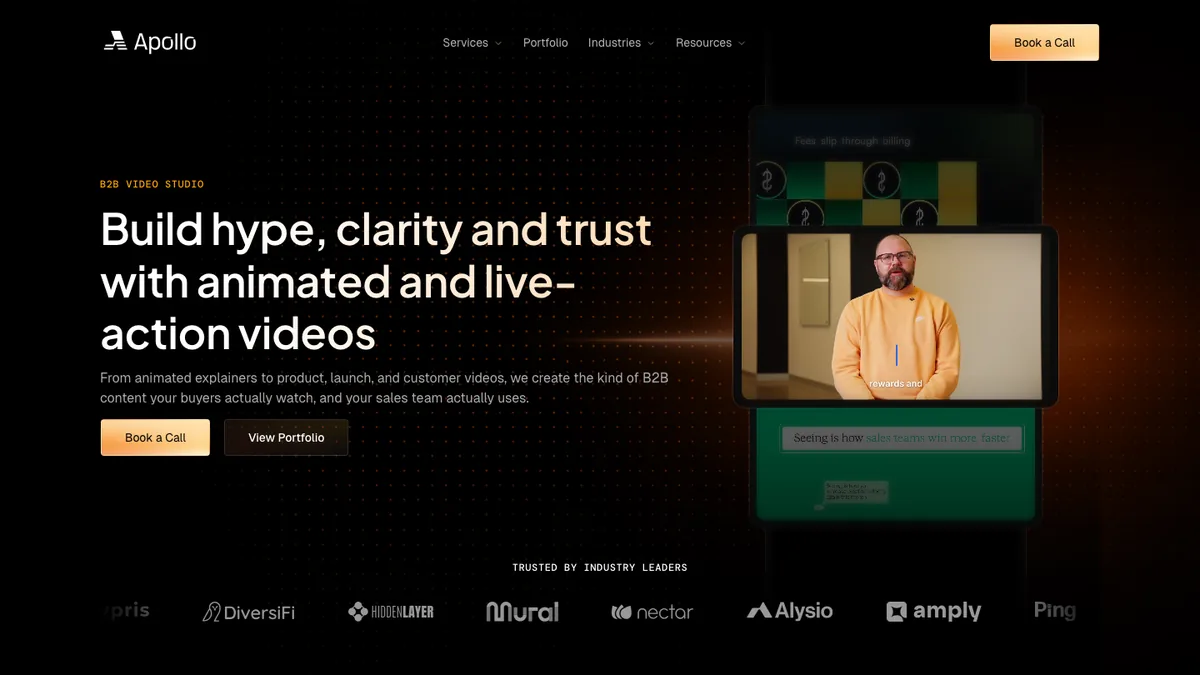
Apollo Studio works exclusively with B2B tech, across SaaS, AI, fintech and cybersecurity, and customer story work sits alongside product and launch video as a named service line. It ranks first on a list built around elapsed time because it publishes the shortest full-production figure of any company here that publishes one: about three weeks.
Two structural things sit behind that number. Motion design is produced in-house, so the interface sequences a software customer story needs are built by the same team running the edit rather than passed to a subcontractor, which removes the handoff where schedules most often slip. And pricing starts at $5,000, scoped per project and stated as all-in with no add-ons, so there is no mid-production renegotiation when a cutdown or a second round of revisions is needed. Co-founder Cade Biegel runs strategy calls directly, which shortens the chain on the decisions that actually hold a testimonial up, such as which customer to film and what the story is about.
The portfolio is the evidence for the technical half. Apollo Studio produced the customer story for Awardco, and its wider work covers Mural, Anvilogic in cybersecurity detection, Vanta in compliance and trust management, Cypris AI, Mindsmith and Ping. Its guide to B2B customer testimonial video also sets out the distinction between a testimonial and a case study film, which is the decision most programmes get wrong before they start.
Who it's less suited for: Better suited to companies whose product needs explaining than to teams running high-volume proof programmes. If you need twenty customer stories filmed across four countries this quarter, a managed programme with a global videographer network is built for that.
2. The Customer Story

Best for: Getting a hard-to-schedule customer into the chair.
The Customer Story is a San Antonio studio built around one insight about elapsed time: programmes stall because the ask is too big. Its remote sessions run 30 to 45 minutes using the customer's existing devices, and on-location shoots are structured to take about two hours of the customer's day.
On a schedule axis that is the most consequential design decision on this list. The longest delay in most testimonial programmes is not production, it is the gap between a customer agreeing in principle and a calendar invite existing. A company that can work inside forty-five minutes gets that invite accepted in the same week the customer says yes, while a half-day shoot waits for a quarter-end. Most projects then deliver within three to four weeks of the shoot.
Clients include Dell, Rackspace Technology, Bitdefender, Pure Storage, Epicor and ThousandEyes, which is a credible enterprise tech list, and packages are quoted flat rather than hourly.
Who it's less suited for: Better suited to enterprise and mixed-industry accounts than to deeply technical niche categories. If your customer is an engineer describing infrastructure, a studio working daily in that category will get more out of the interview.
3. Venture Videos
Best for: A week-by-week schedule committed up front.
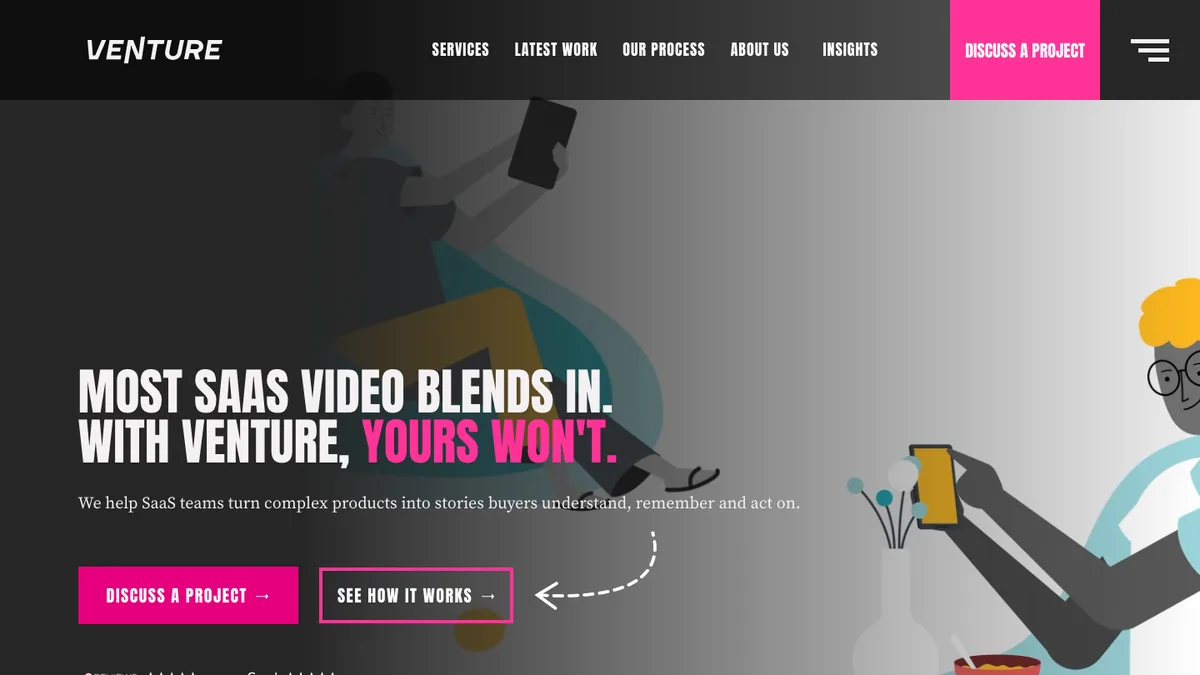
Venture Videos is a UK studio working exclusively with SaaS and tech, and it has helped more than 200 SaaS companies with launches, explainers and customer stories. Clients include Amazon, Google, Box and Bill.com.
It is the only company here that publishes the schedule itself rather than a turnaround estimate: customer selection and planning in week one, filming in week two, editing in week three, delivery in week four. In a category where slippage is the norm, a published week-by-week plan is a real commitment, and it is the thing to ask every other vendor to match. Pricing is published in tiers too, at $15,000 for a Customer Story, $30,000 for a Strategic Customer Story and $50,000 for a Customer Proof Programme, which removes the two-call discovery process that usually precedes any work.
Publishing both the price and the plan means a buyer can start in week one rather than week four.
Who it's less suited for: Better suited to buyers who value price and date certainty with a SaaS-only partner than to teams working to a smaller per-story budget. If your programme depends on many lower-cost stories, remote-first specialists start considerably lower.
4. Testimonial Hero
Best for: Removing the discovery phase at programme scale.
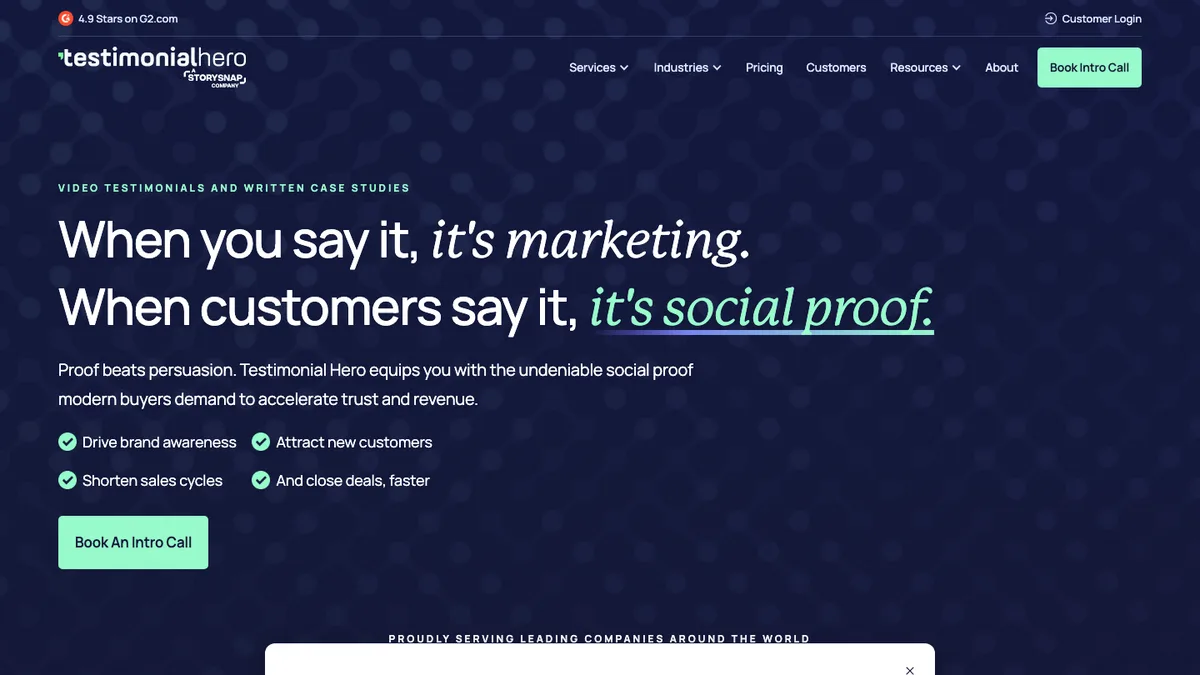
Testimonial Hero is the closest thing this category has to a default. The published numbers are 2,600 or more remote testimonials, 1,600 or more on-site and over 100 captured at events, for clients including HubSpot, Intercom, Grammarly, Gong, Docusign, Amplitude, Qlik, Axonius and NinjaOne. That client list is technical B2B throughout.
What you buy is the operating system rather than the camera: account strategists and creative project managers run the programme, creative producers run the interviews, and a global videographer network covers on-site work wherever the customer happens to be. For elapsed time, the relevant part is that recruitment and scheduling are inside the service, which is where in-house programmes lose months.
It also publishes average costs by package, with video-only remote from $3,800 to $6,200, video-only on-site from $9,200 to $11,800, and bundles pairing video with a written case study from $6,000 remote or $11,600 on-site. It does not publish a production timeline, so ask for one against a named date.
Who it's less suited for: Better suited to programmes measured in dozens than to one highly distinctive creative film. If you want a customer story with an unusual narrative treatment, a boutique studio built around one-off creative will take it further.
5. Content Beta
Best for: Continuous output with no procurement cycle per story.
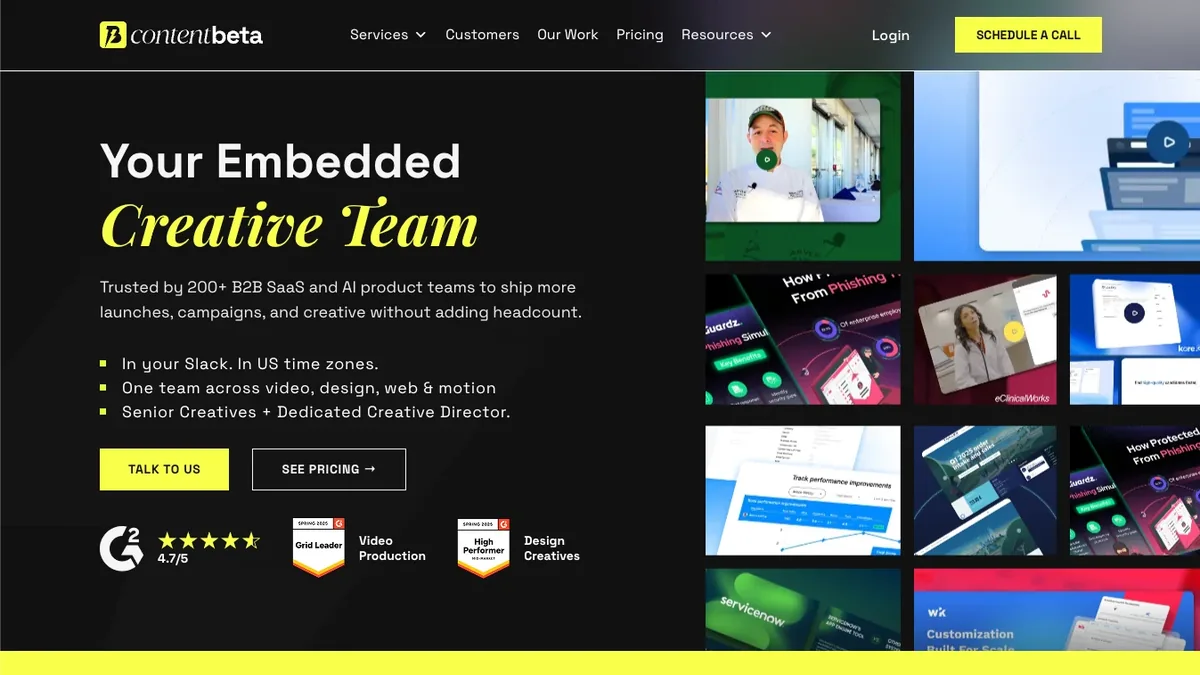
Content Beta runs creative-as-a-service for B2B SaaS, covering video, motion and design on subscription from around $3,000 per month, with testimonials one workstream among several rather than the whole offering.
The schedule argument here is about overhead rather than production. If four customer stories this year sit alongside eleven other videos, running a separate procurement cycle for each one costs more calendar time than the editing does. A subscription absorbs that, so story two starts the week it is briefed instead of the month after it is approved. Per-asset costs also fall once throughput is steady.
The team publishes extensively on B2B testimonial video, which is reasonable evidence of how seriously it takes the category. No production timeline is published for testimonial work specifically.
Who it's less suited for: Better suited to steady multi-format throughput than to a single ambitious customer film. If testimonials are the only thing you need, a dedicated specialist will go further on interview craft.
6. CaseLeap
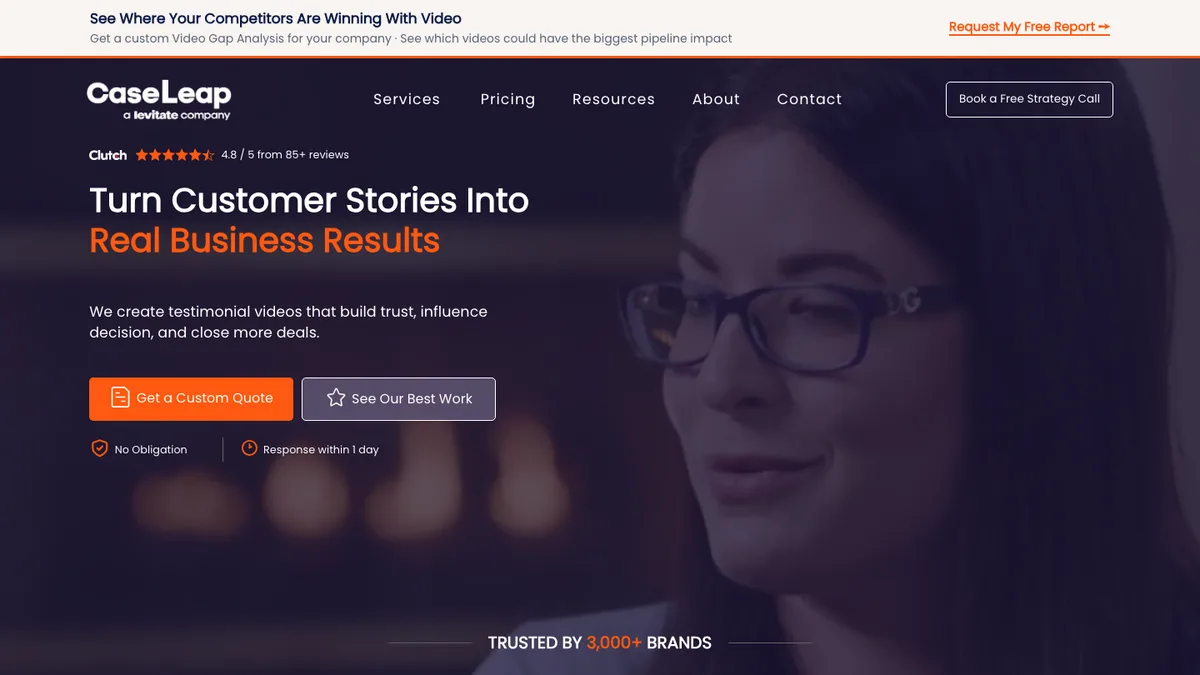
Best for: Three assets from one customer conversation.
CaseLeap reports more than 3,000 customer stories produced, 75 industry awards, and an average client rating of 4.8 out of 5 across 85 or more Clutch reviews, which is the strongest verifiable review record on this list. Clients include Canon, Novartis, FireEye, Cornerstone, TAB Bank, Yodlee and the American Heart Association.
Its relevance on this axis is arithmetic. A single customer conversation yields a video, a written case study and a set of pull quotes, because on-site testimonials, remote interviews, event capture, animated case studies and written case studies all run off the same interview. The customer's willingness is the scarce resource, and three assets per ask means a programme reaches coverage in a third of the calendar time. CaseLeap also runs a video gap report, typically returned within a business day, identifying where proof is missing across the funnel.
Who it's less suited for: Better suited to breadth across many industries than to depth in one. If you want a partner who already knows your technical category in detail, a vertical specialist will reach a working interview faster.
7. Vidico
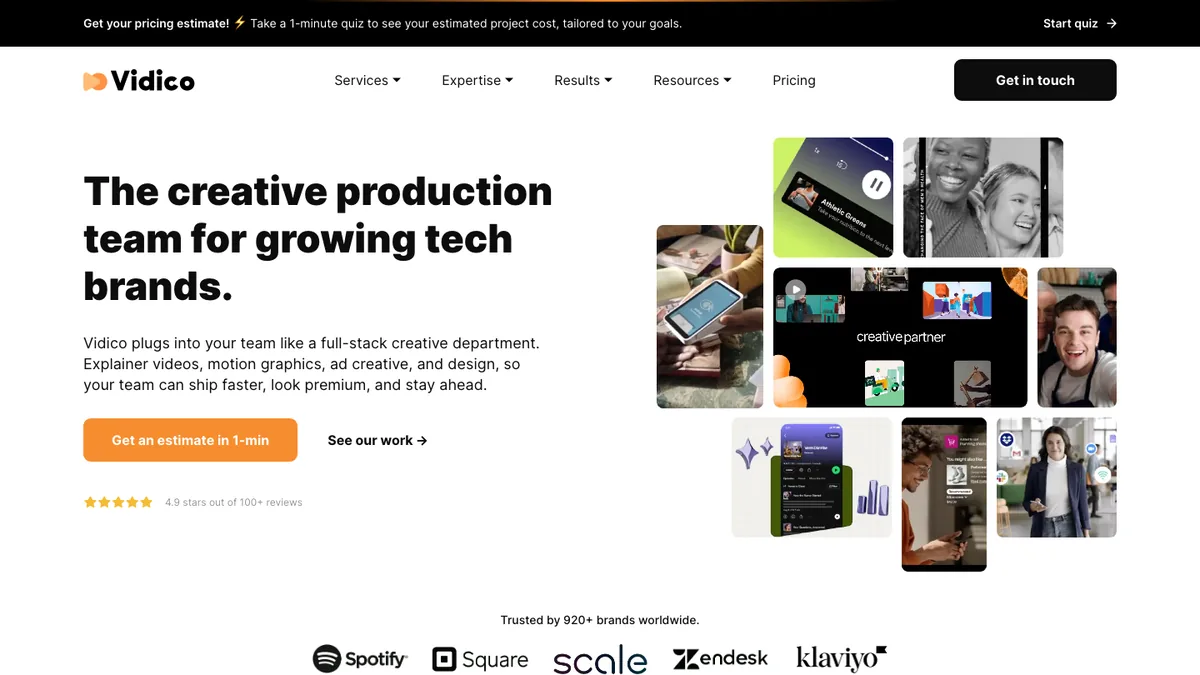
Best for: One shoot that feeds every channel, given time.
Vidico is among the most recognised names in B2B tech video, and its case study service is built around repurposing: one customer shoot planned to yield a hero film, vertical social cutdowns, paid ad variations and still assets rather than one long video posted once.
For a team running paid social that structure is the argument, because the cost of a customer story is dominated by getting the customer to participate at all and the economics improve sharply when one session produces eight usable assets. The reason it sits mid-table here rather than higher is the clock: first productions run six to eight weeks, so the asset breadth arrives on a longer runway than a single scoped story would need. Subscriptions start around $5,000 per month and cover multiple formats under one fee.
Who it's less suited for: Better suited to teams producing continuously across formats than to those commissioning one definitive customer film. If you need a single story this month, a project studio with a shorter published window is the better call.
8. Represent Studio
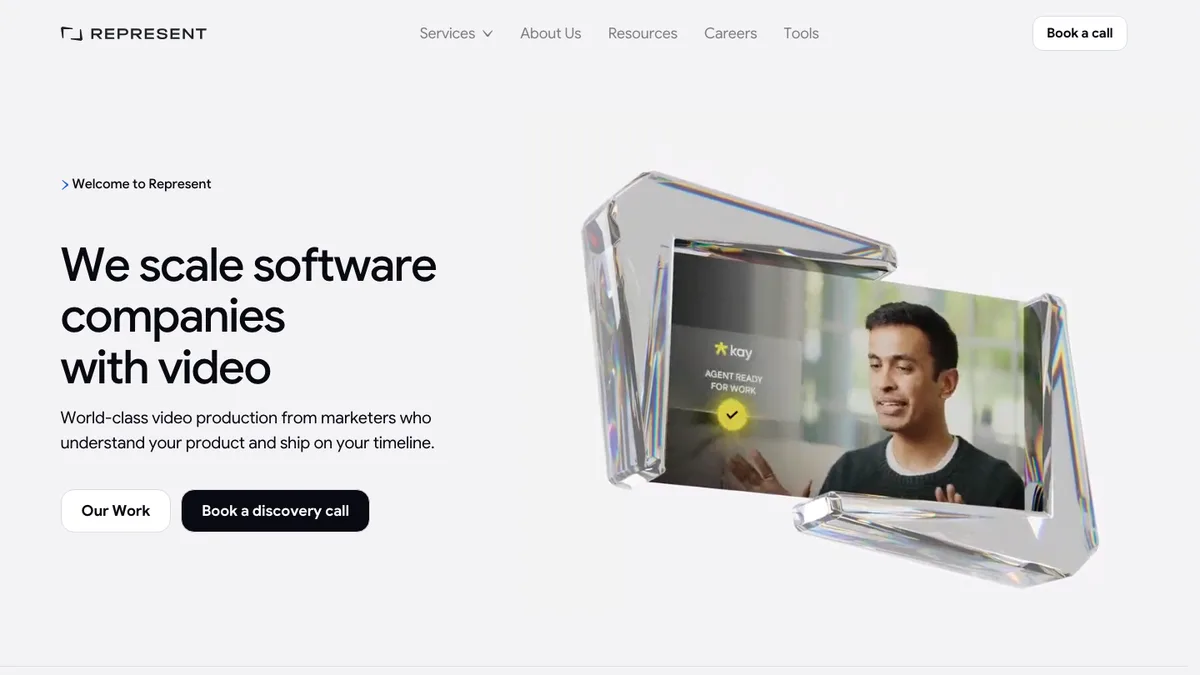
Best for: AI and developer tool companies moving fast.
Represent Studio works with software companies, and its client list is unusually current for this category: Dataiku, Otter, Lindy AI, E2B, Factory AI and FirstMark. Customer testimonials are a named service line alongside launch videos, tutorials and long-form YouTube.
The fit is narrow and real. AI and developer tool companies have a specific testimonial problem, in that the customer is often an engineer who talks in specifics a general producer will flatten into nothing, and the product's value is frequently invisible on screen. A studio working continuously with that buyer arrives understanding it, which removes the two or three interview cycles a generalist spends learning the category. Its stated figures, 300,000 or more activated users and more than $1 billion raised by customers, describe the client base rather than the work, but they tell you accurately who this studio serves.
Who it's less suited for: Better suited to venture-backed software teams moving quickly than to enterprise buyers working through formal procurement. If you need a partner experienced with lengthy vendor onboarding and multi-stage legal review, a larger established agency will fit the process better.
9. Umault
Best for: A film worth waiting for.
Umault is a boutique B2B video agency near Chicago, working with Dell Technologies, SCAYLE, Matomo, PremiumBeat and Mosaik. Its stated position is a reaction against corporate video convention, and the work backs it, sitting closer to advertising than to the interview-plus-b-roll format that dominates this category.
It ranks here precisely because of the axis rather than despite it. If your competitors all publish the same talking-head-against-a-window testimonial, the format has stopped signalling anything, and a customer story shot with genuine cinematic intent is the one a buyer remembers. That is worth a longer schedule, and it should be bought as a deliberate exception to a deadline rather than squeezed into one. Umault's argument is that B2B video fails from being boring rather than from being unclear, which is true more often than the industry admits.
Who it's less suited for: Better suited to a small number of high-craft films than to a volume proof programme. If you need consistent output across many customers each quarter, a managed programme is structured for that in a way a boutique creative studio is not.
10. Demo Duck
Best for: A flagship story with the longest runway.
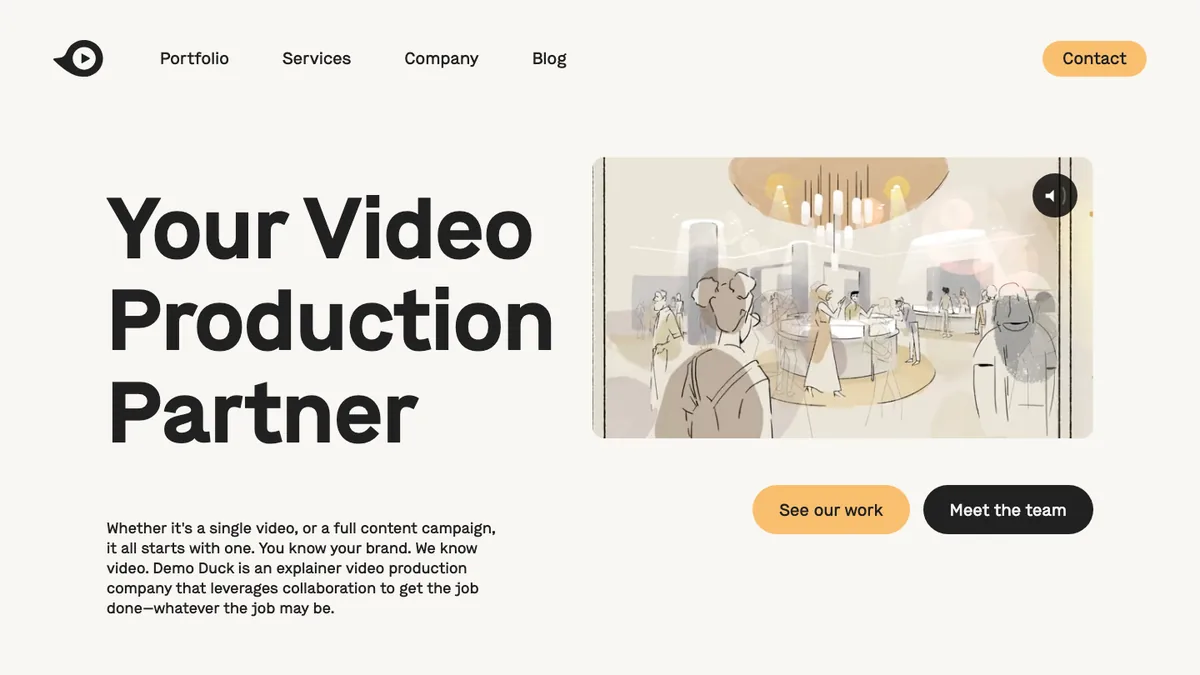
Demo Duck is a Chicago studio with work for Netflix, Google and Geico, and genuine range across animation and live action. For a customer story that has to carry a homepage or open a keynote, that production ceiling is the reason to choose it.
The animation range matters more for testimonials than it first appears, because customer stories about software frequently need to visualise something the camera cannot show, such as a workflow, a data flow or a before-and-after. A studio that can build that properly rather than cutting to a screen recording ends up with a far more watchable film. The trade is the calendar: reported timelines run six to ten weeks, which makes this a plan-a-quarter-ahead choice rather than a this-month one.
Pricing reports vary, with some sources placing projects at $8,000 to $20,000 and others reporting custom work from nearer $25,000. Treat those as indicative and scope directly, since the spread most likely reflects the distance between a simple edit and a full production.
Who it's less suited for: Better suited to teams planning a quarter ahead than to those who need proof content quickly. If your timeline is weeks rather than months, remote-first specialists and project studios with published windows move faster.
Honorable Mentions
- Shootsta: Hybrid model combining client-captured footage with professional editing, which lowers per-story cost and shortens capture on high-volume programmes.
- Moonb: Embedded subscription creative team with a 48-hour average turnaround, useful when customer stories must match a wider content system.
- Superside: Subscription creative at enterprise scale, worth considering when testimonials are one line in a much larger creative budget.
- Wyzowl: Fixed-price production at volume, useful for a competent story without a procurement cycle.
- MHF Creative: Case-study-focused B2B production with a dedicated customer story service line.
- Chasing Creative: Smaller studio with a specific case study video practice.
Why Testimonial Programmes Slip, and Where the Weeks Actually Go
Four delays account for most of the gap between a customer saying yes and a film going live. Only one of them is production.
The ask is too big for the calendar you are asking into. A half-day on-site shoot needs a slot your customer does not have for six weeks. A forty-five minute remote session fits into next Tuesday. Programme design decides this before a vendor is even chosen, and it is the single largest lever on elapsed time.
Discovery before work. Two scoping calls, a proposal, a revision to the proposal and a procurement approval can consume a month before anyone talks to a customer. Published pricing and published package structures collapse that, which is why they are weighted here as a schedule feature rather than a transparency nicety.
Handoffs. A film that passes from interviewer to editor to a subcontracted animator has three queues in it, and each one waits on the last. Studios that keep the interview, edit and motion work together have fewer queues, which matters most for software stories that need interface sequences cut into the interview.
Approval, especially the customer's. Your own stakeholders are a known quantity. Your customer's communications and legal teams are not, and they frequently need to see the final cut. Experienced teams build that review into the schedule as a step with a duration rather than discovering it after delivery. Ask every vendor how they handle customer-side approval, and whether the quote assumes one round or several.
Customer Testimonials by Industry
SaaS and product-led software. The story usually has to explain the product as well as endorse it, which means interface sequences cut into the interview. Keeping that work in-house shortens the edit considerably.
AI and machine learning. The value is often invisible, and the customer is frequently technical. Expect the interview to need a producer who can hear a vague answer and push for the specific one, in the moment.
Cybersecurity. Customers are the most reluctant to appear of any category, because naming a vendor can imply something about their own posture. Expect a smaller pool of willing references, more legal review, and real value in a vendor who has filmed in the category before.
Fintech. Compliance review is part of the schedule, not an afterthought. Any figure a customer says on camera is likely to be checked before release.
Developer tools. The customer is an engineer and will talk in specifics. That is an asset rather than a problem, provided the producer knows enough to follow it rather than steering back to generalities.
Enterprise software. Longest approval chain on both sides, and the one category where a published week-by-week schedule is worth paying a premium for.
How Much Does a Customer Testimonial Video Cost in 2026?
Testimonial pricing is less transparent than most video categories, because cost depends heavily on where the customer is and how many you are filming. Only a few companies here publish figures at all. The bands below use those published numbers where they exist and reported ranges where they do not.
- Under $1,000 per story: Self-serve platforms. Browser-recorded, automatically assembled, no interviewer.
- $3,800 to $6,200 per story: Remote professional testimonials with a real producer and editor, from Testimonial Hero's published average costs for video-only packages. The clearest public benchmark for remote capture.
- From $5,000: Apollo Studio's published starting point for project work, stated as all-in.
- $6,000 to $8,600 per story: Remote testimonial bundled with a written case study, per Testimonial Hero's published video-plus-written tiers.
- $9,200 to $11,800 per story: On-site testimonials with a crew at the customer's location, again from Testimonial Hero's published figures. Bundled with written case studies, its on-site tiers run $11,600 to $13,348.
- $15,000 to $50,000: Venture Videos' published tiers, at $15,000 for a Customer Story, $30,000 for a Strategic Customer Story and $50,000 for a full Customer Proof Programme.
- $3,000 to $5,000 per month: Subscription creative covering testimonials alongside other formats. Content Beta publishes from around $3,000, Vidico from around $5,000.
- $25,000 and above: Flagship customer films with full crew, travel and cinematic treatment.
The most useful comparison is Testimonial Hero's own published gap between the same basic package at $3,800 remote and $9,200 on-site, roughly two and a half times for the identical deliverable filmed in person. That one figure should shape your programme design more than any other number on this page, and it is a schedule decision as much as a budget one, because the remote version is also the one your customer will agree to sooner.
Factors That Influence Testimonial Video Pricing
Remote versus on-site. The largest swing factor, with public evidence behind it at roughly 2.5x on identical packages. On-site means crew, travel and equipment at the customer's location, and a multi-city programme multiplies it.
Customer recruitment. Whether the company identifies, approaches and schedules participants, or you arrive with a confirmed list. This is real work and those who do it price for it. Usually worth paying, because it is the step where in-house programmes die.
Number of stories. Per-story cost drops substantially across a programme, because interview frameworks, brand treatment and edit templates carry forward. Story six costs meaningfully less than story one.
Deliverables per shoot. A hero film, cutdowns, vertical crops and quote cards from one session cost more than a single edit, and far less than commissioning them separately later.
Travel and location. A customer in your city and a customer three flights away are not the same line item. Programmes that cluster shoots geographically save real money.
Legal and approval cycles. Rarely priced explicitly, frequently the cause of overruns. Enterprise customers often need sign-off on the final cut, and experienced teams build that into the schedule instead of discovering it.
Which Customer Testimonial Video Company Is Best For You?
You need a story live in under a month. Apollo Studio or Venture Videos, the two companies here that publish a full production window, at about three weeks and four weeks respectively.
Your best reference customer has forty-five minutes and no more. The Customer Story. The whole model is built around the size of the ask.
You need twenty stories this quarter across several countries. Testimonial Hero. Recruitment, scheduling and a global videographer network are inside the service.
Your customer story has to explain the software, not just praise it. Apollo Studio or Represent Studio. Both work only with software companies, which shows up in the interview rather than in the showreel.
You want a date committed in writing before you sign. Venture Videos, the only one publishing a week-by-week plan.
You need proof content continuously and cannot run procurement each time. Content Beta, or CaseLeap if written case studies matter as much as film.
You want the most assets per ask of your customer. CaseLeap for video plus written plus quotes, or Vidico for multi-format repurposing from one shoot.
The film matters more than the date. Umault or Demo Duck. Buy the longer runway deliberately rather than discovering it.
Final Thoughts
Ask every company you shortlist the same question: what date will this be published, and what has to happen for that date to hold.
The answers divide quickly. A few will give you a week-by-week plan. Some will give you a production window and a list of dependencies. Most will give you a range that starts after a discovery call that has not been scheduled yet. That distribution tells you more about how the next three months will go than any showreel.
Then design the ask before you choose the vendor. The single biggest lever on elapsed time is not the studio, it is how much of your customer's day you are asking for, because a forty-five minute remote session gets accepted next week and a half-day shoot waits for next quarter. A good testimonial you actually published beats an excellent one still waiting on a calendar.
And settle customer-side approval at the start. Your stakeholders are predictable. Your customer's legal team is not, and it is the step that turns a three-week production into a three-month one.
Related Articles
- Best B2B Video Production Companies in 2026 (the broader guide)
- Best B2B Testimonial Video Production Companies (the craft-led companion, ranked on recruitment and interview depth)
- Best B2B Video Production Agencies for SaaS Companies
- B2B Video Production Retainers
Frequently Asked Questions
Among the companies here that publish a figure, about three weeks for a full production at the shortest and four weeks on a published week-by-week plan, up to six to ten weeks for a flagship film. Most companies in this category publish no timeline at all, so ask for one against a named date before you sign.
Four reasons, and only one is production: the ask is too large for the customer's calendar, discovery and procurement happen before any work starts, each handoff inside the production adds a queue, and the customer's own legal or communications review arrives unplanned at the end.
Published figures run from about $3,800 for a remote professional testimonial to $9,200 and up on-site, with specialist project studios starting around $5,000 and full programmes published up to $50,000. Remote capture is roughly two and a half times cheaper than on-site for the same deliverable.
On-site delivers better craft and suits hero films and flagship accounts. Remote is cheaper, faster, and asks far less of the customer, which means more customers agree. For most programmes remote is the right default, with on-site reserved for a small number of accounts.
It varies, and it is the most important thing to establish. Some companies run identification, outreach and scheduling as part of the service. Others begin work once you provide a confirmed participant. The second kind leaves the slowest part of the programme with you.
A testimonial is the customer's endorsement in their own words. A case study film is structured around a problem, an intervention and a measured result, and usually needs data as well as an interview. Many programmes need both, and they are not the same brief.
Less than you think. Published approaches in this category run from 30 to 45 minute remote sessions to about two hours on location. The smaller the ask, the sooner it is accepted, and the acceptance delay is usually longer than the production.
Frequently, especially with enterprise and regulated customers, and in cybersecurity where naming a vendor carries its own implications. Treat it as a scheduled step with a duration rather than a formality, and confirm whether your quote assumes one approval round or several.
Plan for more than one film. A hero cut, a 30-second version for paid social, a vertical crop and pull quotes for sales decks are the formats that get used, and several companies here produce written case studies from the same interview. Designing that in at the shoot costs far less than retrofitting it.
Yes, and for complex software it usually has to, which means interface sequences cut into the interview. Companies that produce motion design in-house handle that with fewer handoffs than those subcontracting it, which shows up in both the edit and the schedule.