Best Product Demo Video Production Companies in 2026


Key Takeaways
- Apollo Studio: Best for scoped projects where a senior team handles unreleased product directly
- Vidico: Best for a structured process at enterprise volume
- Broadcast2World: Best for long enterprise review cycles at a mid-range price
- Demo Duck: Best for a demo with multiple stakeholders and a quarter to plan it
- Videodeck: Best for a fixed price and a ten-day cycle with no scoping phase
- Content Beta: Best for a published per-demo cost inside a subscription
- What a Story: Best for a project range and revision terms stated before the call
- Motion The Agency: Best for a fixed price with a published money-back policy
- Blue Carrot: Best for a documented review record and stated effort hours
- Motifmotion: Best for regulated categories where the demo also has to teach
Most guides to this category rank on craft: whose animation is smoothest, whose scripts land hardest. Useful, and it assumes the hard part is choosing. For most B2B software teams the hard part comes after choosing, when the demo has to be bought through a real process, built from product footage that has not shipped yet, and signed off by people who were not in the kickoff call.
That is what this guide ranks on. Every company below can make a good product demo. They differ enormously in what they commit you to, how they handle a feature that is still behind a flag, who you actually speak to when the script is wrong, and what happens when your VP of Product sees cut three and wants the second half restructured.
If you have ever had a demo stall for five weeks because nobody could decide who approved it, this is the list for you.
How We Ranked These Companies (Methodology)
Every "best companies" list optimises for something, and most will not say what, which makes them impossible to argue with and therefore useless.
We ranked for B2B software teams who have to buy a product demo through a real process and keep it moving through sign-off. That is a specific brief. If you are a founder who can commission a video on a call and approve it alone, weight these criteria differently, and read the craft question as the first one instead. Each entry says who should choose someone else.
Contract model and what it commits you to
The heaviest criterion. A scoped project, a credit pool, a monthly subscription and a retainer are four different commitments, and they fail in different ways. We credited companies that publish what the engagement is, what sits inside it, and what counts as a new piece of work rather than a revision.
Handling pre-release product material
Product demos are the one video format routinely built from software that has not shipped. That means screenshots of features behind a flag, roadmap context, and sometimes a build nobody outside the company has seen. We favoured companies with named clients in categories where that is normal, and with a short chain between the person writing the script and the person holding the footage.
Review and sign-off workflow
A demo is approved by more people than any other marketing video: product, marketing, sometimes sales and legal. We looked for evidence of companies that work inside multi-stakeholder approval rather than around it, including published revision terms and the kind of client list that implies a formal process.
Who you actually work with
Whether the person who understood the product in the first call is the person writing cut three. Senior involvement is not a luxury on a demo brief, because the expensive mistakes are made in the decision about what to leave out, and that decision cannot be delegated down.
Verifiable software track record
Named software clients, published pricing, documented review records and figures we could check. We favoured what is independently verifiable over what is asserted.
The Best Product Demo Video Production Companies Compared
| Company | Best For | Contract model | Published pricing | Better Suited For… Than… |
|---|---|---|---|---|
| Apollo Studio | Unreleased product, senior team | Scoped project, all-in | From $5,000 | Products that need explaining, than high-volume feature clips |
| Vidico | Structured process at volume | Subscription or project | From about $5,000 per month | Continuous multi-format output, than a single fast demo |
| Broadcast2World | Long enterprise review cycles | Project | About $2,400 to $4,800 per 60s | Animated enterprise programmes, than live action or founder-led |
| Demo Duck | Multiple stakeholders, planned | Project | Reported $8,000 to $25,000 and up | Teams planning a quarter ahead, than monthly release demos |
| Videodeck | Fixed price, no scoping phase | Per video or monthly plan | $5,000 single, $2,000 to $3,500 in packs | Fast performance-oriented demos, than cinematic hero pieces |
| Content Beta | Published per-demo cost | Credit subscription | From $3,000 per month, $2,000 one-off pack | Steady release-cadence demos, than one flagship film |
| What a Story | Terms stated up front | Project or subscription | $2,500 to $25,000 per asset | SaaS marketing teams wanting a quote fast, than deep technical categories |
| Motion The Agency | Fixed price, money-back policy | Fixed project or subscription | From $3,480 per video | Animated interface videos, than live-action presenter demos |
| Blue Carrot | Documented review record | Project | About $2,000 to $4,000 per minute | Onboarding and tutorial demos, than sales-led hero demos |
| Motifmotion | Regulated categories | Project | $3,000 to $15,000 per minute | Education and healthcare software, than fast-moving startups |
The 10 Best Product Demo Video Production Companies in 2026
1. Apollo Studio
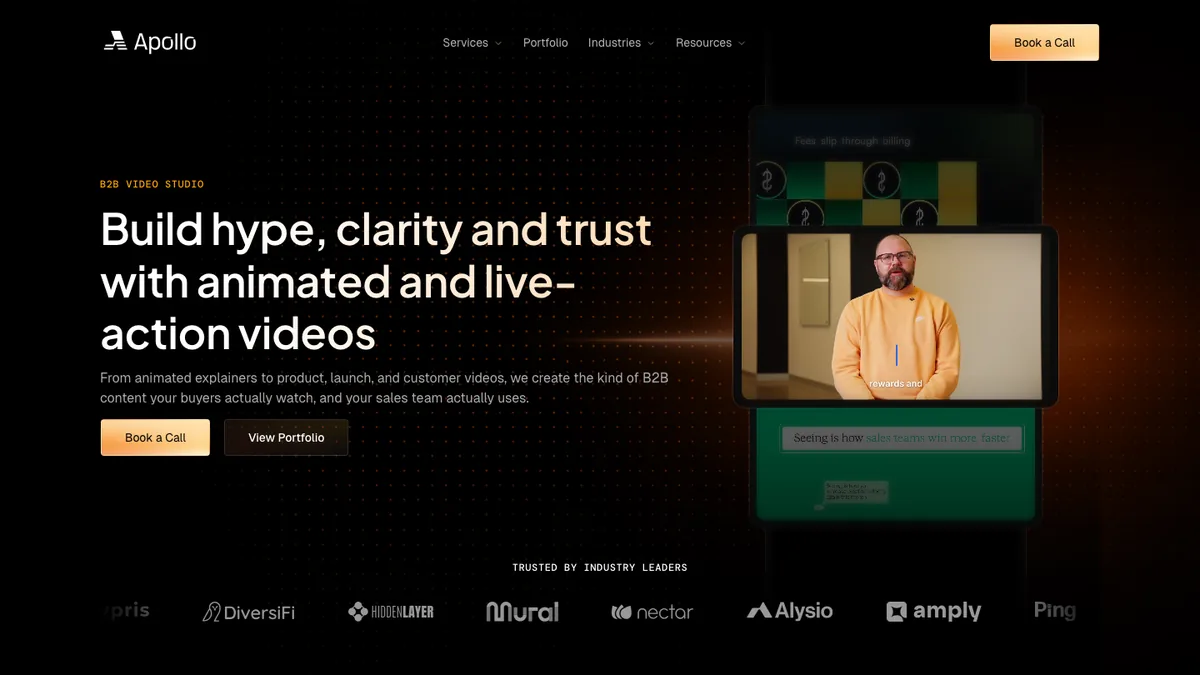
Best for: Scoped projects where a senior team handles unreleased product directly.
Apollo Studio works only with B2B tech companies, across SaaS, AI, fintech and cybersecurity, and product demo video is a named service line rather than one format among many. It ranks first on a list built around buying and managing the work because the two criteria weighted heaviest here are structural rather than promised.
The first is the commitment. Pricing starts at $5,000, scoped per project and stated as all-in with no add-ons, so the number quoted is the number invoiced rather than a base that grows with cutdowns and revisions. Full productions run about three weeks. A single scoped number is easier to defend to a budget holder than a credit pool or a monthly commitment.
The second is who does the work. Motion design is in-house, so interface sequences are animated and simplified by the same team that wrote the script, and co-founder Cade Biegel runs strategy calls directly. That matters most on demos built from product that has not shipped: the chain between the unreleased build and the decision about what appears on screen is short, and that decision sits with someone senior enough to make it.
The client list sits in categories where this is routine: product work for Anvilogic in security detection, Vanta in compliance and trust management, Cypris AI and Markopolo AI, product explainers for Mural, Redo and Mindsmith, and a product tour for Ping. Apollo also sets out the difference between a produced demo and an interactive product tour, which is the first decision most teams should make.
Who it's less suited for: Better suited to companies whose product needs explaining than to teams that want a high volume of short feature clips every sprint. If the brief is thirty two-minute walkthroughs a quarter for existing users, a subscription team or a demo platform is built for that.
2. Vidico
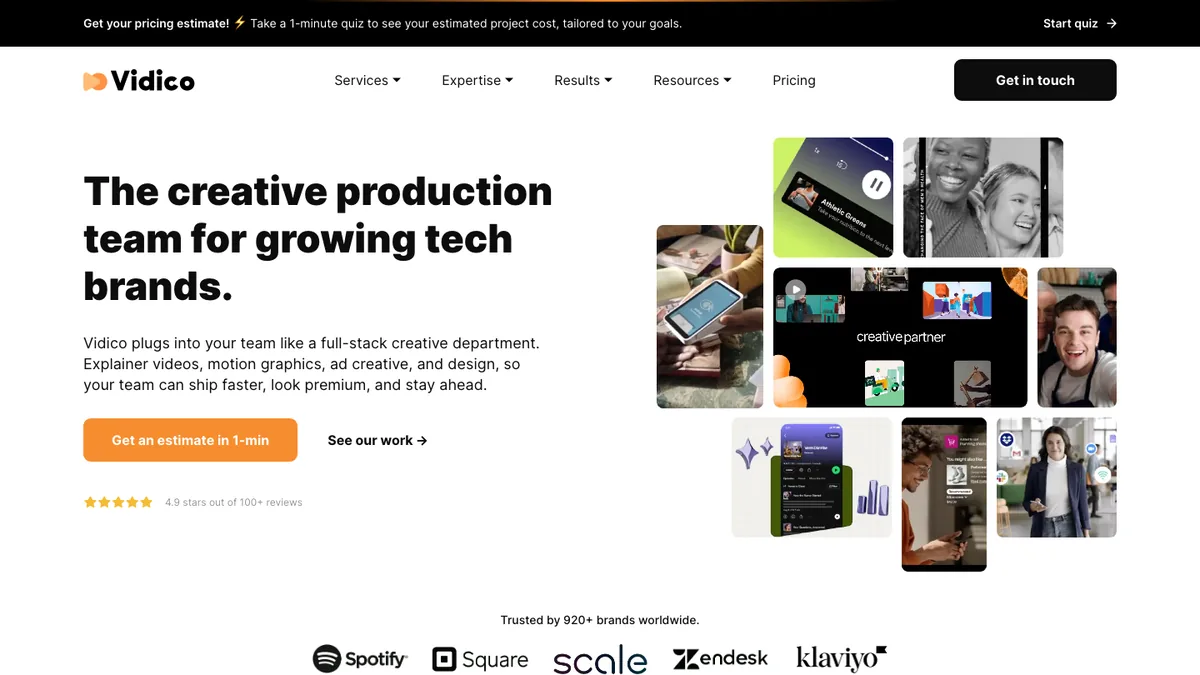
Best for: A structured process at enterprise volume.
Vidico reports more than 1,200 product and brand videos for over 920 brands, with Spotify, Square, Scale, Zendesk, Klaviyo, DigitalOcean and Buffer on the list, and product demo video is a dedicated service with its own page. At that volume the process is the product: a defined pipeline, a known sequence of reviews, and an output plan written before production starts.
For a buyer with a formal process, that predictability is the argument. One production is planned to yield more than 40 assets across homepage, sales email, social and ads, with localisation available in 17 languages across 200-plus regions, so the scope conversation happens once rather than every time a channel owner asks for a cut. Vidico also publishes performance figures from its own case work, such as Juni's demo outperforming previous ads by 75 percent and Cascade reaching a 93 percent view rate. Those are the company's own numbers, and they are the right kind to be publishing.
Subscriptions start around $5,000 per month, project pricing comes via a short quiz, and first productions run six to eight weeks.
Who it's less suited for: Better suited to teams producing continuously across channels than to those needing one demo quickly. If the release is in four weeks, a company with a shorter first-production cycle is the better call.
3. Broadcast2World
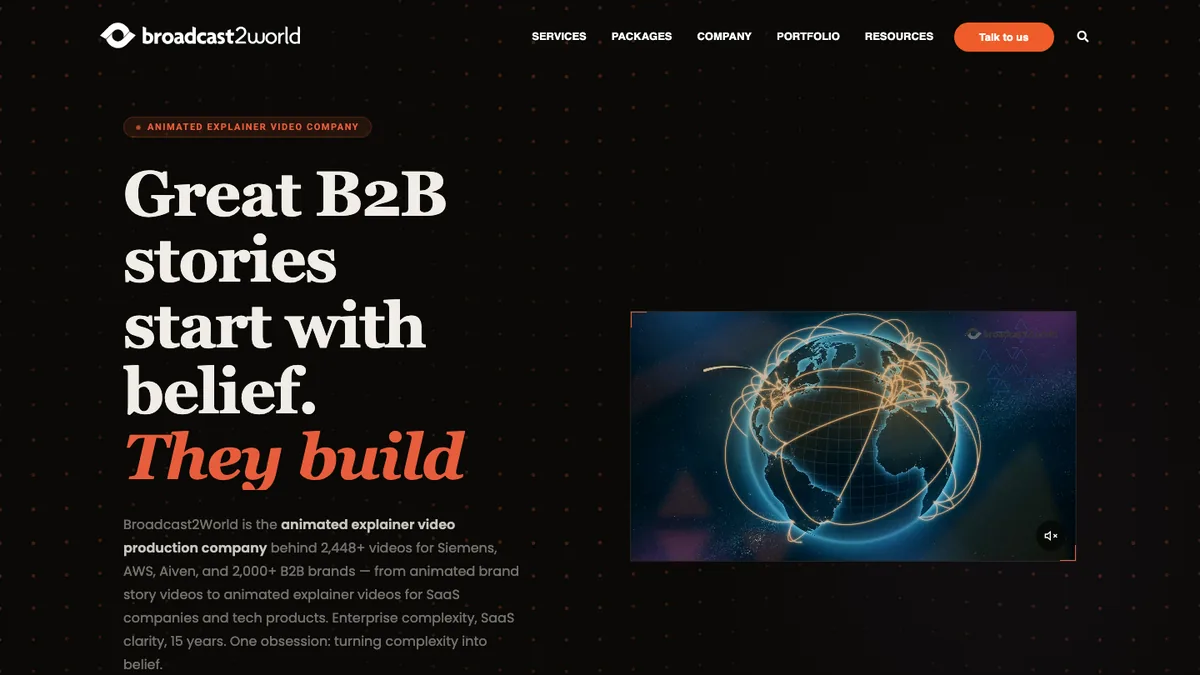
Best for: Long enterprise review cycles at a mid-range price.
Broadcast2World runs a dedicated demo video service from offices in Piscataway, New Jersey and Gurugram, and its enterprise client list is long: Microsoft, McAfee, HubSpot, Epicor, Fujitsu, Symantec and DocStar among them. The service covers scriptwriting, voiceover, storyboarding, graphics, animation and sound across 2D, 3D, motion graphics and mixed media.
That client list is the reason it ranks third on a procurement axis. Enterprises of that size do not approve a video in two meetings, and a company whose portfolio is full of them has a production system built for the pace: staged reviews, documented revisions and a scope that survives a stakeholder arriving late. The pricing sits below most companies carrying comparable logos, with published 2D animation at roughly $2,400 to $4,800 for a 60-second video and 3D as the most expensive option. Production runs four to six weeks from research to final edit.
The efficiency reads as a mature process built over fifteen-plus years rather than work cut short, and the consistency across a large enterprise portfolio suggests system rather than luck.
Who it's less suited for: Better suited to animation-led demo programmes than to live-action or founder-led pieces. If the demo needs a real person on camera, you would need a second partner for it.
4. Demo Duck
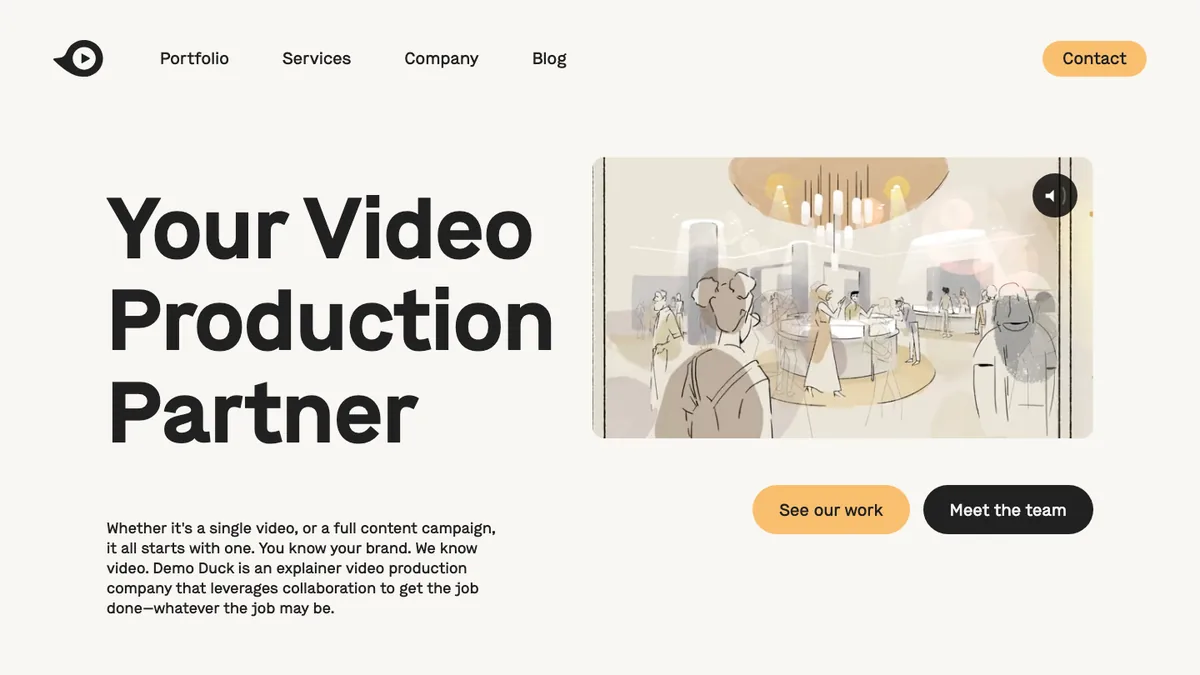
Best for: A demo with multiple stakeholders and a quarter to plan it.
Demo Duck is a Chicago studio with work for Netflix, Google and Geico, and genuine range across animation, live action and mixed media. For a demo that has to open a launch, carry the homepage for a year and satisfy several executives on the way, that production ceiling and that client calibre are the reason to choose it.
The range matters for one case in particular. Some products have an interface worth showing, and some have value that lives in a data flow or a model the camera cannot see. Demo Duck is strong at the second, building a visual language for something invisible rather than cutting to a screen recording, which is the hardest problem in this category. It also needs a longer approval runway, because the concept has to be bought internally before production starts.
Pricing reports vary, with some sources placing projects at $8,000 to $20,000 and others reporting custom work from nearer $25,000 with six to ten week timelines. Treat those as indicative and scope directly, since the spread most likely reflects the distance between a simple animated demo and a full production.
Who it's less suited for: Better suited to teams planning a quarter ahead than to those refreshing a demo every release. If the interface changes monthly, a faster update cycle matters more than the ceiling.
5. Videodeck
Best for: A fixed price and a ten-day cycle with no scoping phase.
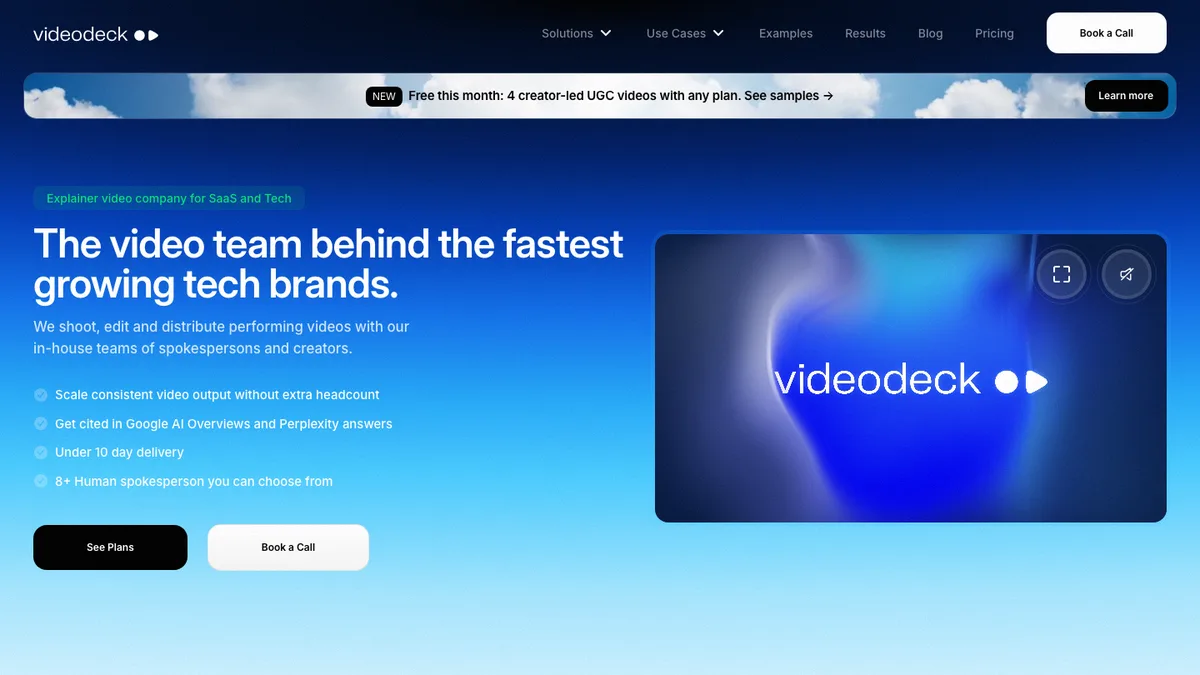
Videodeck works exclusively with SaaS and tech companies, reports more than 100 software clients across martech, AI, fintech, developer tools and productivity, and delivers in under ten days. Its distinctive asset is a bench of in-house spokespersons, so a product walkthrough can be presented by a real person without anyone from your team going on camera.
On a buying axis the appeal is the absence of process. Pricing is published in full: $5,000 for a single video, $3,500 each in a pack of five, $3,000 each in a pack of ten, and monthly plans from $2,500 per video at four a month down to $2,000 at twelve. There is no discovery phase to fund and no quote to wait for, which for a team that needs a demo this month rather than this quarter removes the step that usually causes the delay.
The ten-day cycle also makes it one of the cheapest ways on this list to keep a demo current once the first one exists.
Who it's less suited for: Better suited to fast, performance-oriented demo content than to a single cinematic hero piece. If the demo needs heavy interface animation or a distinctive visual treatment, an animation-led studio is the better tool.
6. Content Beta
Best for: A published per-demo cost inside a subscription.
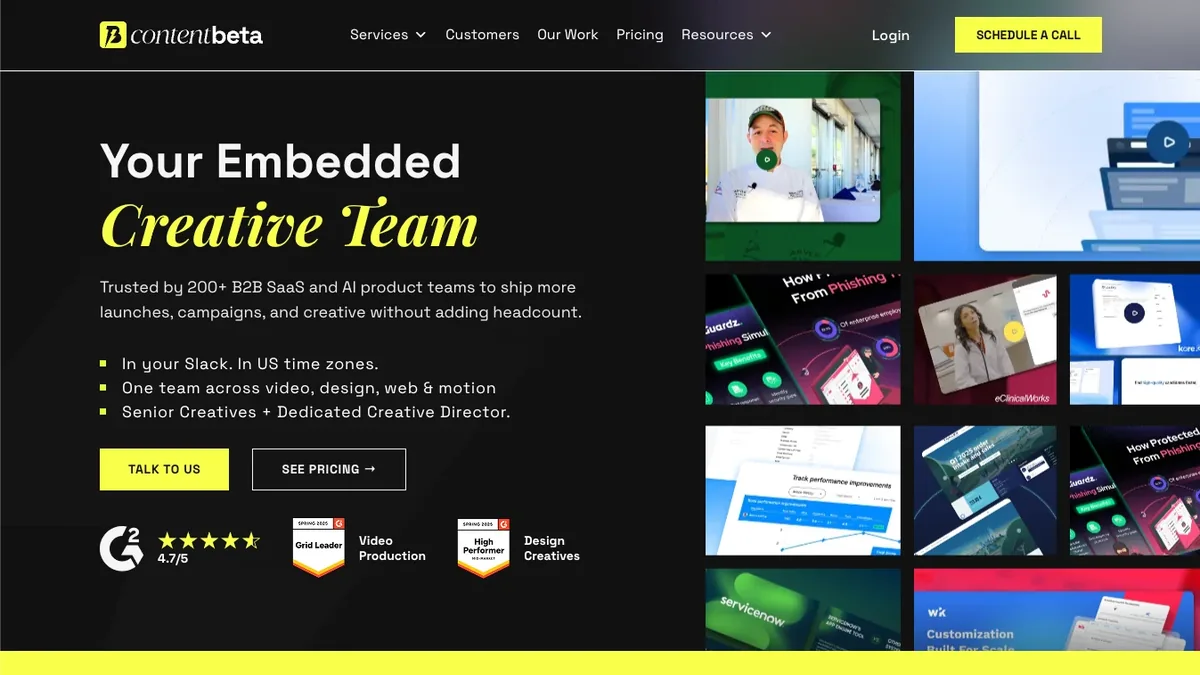
Content Beta runs creative-as-a-service for B2B SaaS and AI companies, and product demo video is its most-published category. The pricing is unusually specific: subscriptions from $3,000 per month for 50 credits, or a $2,000 one-time pack of 25, with a one-minute product demo costed at around eight credits, which the company itself puts at roughly $480 before revisions and nearer $1,000 with them. Turnaround is 8 to 10 days with unlimited revisions.
For a team whose releases are continuous, that model turns a demo update from a procurement decision into a routine task, which is the single biggest difference between a demo programme and a series of one-off projects. The credit mechanic is also the thing to read closely before signing: understanding what a credit buys, and what a revision costs against the pool, is the whole of the commitment.
The company publishes extensively on B2B demo video, including its own rankings of demo companies, which is reasonable evidence of how seriously it takes the category.
Who it's less suited for: Better suited to steady release-cadence demo output than to a single flagship film. If the demo has to carry a keynote or a category launch, a project studio will give it more concentrated creative attention.
7. What a Story
Best for: A project range and revision terms stated before the call.
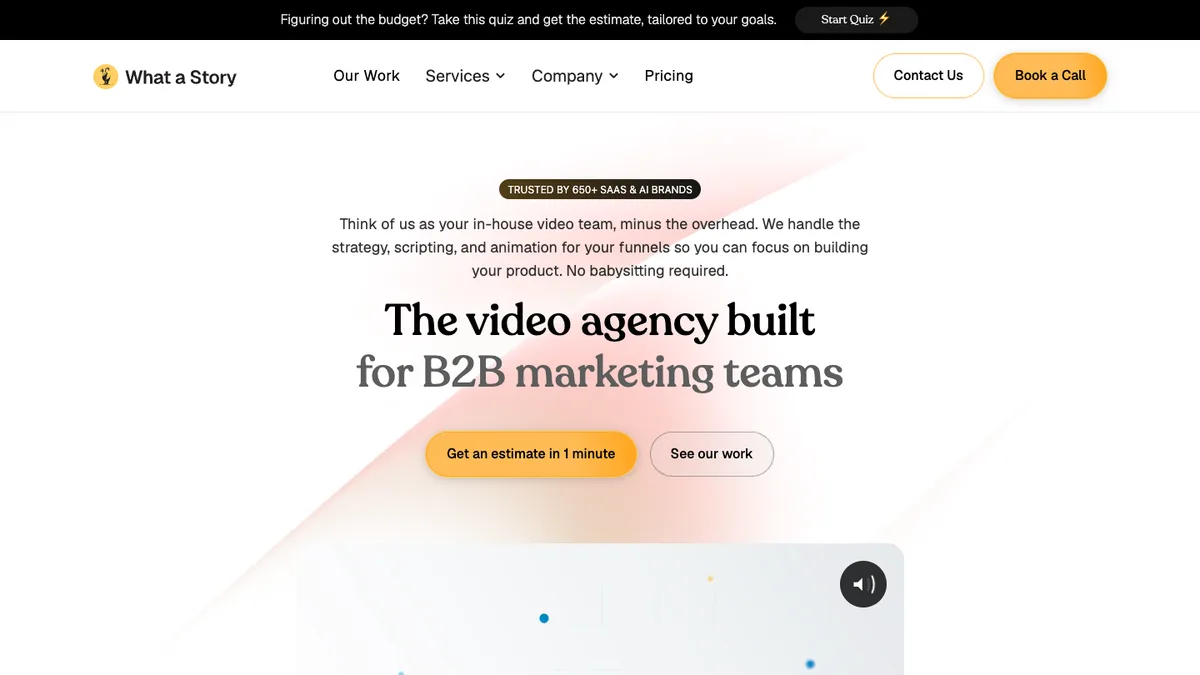
What a Story positions itself as the video agency built for B2B marketing teams and reports more than 1,200 videos across ten-plus years, with software clients including JustCall, Aspire, DuploCloud, Membrain, ZELIQ and Geopointe. Product demo video is a named service alongside explainers and onboarding content.
What earns the place here is transparency on the terms rather than on the price alone. The site publishes a project range of $2,500 to $25,000 for a single video asset, and states what sits inside it: discovery, script, storyboard, 2D or 3D animation, voiceover and unlimited revisions. There is also a subscription, the Content Engine, at $6,000 per month with roughly three-day turnaround on drafts. Project delivery runs two to six weeks depending on scope. Few companies in this category will put revision terms on a page before a conversation, and revisions are where demo scope usually breaks.
The work is animation-led, which suits demos where the interface benefits from being simplified rather than captured.
Who it's less suited for: Better suited to SaaS marketing teams wanting a fast, well-priced animated demo than to deeply technical categories where the buyer is an engineer. For a security or infrastructure product, a studio working daily in that category will reach a working script faster.
8. Motion The Agency
Best for: A fixed price with a published money-back policy.
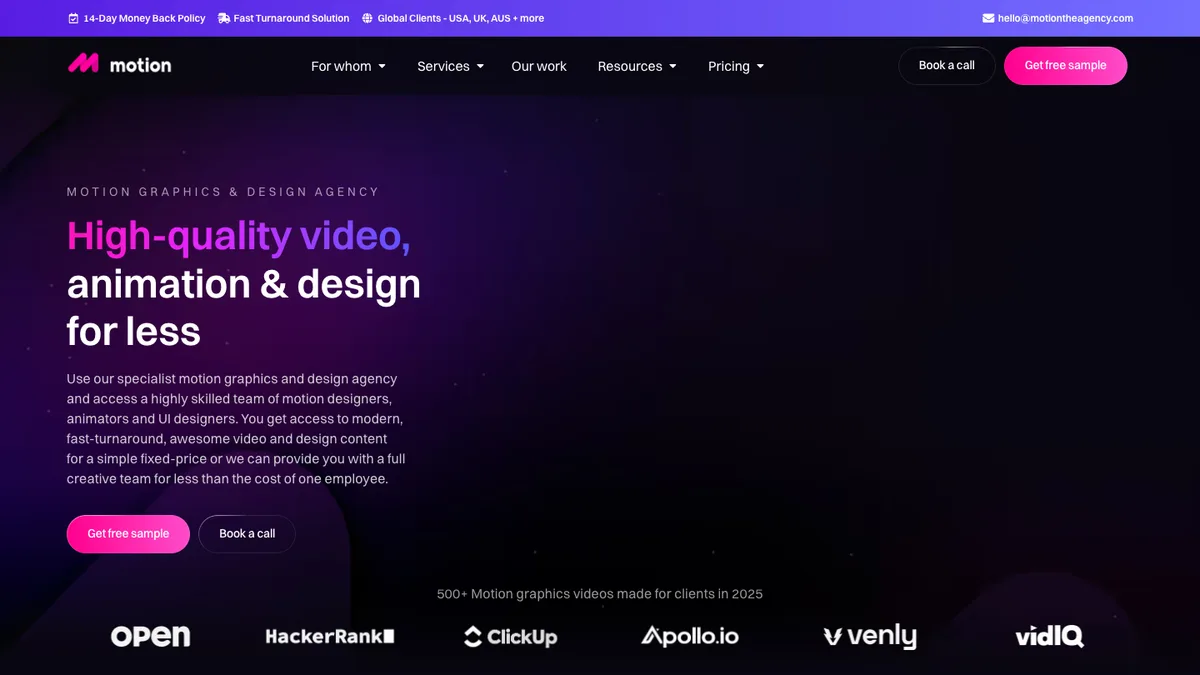
Motion The Agency is a London-registered motion graphics and design studio with clients including HackerRank, ClickUp, Attio, Bonsai and VidIQ, and it reports more than 500 motion graphics videos produced in 2025. UI animation is a stated specialism, produced in After Effects, Figma and Blender, which is the toolset a software interface demo needs.
The procurement features are unusually concrete. Pricing is fixed and published from $3,480 per video, subscriptions from $3,680 per month, and there is a 14-day money-back policy, which is rare enough in this category to be worth naming. For a first engagement with an unfamiliar vendor, a stated exit is worth more than a discount, and for a team that needs a two-minute animated feature demo each release, a known per-video price is the difference between a programme and a sequence of negotiations.
The agency also publishes its own analysis of product demo examples, which suggests it has thought about the format rather than treating it as a variant of an explainer.
Who it's less suited for: Better suited to animated interface videos than to live-action or presenter-led demos. If the brief needs a real person walking through the product, a studio with crews or spokespersons is the right tool.
9. Blue Carrot
Best for: A documented review record and stated effort hours.
Blue Carrot is an animation studio with a dedicated SaaS practice covering explainers, product demos, onboarding and tutorial videos, and UI animation. It reports more than 300 projects for over 200 companies in 30-plus countries, carries 42 reviews on Clutch, and lists ecosio, Comarch, Socket Supply, Dun & Bradstreet and News Corp among its clients.
Two things earn the place on this axis. The review record is documented rather than asserted, which is the cheapest due diligence available to a buyer who has to justify a vendor choice internally. And the studio is specific about effort, stating 4 to 8 weeks and 100 to 200 artist hours for a one-to-three-minute SaaS video from scratch, alongside published pricing of roughly $2,000 to $4,000 per minute for 2D animation within a full range of $1,000 to $7,000 per minute by complexity. Stated hours let a buyer sanity-check a quote, which almost nothing else in this market allows.
The centre of gravity is education and onboarding content, which suits demos whose audience is new users learning a workflow rather than buyers deciding to buy.
Who it's less suited for: Better suited to onboarding and tutorial-style demos than to sales-led hero demos that have to earn a call. If the demo's job is persuasion rather than instruction, a studio built around story will take it further.
10. Motifmotion
Best for: Regulated categories where the demo also has to teach.
Motifmotion is a Philadelphia and Washington DC animation studio, working since 2015, with a dedicated SaaS and product demo service alongside its training and e-learning practice. Clients skew to healthcare and education, including Johnson & Johnson, Mayo Clinic, the University of Pennsylvania and Temple University.
Those clients are the procurement signal. Healthcare and education buyers run the longest approval chains of any category, often with compliance review attached, and a studio whose portfolio is built on them is used to producing inside that constraint rather than complaining about it. It publishes per-minute pricing in three tiers, which is rare: $3,000 to $6,000 per minute for modest productions, $6,000 to $9,000 for moderate, and $9,000 to $15,000 for premium. The seven-step process is scripted, designed and animated end to end, with delivery in a few weeks depending on scope.
The fit is a demo that has to teach as well as sell, where the same asset serves a buyer and the people who will use the product.
Who it's less suited for: Better suited to healthcare, education and regulated software than to fast-moving startups shipping weekly. If the interface changes every sprint, a subscription or fixed-price model will keep the demo current at lower cost.
Honorable Mentions
- Explainify: Animation-first B2B specialist with strong scoping discipline, worth a look when the demo is really an explainer with an interface in it.
- Wyzowl: Fixed-price production at volume, useful for a competent demo without a procurement cycle.
- Represent Studio: Software-only studio with product tutorials as a named service, strong for AI and developer tool companies.
- Superside: Enterprise subscription creative, relevant once demos are one line in a much larger creative budget.
- Lemonlight: Large US production network with a stated two-week turnaround on SaaS demos.
- Moonb: Embedded subscription creative team with a 48-hour average turnaround, relevant when demos need to match a wider content system.
Why Buying a Product Demo Is Different From Buying Any Other Video
Four things make this category harder to buy than an explainer or a brand film, and none of them is about craft.
The product is often not finished. A demo is routinely built from a feature behind a flag, a staging environment, or a build that changes while the edit is in progress. That has practical consequences: who can see the build, under what agreement, and what happens to the edit when the interface moves mid-production. Ask every vendor how they have handled a UI change during an edit, because every one of them has, and the answer tells you whether it is priced as a revision or a new scope.
More people approve it than you expect. Marketing commissions the demo, product owns the accuracy of what is on screen, sales owns whether it earns a call, and in regulated categories legal owns the claims. A four-stakeholder approval on a three-week production needs a review structure, not goodwill.
The brief is a subtraction problem. Every other video brief adds. A demo brief removes: of forty things the product does, the demo shows four. That decision needs someone senior and someone who understands the buyer, and it is the single most common reason a demo fails while looking fine.
It expires. Your interface will change, and the demo dates with it. The vendor's update terms matter more here than in any other format, so settle how a screen swap is priced before you sign rather than after.
Product Demos by Industry
SaaS and product-led software. Release cadence is the deciding factor. If you ship continuously, a subscription or a published per-video price keeps the demo current; if you ship twice a year, a scoped project gives the asset more creative attention.
AI and machine learning. The value usually is not visible in the interface, so the demo has to make a model or a data flow legible. This is a story and concept problem before it is an animation problem, and it needs a vendor comfortable building a visual language for something invisible.
Cybersecurity. Two constraints: the product prevents things rather than producing them, and the buyer is technically literate and allergic to overclaiming. A vendor with named security clients will reach a credible script much faster than one learning the category on your budget.
Fintech. Compliance review is part of the production, not a step after it. Expect claims and on-screen figures to be checked, and choose a vendor whose process has room for that.
Developer tools. The audience reads code and will notice anything faked. Demos here work when the terminal, the editor or the API response on screen is real and the narrative is doing the simplification instead.
Healthcare and regulated software. Longest approval chain of any category, and the demo frequently has to serve both the buyer and the eventual user, which pushes it towards vendors with an instructional practice.
How Much Does a Product Demo Video Cost in 2026?
Product demo pricing is more transparent than most video categories, because several of the companies serving it publish figures. The bands below use published numbers where they exist and attributed ranges where they do not.
- Under $1,000 per demo: Subscription creative at volume. Content Beta's own published costing puts a one-minute product demo at around eight credits, roughly $480 before revisions and about $1,000 with them, on a $3,000-per-month plan.
- $2,400 to $4,800 per 60 seconds: Broadcast2World's published 2D animation range.
- $2,000 to $4,000 per minute: Blue Carrot's published average for 2D animation, within a full range of $1,000 to $7,000 per minute by complexity.
- From $3,480 per video: Motion The Agency's published fixed price, subscriptions from $3,680 per month.
- $2,000 to $5,000 per video: Videodeck's published pricing, from $5,000 for a single video down to $2,000 each on its largest monthly plan.
- $2,500 to $25,000 per asset: What a Story's published project range, with its Content Engine subscription at $6,000 per month.
- $3,000 to $15,000 per minute: Motifmotion's published tiers, from modest to premium production.
- From $5,000: Apollo Studio's published starting point for project work, stated as all-in.
- $8,000 to $25,000 and up: Demo Duck's reported range for custom work, depending on format and complexity.
- From about $5,000 per month: Vidico's subscription starting point, with project pricing by quote.
The figure that matters is not the quote but the total of the quote plus everything that turns out to sit outside it. Two vendors at the same headline price can differ by half again once cutdowns, extra revision rounds, voiceover alternates and a screen swap are added, and that difference is invisible until the second invoice.
Factors That Influence Product Demo Pricing
What the quote includes. Discovery, scripting, storyboard, voiceover, revisions and cutdowns are sometimes all inside the number and sometimes billed separately. Get the inclusion list in writing, because it is the single largest source of variance in this category.
Revision terms. Unlimited revisions, a fixed number of rounds and a per-round charge are three different commercial models. On a demo, which more people approve than any other format, this is the term most likely to cost you.
Captured versus animated interface. A captured interface is cheaper to produce and more expensive to keep current, because every UI change dates it. An animated, simplified interface costs more up front and survives redesigns longer.
Length. Most published pricing is per minute or per 60 seconds. A two-minute demo is not twice the price of a one-minute demo, but it is close, and it is also usually too long.
Presenter or voiceover. A person on camera adds production cost and a scheduling dependency, and performs better in feeds and outbound. Voiceover is cheaper and easier to update.
Update terms. Whether a screen swap is priced as a small edit or a new project. This matters more for demos than for any other format.
Which Product Demo Video Company Is Best For You?
You have to take one defensible number to a budget holder. Apollo Studio, Videodeck or Motion The Agency. All three publish a starting price, and Apollo Studio publishes a starting point of $5,000 stated as all-in.
Your demo is built from a feature that has not shipped. Apollo Studio or Vidico. A short chain to a senior team, or a documented process at scale, both work. A credit pool and a rotating roster is the weakest answer to this problem.
Four or more people have to approve it. Broadcast2World, Demo Duck or Motifmotion, all of whose portfolios are built on buyers with formal processes.
Your interface changes every month. Content Beta, Videodeck or Motion The Agency. Buy a known per-demo cost and a short cycle, because the demo will need updating before the invoice clears.
You need it live in under three weeks. Videodeck or Content Beta. Ten days and 8 to 10 days respectively, with no scoping phase to fund first.
You want revision terms settled before you sign. What a Story or Content Beta, both of which publish unlimited revisions, or Motion The Agency for its stated money-back window.
You need to justify the vendor choice internally. Blue Carrot's documented review record and stated effort hours, or Vidico's and Broadcast2World's enterprise client lists.
Your demo's audience is users, not buyers. Blue Carrot or Motifmotion. Onboarding and instructional animation is their core practice.
Final Thoughts
The instinct when hiring a demo company is to judge the showreel. It matters, and it is the second question.
The first is whether you understood the product. Watch a full demo from each company you are considering, for a product you have never heard of, and ask at the end whether you could explain to a colleague what it does and why someone would pay for it. If the answer is no, the company showed you an interface and called it a demo.
The third question is the one this list is built on, and it is the one most teams skip: what are you actually signing. Get the inclusion list, the revision terms and the price of a screen swap in writing before you choose, and ask who will be writing cut three. A demo that is cheaper on the quote and slower through sign-off costs more than one that is not, and nothing in a showreel will tell you which you are buying.
Related Articles
- Best B2B Video Production Companies in 2026 (the broader guide)
- Best Product Demo Video Agencies (the craft-led companion, ranked on story and interface work)
- Best B2B Video Production Agencies for SaaS Companies
- How Much Does B2B Video Production Cost in 2026
- B2B Video Production Retainers
Frequently Asked Questions
A produced video that explains what a piece of software does and why it matters, using selected parts of the interface to prove the point. It is distinct from a screen recording, which shows everything and explains little, and from an interactive product tour, which lets a buyer click through the product themselves.
Published figures in this list run from roughly $480 for a one-minute demo on a subscription to $25,000 and up for custom project work. Scoped project work from specialist studios commonly starts around $5,000. The headline price is less useful than the inclusion list, because cutdowns, revision rounds and screen swaps are sometimes inside it and sometimes not.
From about 8 to 10 days at the fastest published cycles up to six to ten weeks for a full custom production. Three weeks is a common figure for a scoped project with a specialist studio. First productions with a new vendor usually take longer than subsequent ones.
Yes, and for product demos it is normal. What varies is how it is handled: who sees the build, under what agreement, and what happens to the edit when the interface changes mid-production. Ask for a specific example rather than a reassurance.
That depends entirely on the update terms you agreed. Some vendors treat a screen swap as a minor edit inside an existing engagement, others price it as new work. Settle this before signing, because it is where demo budgets are actually spent.
A produced demo solves comprehension, for a buyer who does not yet understand why the product matters. An interactive tour solves access, for a buyer who already understands the category and wants to try the product. If prospects arrive confused, buy the demo. If they arrive informed and impatient, buy the tour.
A subscription suits continuous release cadence, where the demo is updated often and a known per-demo cost matters more than concentrated creative attention. A project suits a flagship demo that has to carry a launch or a homepage for a year. Teams shipping weekly and running one hero demo often need both.
More than any other marketing video. Marketing commissions it, product owns on-screen accuracy, sales owns whether it earns a call, and in regulated categories legal reviews the claims. Plan the review structure before production starts rather than discovering it at cut two.
Both are legitimate. A captured interface is cheaper and more convincing to a technical audience, and dates with every UI change. An animated, simplified interface costs more and survives redesigns longer, and handles dense screens better. Developer tool audiences generally expect the real thing.
Most work best between 60 and 120 seconds for a buyer-facing demo. Longer versions are usually serving a different audience, typically existing users learning a workflow, and that is a separate asset rather than a longer cut of the same one.