Best B2B Video Production Companies in 2026

Key Takeaways
- Apollo Studio — Best for complex B2B tech (SaaS, AI, cybersecurity)
- Vidico — Best for scaling video across multiple formats
- Superside — Best for enterprise creative at volume
- Demo Duck — Best for high-production custom explainers
- Wyzowl — Best for fixed-price predictability
- Broadcast2World — Best for animated storytelling on mid-range budgets
- Explainify — Best for animation-first simplification
- Yum Yum Videos — Best for story-driven animation for startups
- Content Beta — Best for SaaS content velocity
- MyPromoVideos — Best for B2B tech video at volume
Most B2B videos get made. Very few get watched.
That's the real problem with hiring a video agency. The output is almost always competent — decent motion, clean audio, a voiceover that hits the beats. And it still doesn't work, because the person who wrote it never understood the product well enough to explain why anyone should care.
For B2B companies, that gap is expensive. Your buyer is a technical evaluator with six tabs open and a shortlist to cut. A video that looks good but explains badly doesn't lose gracefully, it gets closed at eight seconds, and the deal moves on without you.
This guide ranks the B2B video production companies worth your shortlist in 2026, what each one is genuinely good at, what it costs, and where each falls short.
How We Ranked These Companies (Methodology)
Every "best agencies" list is ranked on something. Most don't say what. We'd rather be explicit, because the axis you rank on determines who wins, and ours will suit some buyers and not others.
We ranked for fit to complex B2B products, not for agency size, age, or video count. A studio that has shipped 4,000 videos is genuinely impressive, and if you need predictable volume that track record matters more than anything else on this page. But it doesn't tell you whether the team can make a security operations platform or an AI research tool comprehensible in sixty seconds. Those are different competencies, and we weighted for the second.
Here's what went into it.
B2B and tech specialisation
Weighted heaviest. There's a real difference between a studio that works with B2B tech constantly and a generalist that takes tech projects when they come. It shows up in the script — specialists write from an understanding of the product and the buyer, generalists write from a brief. We gave the most credit to teams whose portfolios are concentrated in software, and particularly in the harder corners of it.
Portfolio quality and craft
We watched the work. Not the reel — the actual deliverables, start to finish. As AI-generated video floods the low end of the market, execution quality has become the clearest differentiator between studios that charge $3,000 and studios that charge $30,000. We looked for narrative discipline, animation that serves comprehension rather than decoration, and consistency across a body of work rather than one standout piece.
Pricing transparency and model fit
Some of these companies publish rates. Some don't. We didn't penalise custom pricing, but we did credit transparency, and we paid attention to whether the commercial model matches the need. A subscription is excellent if you're producing continuously and wasteful if you need one launch film a year. Project pricing is the reverse.
Process, speed, and communication
Video projects fail on process far more often than on craft. We looked at stated timelines, how clearly each studio defines its phases, how many rounds of revision are built in, and whether senior people stay on the project after the pitch.
Independent reviews and ecosystem reputation
Clutch and G2 profiles, named client references, and visible standing in the B2B marketing community.
The Best B2B Video Production Companies Compared
| Company | Best For | Pricing | Model | Better Suited For… Than… |
|---|---|---|---|---|
| Apollo Studio | Complex B2B tech | Project-based | Full-service studio | Technical products that need explaining, than parallel volume across regions |
| Vidico | Scaling across formats | From ~$5,000/mo | Subscription + project | Continuous production, than one-off commissions |
| Superside | Enterprise volume | Flex from ~$15,000/mo | Subscription | Multi-discipline consolidation, than video-only specialisation |
| Demo Duck | Custom explainers | ~$8,000–$25,000+ | Project-based | Planning a quarter ahead, than tight launch deadlines |
| Wyzowl | Fixed-price certainty | $2,500–$9,000 | Fixed packages | Predictable scope and price, than bespoke creative |
| Broadcast2World | Mid-budget animation | ~$2,400–$4,800 / 60s | Project-based | Animation-led programmes, than live-action and testimonials |
| Explainify | Animation-first clarity | Custom | Project-based | Teams committed to animation, than multi-format programmes |
| Yum Yum Videos | Startup animation | Custom | Project-based | Products helped by brand personality, than deeply technical ones |
| Content Beta | SaaS content velocity | Subscription tiers | Creative-as-a-service | Steady throughput, than a single flagship piece |
| MyPromoVideos | B2B tech at volume | Custom | Project-based | Reliability across broad B2B, than deep single-category fluency |
The 10 Best B2B Video Production Companies in 2026
1. Apollo Studio
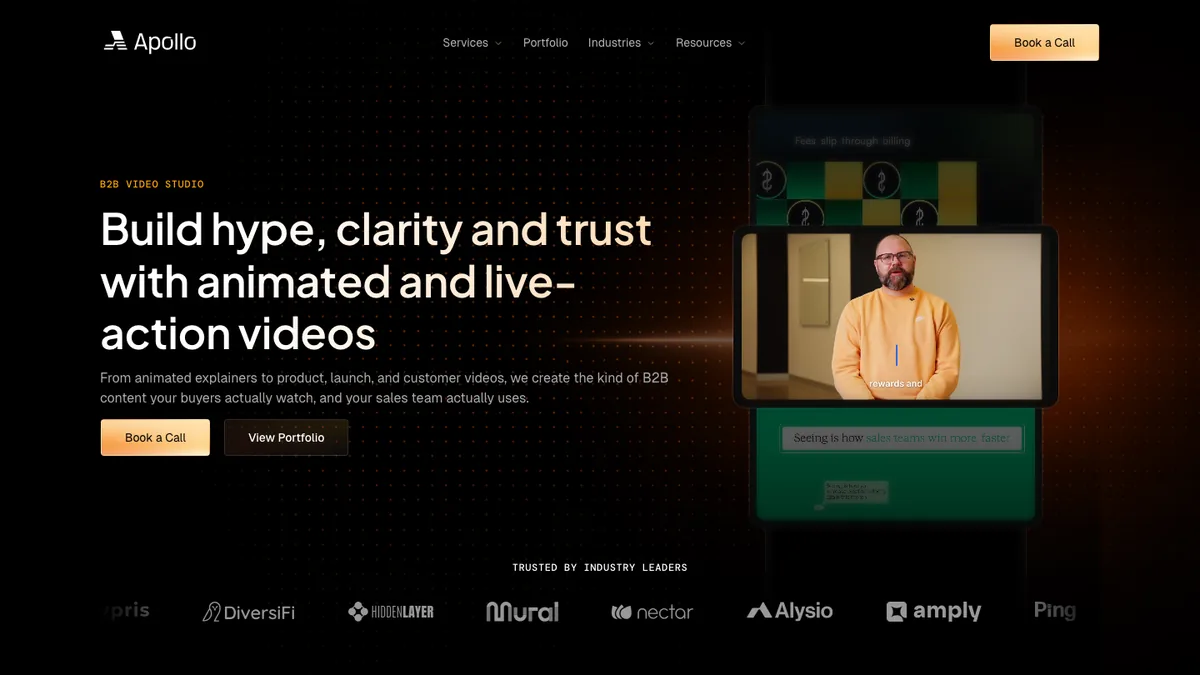
Best for: B2B tech companies whose product is genuinely hard to explain — especially SaaS, AI, and cybersecurity.
Apollo is a specialist studio built around a narrow proposition: B2B tech only. Not B2C, not general corporate, not brands that occasionally sell software. That focus is the entire pitch, and it's why the studio ranks first on our criteria.
It shows in the client roster. Apollo has produced work for Mural, the collaboration platform, Awardco, Anvilogic in security operations, Cypris AI for R&D teams, and Markopolo AI — products that resist easy explanation. Anvilogic and Cypris are the clearest evidence of the thesis: technical buyer, crowded category, and a narrow gap between clarity and a closed tab.
The approach puts story ahead of visual polish, on the argument that visuals without narrative are decoration, and decoration doesn't survive a shortlist. Motion design is produced in-house rather than outsourced to a production mill, which is unusual at this size and shows in the consistency of the work. Live-action puts real founders and customers on camera — a deliberate position against the drift toward AI avatars.
Speed is the other differentiator. A lean senior team turns post around in about a week and full productions in roughly three, a meaningful gap against studios quoting six to ten. Co-founder Cade Biegel runs strategy calls directly, so the person scoping the project is the one accountable for it.
Apollo covers explainers, product, launch, customer, and ad videos across SaaS, AI, fintech, cybersecurity, and healthcare, from Utah, worldwide.
Who it's less suited for: Better suited to a scoped set of videos that have to land with a technical buyer than to organisations shipping eight videos simultaneously across regions, which is where a larger production network fits. The deliberate B2B tech focus also makes it the wrong call for consumer, retail or general corporate work.
2. Vidico
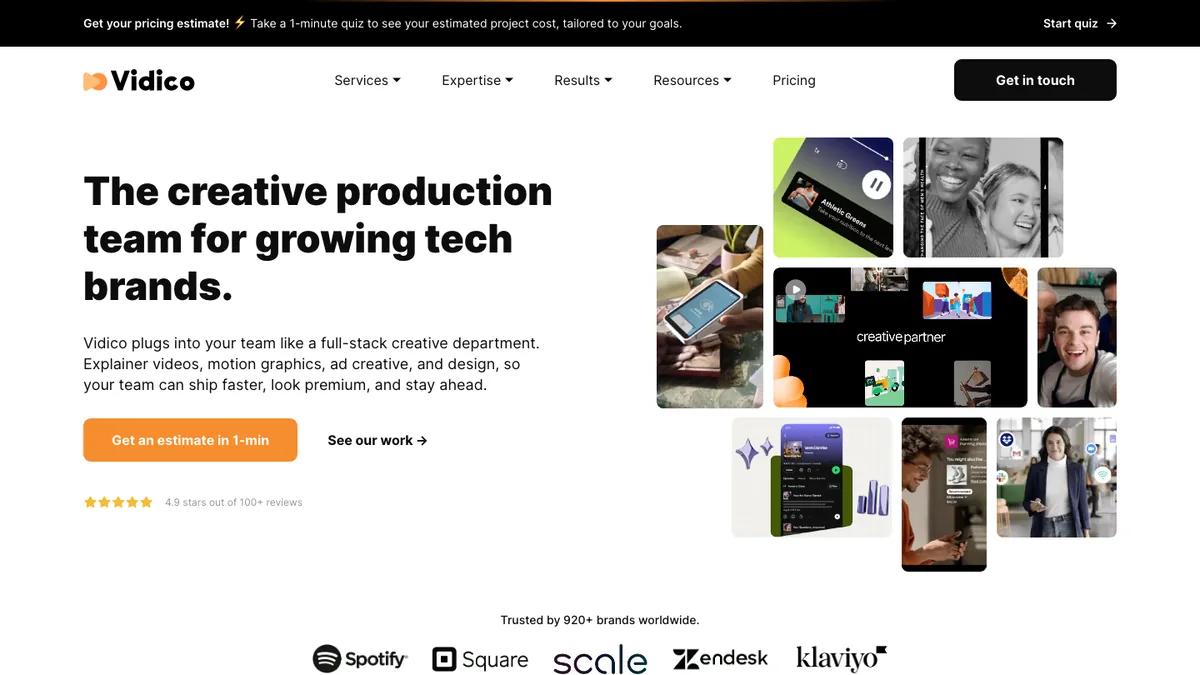
Best for: Companies scaling video across multiple formats at once.
Vidico has become one of the most recognised names in B2B SaaS video, and the reason is operational as much as creative. Founded in Melbourne and now operating across New York, Dubai, and Singapore, the studio built a model designed for companies that need video continuously rather than occasionally.
Monthly subscription plans start at roughly $5,000 and cover multiple video types under a single fee — product demos, explainers, ads, social cuts. For a marketing team producing consistently, the per-video economics improve as the engagement runs, because the creative system and product understanding carry forward instead of being rebuilt each time.
The portfolio skews toward high-growth SaaS, and the work is polished and reliably on-brief. Vidico is a strong default for a team that knows it needs a steady stream of video and doesn't want to re-brief a new agency each quarter.
Who it's less suited for: Better suited to teams producing video continuously than to those commissioning occasionally. If you need one exceptional launch film a year, you'll pay for capacity you don't use, and a project studio will serve a single bespoke flagship piece better.
3. Superside
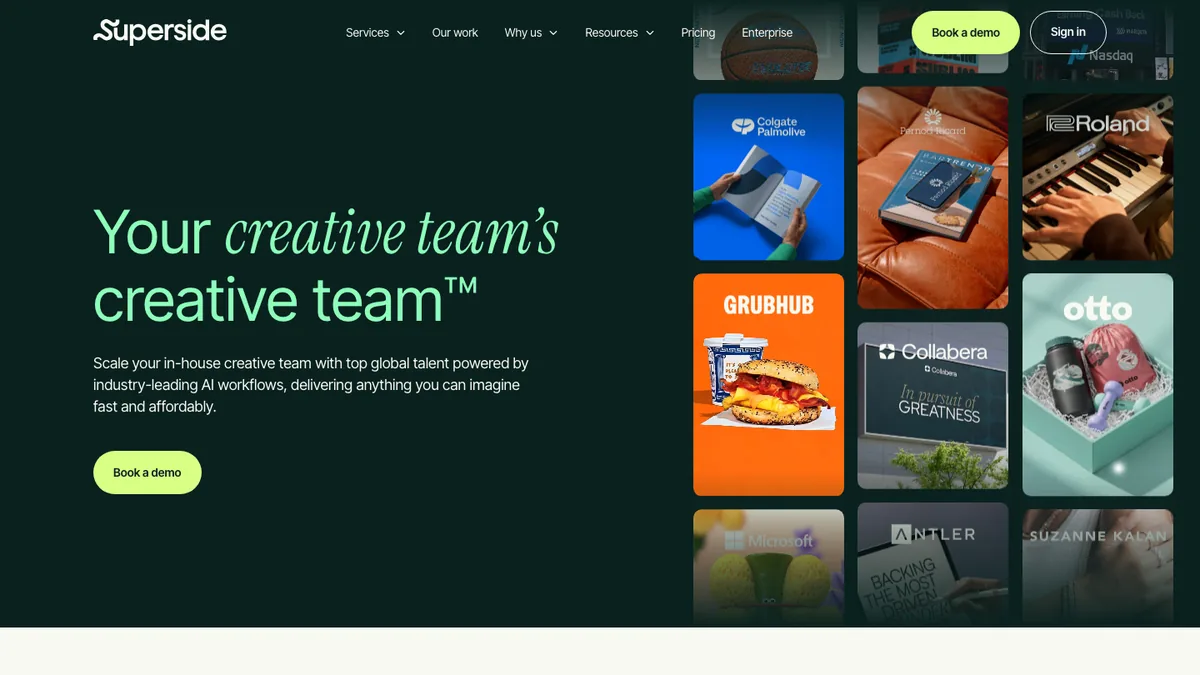
Best for: Enterprise teams buying creative at volume across disciplines.
Superside isn't a video studio — it's a globally distributed creative company covering design, brand, ad creative, and video under one subscription. For large organisations, that consolidation is the appeal: one vendor, one contract, one process, across creative functions that would otherwise mean managing five suppliers.
Pricing sits at the enterprise end. Reported figures vary across sources, but the Flex plan starts around $15,000 per month on an annual term, with dedicated-team plans materially higher. In exchange you get scale, a managed process, and the ability to turn creative around quickly across formats.
For a company already running significant paid media and needing constant creative refresh, the maths works. Superside is built for volume and consistency rather than for a single career-defining piece of film.
Who it's less suited for: Better suited to organisations consolidating multiple creative disciplines than to teams testing whether video works for them — the commitment is significant both financially and contractually. And because video sits alongside several other disciplines, you're buying breadth rather than the concentrated specialisation a dedicated studio offers. Complex technical products in particular tend to need more product immersion than a broad creative partner is structured to provide.
4. Demo Duck
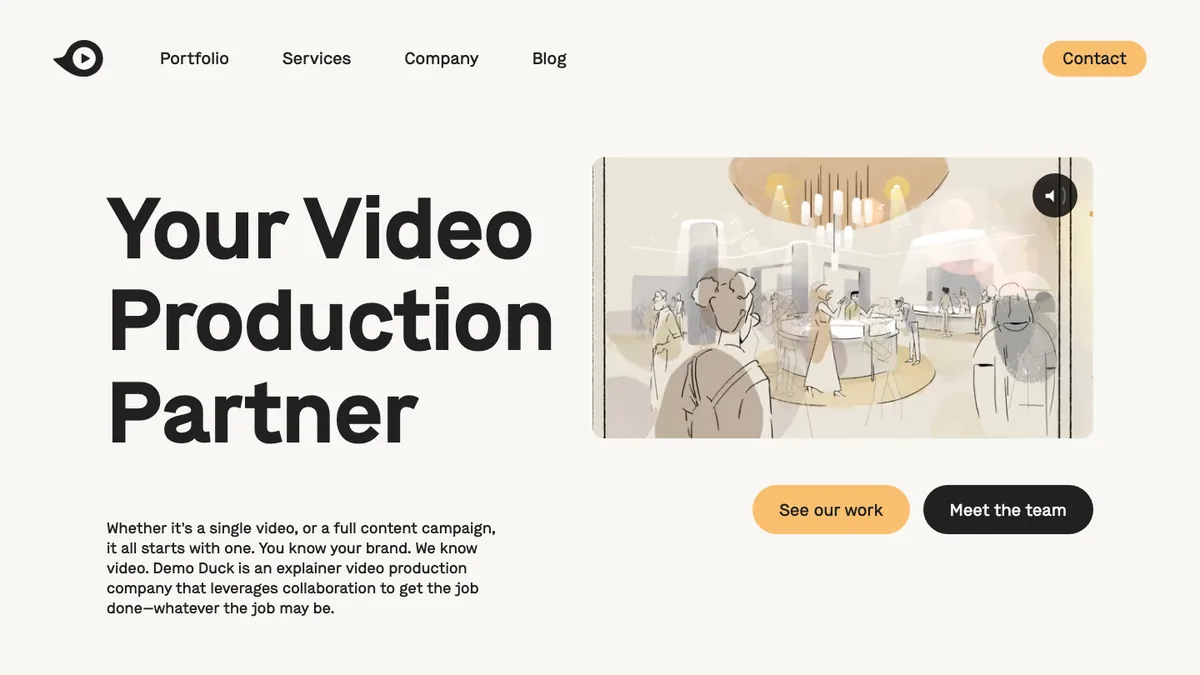
Best for: Companies wanting a high-production custom explainer with real creative range.
Demo Duck is a Chicago studio with a portfolio spanning startups to Fortune 500 — work for Netflix, Google, and Geico among them. The studio moves comfortably between animation and live-action, which makes it a genuine creative partner rather than a single-format shop.
The work is consistently strong, and the range is the differentiator. If your video programme needs an animated explainer this quarter and a live-action customer film the next, Demo Duck can do both without you re-sourcing.
Pricing reporting varies. Some sources place projects in the $8,000–$20,000 band; others report custom projects starting around $25,000 with six-to-ten-week timelines. The spread likely reflects the range of formats, so treat it as an indication and scope directly.
Who it's less suited for: Better suited to teams planning a quarter ahead than to those working against a tight launch date — timelines run longer than much of this list, and a deadline eight weeks out may not clear. The spread in reported pricing also means you'll want a firm quote early rather than a ballpark.
5. Wyzowl
Best for: Teams that need budget certainty above all.
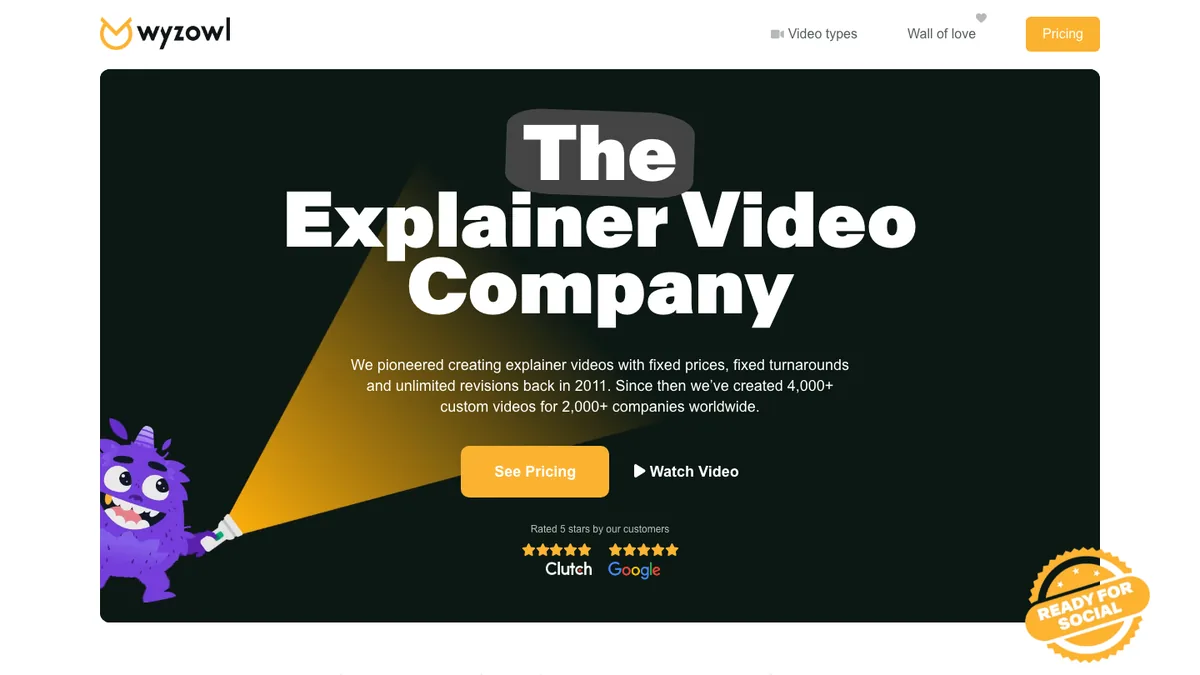
Wyzowl pioneered fixed-price explainer production in 2011, and the model has held up. The studio reports over 4,000 videos for more than 2,000 companies across 40 countries, with clients including Amazon, PayPal, Slack, HSBC, and Deloitte. Packages run from roughly $2,500 to $9,000 per video.
That combination — a published price, a defined scope, and a very large body of completed work — makes Wyzowl the lowest-risk option here. You know what you're paying and roughly what you'll get. For a team that needs to get a competent explainer live without a procurement cycle, it's hard to argue against.
Who it's less suited for: Better suited to teams who value predictable scope and price than to those wanting bespoke creative. The model is built for repeatable quality, so if your product needs an unusual narrative approach or your brand demands a distinctive visual language, the package structure will constrain what's possible.
6. Broadcast2World
Best for: Animated storytelling on mid-range budgets.
Established in 2010 and headquartered in Piscataway, New Jersey, Broadcast2World has built a serious enterprise client base — Siemens, Fujitsu, Lenovo, Cognizant, and McAfee among them — while keeping pricing accessible at roughly $2,400 to $4,800 for a 60-second video.
That combination is genuinely unusual. Most studios with that client list price well above it, and the gap is worth understanding before you assume it signals lower quality. B2W runs a story-led animation process refined across a very large portfolio, and the efficiency comes from a mature production system rather than from cutting the work short.
The consistency is the real evidence. Enterprise clients like Siemens and McAfee don't return to a studio that produces occasional highlights, and B2W's body of work holds a steady standard across hundreds of pieces. For a marketing team that needs dependable animated explainers at a defensible price — particularly one that has to justify the spend internally — it's one of the strongest value propositions on this list.
Who it's less suited for: Better suited to animation-led programmes than to those built on customer testimonials or founder-led film — the live-action offering is lighter, and you'd likely need a second partner for it. The efficient, volume-oriented process also means less bespoke creative exploration than a boutique studio will offer.
7. Explainify
Best for: Animation-first simplification of complex software.
Explainify has focused since 2012 on one thing: turning complicated B2B ideas into clear animated video. The team has produced close to 1,000 custom animations for clients ranging from startups to Fortune 500 companies.
The narrowness is the strength. Explainify has solved the "how do we make this understandable" problem repeatedly across more than a decade, and that accumulated pattern recognition is worth a great deal when your product is genuinely hard to describe. Studios that do everything have to rediscover the answer each time; studios that do one thing develop instincts about it.
That shows up most in scripting. The hardest part of an explainer is deciding what to leave out, and it's where inexperienced teams fail — they try to cover the product rather than land one idea. Explainify's work is consistently disciplined about scope, which is why it holds up for genuinely complex software rather than only for simple propositions.
Who it's less suited for: Better suited to teams who know they want animation than to those building a multi-format programme. If your strategy needs live-action, testimonials, or event content alongside animated work, you're buying one piece of it and will need to source the rest elsewhere.
8. Yum Yum Videos
Best for: Story-driven animation for startups and growing SaaS companies.
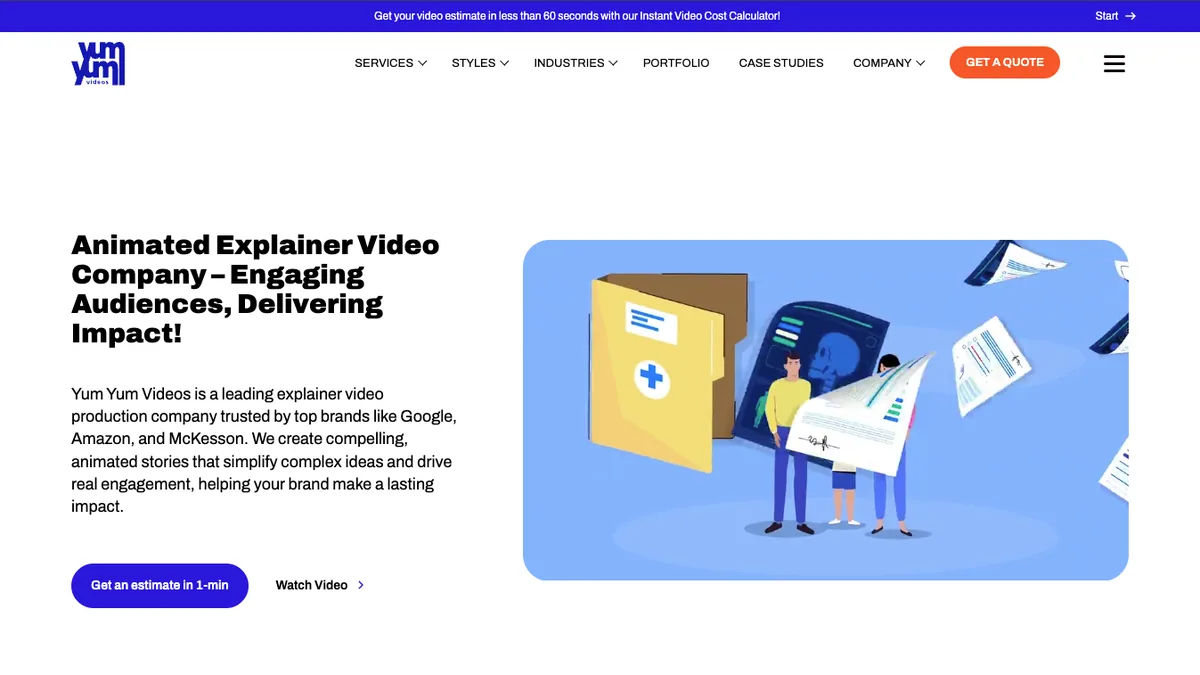
Yum Yum Videos has built a strong reputation for animated explainers that lead with narrative, and a client list that includes Amazon, Google, McKesson, FOX, Roblox, Walmart, American Express, and Huawei.
The work performs particularly well in awareness-stage placements, where the job is to make someone care in the first few seconds rather than to walk them through a feature set. The studio's animation carries more personality than most B2B work, which matters when your video has to survive a social feed rather than a landing page.
For startups, there's a practical argument too. Early-stage companies often need a video that does several jobs at once — explains the product, signals credibility to investors, and gives the founder something to send. Yum Yum's story-first approach tends to produce pieces that travel well across those contexts rather than being narrowly optimised for one.
Who it's less suited for: Better suited to products that benefit from brand personality than to deeply technical ones — the portfolio spans many industries rather than concentrating in technical B2B. For a security or infrastructure product where the buyer is an engineer, a specialist will likely reach a working script faster, and the brand-forward style can read as too consumer for some enterprise audiences.
9. Content Beta
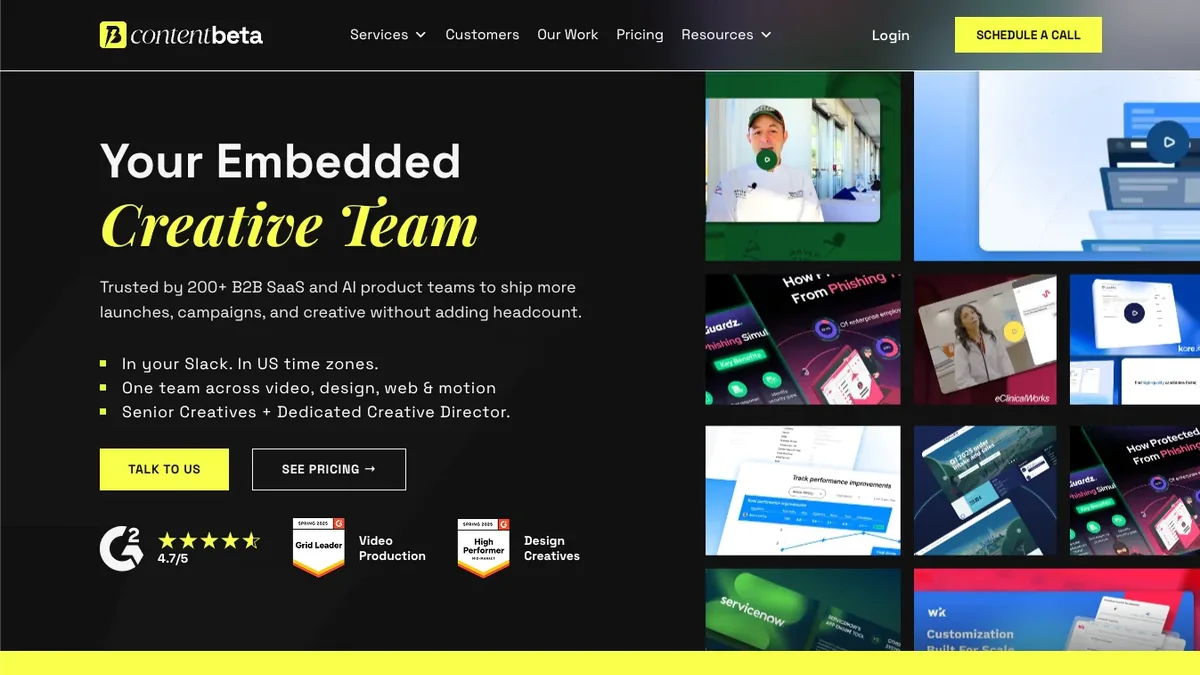
Best for: SaaS teams needing content velocity across formats.
Content Beta runs a creative-as-a-service model built specifically for SaaS — video, motion, and design delivered on subscription. The proposition is throughput: a steady stream of product videos, demos, feature announcements, and social cuts without re-briefing an agency each time.
That fits a particular and increasingly common problem. Product-led SaaS companies ship constantly, and every release needs supporting creative. Handling that through project-based agencies means perpetual scoping overhead; handling it in-house means hiring a video team before the volume justifies one. A subscription sits between the two.
The company also publishes extensively on B2B video — comparison guides, format breakdowns, agency roundups — which is a reasonable proxy for how seriously it takes the category. Teams that write this much about a discipline tend to have opinions about it, and opinions are what you're buying when you hire creative.
Who it's less suited for: Better suited to teams with continuous demand than to those commissioning a single flagship piece — subscription creative optimises for volume and consistency, and a project studio will usually go further on one ambitious video. The model also assumes enough steady throughput to justify the retainer.
10. MyPromoVideos
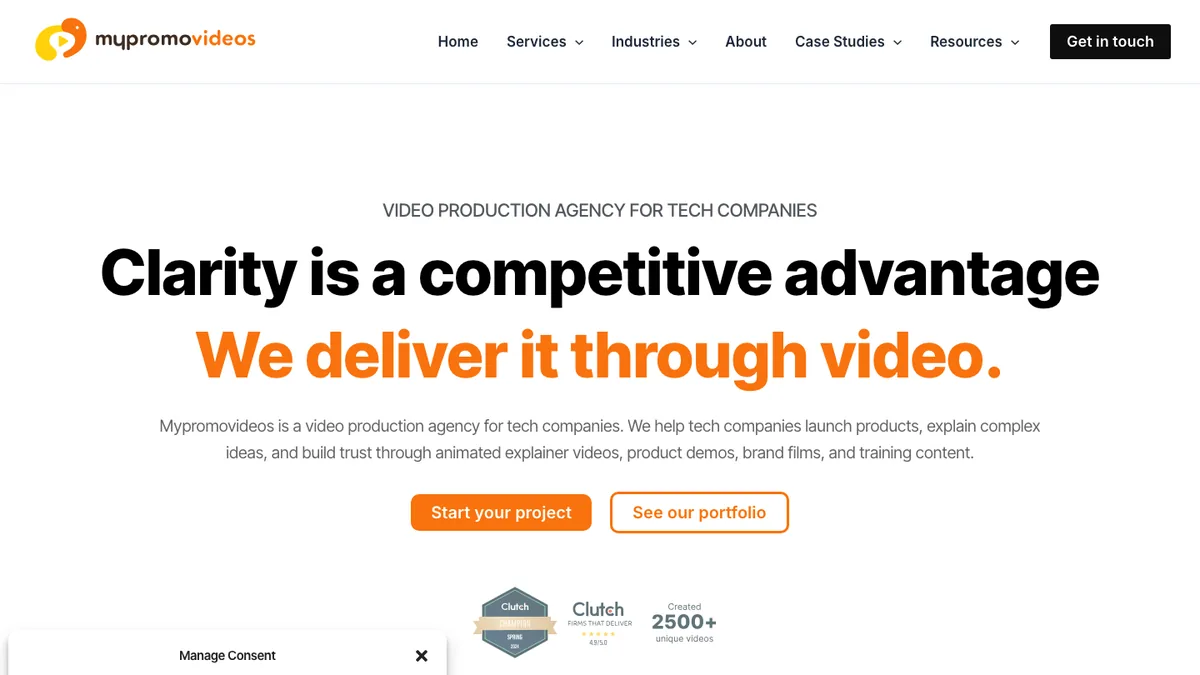
Best for: B2B tech companies wanting a long track record at volume.
MyPromoVideos reports more than 2,000 B2B videos, a 4.9 Clutch rating, and around 15 years working with B2B tech across SaaS, fintech, and enterprise technology. That's a substantial record, and the Clutch rating is third-party evidence rather than a self-reported claim — worth weighting accordingly, since most of what agencies say about themselves isn't verifiable.
For a buyer whose primary concern is reliability, the track record answers the question directly. Fifteen years and two thousand videos means the failure modes are known and the process has been stress-tested against the usual problems: stakeholders who change their minds at round three, product teams who ship a redesign mid-project, launch dates that move.
That matters more than it sounds. A great deal of what goes wrong in video production isn't creative — it's operational, and experience is the only reliable defence against it.
Who it's less suited for: Better suited to teams prioritising reliability across a broad B2B remit than to those needing deep fluency in one category. Broad experience means fewer operational surprises; it also means less of the specialist's instinct for an unusually complex product. If your category carries its own vocabulary and buyer psychology, expect a longer ramp.
Honorable Mentions
- Levitate Media — Serves B2B and B2C across technology, SaaS, healthcare, manufacturing, and finance. Worth a look if your needs span both sides.
- Lemonlight — Strong for high-volume, fast-turnaround branded video, particularly social-first formats.
- SoCreative — A solid mid-market option for B2B teams wanting production and strategy together.
- Knowlify — Document-to-video automation. Not an agency, but genuinely useful when you need volume fast and cheap and can accept templated output.
Which B2B Video Production Company Is Best For You?
Your product is complex and technical. Go specialist. Apollo Studio, Explainify, or Demo Duck. The constraint isn't production quality — it's whether the team can understand your product well enough to explain it, and that's a different skill.
You need continuous video across formats. Vidico or Content Beta. Subscription economics work in your favour once you're producing consistently, and the accumulated product understanding compounds.
You have a fixed budget and need certainty. Wyzowl or Broadcast2World. Both publish pricing, both have large completed portfolios, and neither will surprise you at invoice.
You're an enterprise buying creative at scale. Superside. The consolidation argument is real once you're managing multiple creative disciplines.
You're a startup needing one strong top-of-funnel piece. Yum Yum Videos or Broadcast2World. Good storytelling at a price that won't consume the quarter's budget.
You need it live in three weeks. Apollo Studio's stated turnaround is the fastest on this list for genuinely custom work. Confirm the schedule before you commit.
Find the Right Video Partner by Industry
SaaS. The challenge is showing the product working without turning the video into a manual. Look for studios with real product-video portfolios, not just brand films.
AI. The hardest category to explain, because the product is often abstract and the category is saturated with claims. Prioritise narrative ability over visual spectacle.
Fintech. Compliance constrains what you can say. You need a partner comfortable working inside review cycles without losing the story.
Cybersecurity. Your buyer is technical and allergic to marketing language. Specialisation matters more here than in any other category — a studio that has made security videos before will skip weeks of education.
Healthcare. Regulatory review and clinical accuracy shape everything. Look for demonstrated experience with the approval process, not just healthcare-adjacent visuals.
How Much Does B2B Video Production Cost in 2026?
Across this market, expect roughly:
- $2,500–$5,000 — Fixed-package explainers and short animated pieces. Defined scope, proven process, limited customisation.
- $8,000–$25,000 — Custom mid-market production. Bespoke script, original animation or live-action, real creative direction. Most serious B2B explainer and product video work lands here.
- $5,000–$15,000+ per month — Subscription models. Sensible when you're producing continuously; wasteful when you aren't.
- $25,000–$100,000+ — Enterprise and flagship production. Multi-format campaigns, significant live-action, or launch films carrying real commercial weight.
Factors That Influence Video Production Pricing
Length and complexity. A 60-second animated explainer and a three-minute product walkthrough are different orders of work, and complexity drives cost harder than duration.
Animation versus live-action. Live-action carries crew, location, and talent costs. Animation front-loads effort into design and motion. Neither is reliably cheaper — it depends on the piece.
Custom versus templated. Bespoke illustration and original motion design cost significantly more than library assets, and look significantly better.
Revision rounds. Check what's included. Unlimited revisions sound generous and often signal a process that expects to miss.
Strategy and scripting. Some studios include discovery and scripting; others treat it as a separate line. This is where most of the value in a B2B video actually sits, so find out early.
Turnaround. Compressed timelines usually carry a premium — though studios structured for speed, like Apollo, price it as standard rather than as a rush fee.
Final Thoughts
The B2B video market has split. At one end, AI tools and templated services have made competent video nearly free. At the other, a small number of studios are charging more than ever for work that is genuinely crafted.
The middle is disappearing, and that's the useful signal for buyers. If your product is straightforward and you need volume, the cheap end now works well enough — use it. If your product is complex and your buyer is technical, the differentiator isn't production value. It's whether anyone on the team understands your product well enough to make it make sense.
Rank your shortlist on that. Watch three full videos from each studio — not the reel — and ask yourself whether you understood the product at the end. That single test will tell you more than any pricing page.
Frequently Asked Questions
A B2B video production company plans, scripts, produces, and edits video specifically for business-to-business audiences. That typically covers explainer videos, product demos, launch films, customer testimonials, and paid social ads. The main difference from general video production is the audience: B2B buyers are usually evaluating a considered purchase, often technical, and frequently as part of a buying committee.
Most B2B video production costs between $2,500 and $25,000 per video in 2026. Fixed-package explainers start around $2,500, custom mid-market production runs $8,000 to $25,000, and enterprise or flagship work exceeds $25,000. Subscription models typically start around $5,000 per month.
Typical timelines run four to ten weeks from brief to delivery. Faster studios ship custom work in about three weeks, and post-production-only projects can complete in roughly a week. Timelines depend most on how many stakeholders review the script.
An explainer introduces what your product does and why it matters, usually in under 90 seconds, for top-of-funnel audiences. A product video shows the software actually working and serves buyers who are already evaluating. A launch video announces a release and is built for momentum and reach rather than explanation.
Hire a specialist when your product is complex or technical, because the hard part is comprehension rather than production. Hire a generalist when your offering is easy to explain and you need range across formats and audiences.
Animation is better for explaining abstract or technical concepts, showing software interfaces, and controlling a message precisely. Live-action is better for trust and proof — customer testimonials, founder stories, and culture content. Most mature B2B video programmes use both.
Bring a clear goal for the video, a defined audience, your top three messages, examples of work you like and dislike, brand assets, and your internal review process. The last one matters most: unclear approval chains are the single most common cause of delay.
No. Most B2B teams get the best return from two: a top-of-funnel explainer that earns attention, and a product video that helps buyers evaluate. Add customer stories once you have referenceable clients and results worth showing.
Track completion rate first — it tells you whether the video works at all. Then measure the downstream action: demo requests, landing page conversion, sales cycle length, and whether your sales team actually uses it. A video the sales team sends unprompted is usually the strongest signal.
AI tools can produce competent video quickly and cheaply, and for high-volume, low-stakes content they increasingly make sense. What they don't yet replace is the strategic work — understanding a complex product, finding the narrative that makes it click, and making a distinctive creative choice. As AI raises the baseline, genuine craft becomes more valuable, not less.