Best Explainer Video Production Companies in 2026

Key Takeaways
- Explainify — Best for pure simplification of complex ideas
- Apollo Studio — Best for complex B2B tech products
- Sandwich Video — Best for live-action tech explainers
- Digital Brew — Best for award-winning production across formats
- Wyzowl — Best for fixed-price certainty
- Kasra Design — Best for enterprise-grade animation
- Yum Yum Videos — Best for story-driven animation
- Broadcast2World — Best for mid-budget animated storytelling
- MotionGility — Best for volume across global enterprise
- Hound Studio — Best for cost-effective animation at scale
Nobody has ever closed an explainer video because the animation wasn't good enough.
They close it because forty seconds in, they still don't know what the product does. The animation was fine. The voiceover was warm and professional. The problem was upstream of all of it, in a script that tried to describe the entire product instead of landing one idea.
This is the part of explainer video production that almost no buyer evaluates, and it's the part that decides whether the video works. Most agency shortlists get built by comparing showreels — which is comparing the last ten percent of the process while ignoring the first ninety.
So this guide ranks explainer video companies on scripting first. What each one is genuinely good at, what it costs, and who it actually suits.
How We Ranked These Companies (Methodology)
We ranked for companies whose product is hard to explain — not for buyers wanting the most visually elaborate animation. If your product is simple and you want something beautiful, weight these criteria differently, because ours start from comprehension.
Scripting and narrative discipline
Weighted heaviest, and it's the criterion almost no other list uses. We looked for evidence of restraint: videos that land one idea rather than touring a feature set, that establish a problem before naming a product, and that know which forty seconds to cut. This is visible in the work if you watch full videos rather than reels — and it's the single strongest predictor of whether an explainer performs.
Animation craft and format range
2D, 3D, live-action, and mixed. Range matters because the right format depends on what you're explaining, and a studio locked into one style will use it whether or not it fits. We credited technical quality, but weighted whether the craft serves comprehension over whether it's impressive in isolation.
Track record in explainers specifically
Not general video volume — explainers. A studio that has made 1,000 explainers has encountered most of the ways they fail. That accumulated pattern recognition is worth more than a broad portfolio of unrelated video work.
Pricing transparency
Some publish rates, most don't. We didn't penalise custom quoting, but we credited studios that make cost knowable before a sales call, since opaque pricing is the most common friction in buying video.
Independent reviews
Clutch profiles in this category are unusually substantive — Digital Brew carries 16 reviews, Kasra Design 21 — so this criterion carries more weight here than on a broader video list. Where a studio has a verifiable third-party record, we weighted it.
The Best Explainer Video Companies Compared
| Company | Best For | Style | Pricing | Better Suited For… Than… |
|---|---|---|---|---|
| Explainify | Pure simplification | Animation | Custom | Complex concepts, than multi-format programmes |
| Apollo Studio | Complex B2B tech | Animation + live-action | Project-based | Complex B2B tech explainers, than consumer or corporate work |
| Sandwich Video | Live-action tech | Live-action | Premium | Founder-led storytelling, than constrained budgets |
| Digital Brew | Award-winning range | 2D, 3D, live-action | Custom | Broad format range, than niche B2B specialisation |
| Wyzowl | Fixed-price certainty | Animation | $2,500–$9,000 | Predictable scope, than bespoke creative |
| Kasra Design | Enterprise animation | 2D, 3D | Custom | Global enterprise brands, than fast-moving startups |
| Yum Yum Videos | Story-driven animation | Animation | Custom | Brand personality, than deeply technical products |
| Broadcast2World | Mid-budget storytelling | Animation | ~$2,400–$4,800 / 60s | Animation-led work, than live-action programmes |
| MotionGility | Enterprise volume | Animation | Custom | High-volume needs, than boutique creative attention |
| Hound Studio | Cost-effective scale | Animation | Custom | Budget-conscious volume, than premium bespoke work |
The 10 Best Explainer Video Production Companies in 2026
1. Explainify
Best for: Products that are genuinely difficult to describe.
Explainify has done one thing since 2012: turn complicated B2B ideas into clear animated video. Close to 1,000 custom animations later, for clients ranging from startups to Fortune 500 companies, it remains the clearest benchmark for the criterion this list weights most heavily.
The discipline shows in the scripting. The hardest decision in any explainer is what to leave out, and it's where most teams fail — they try to cover the product rather than land one idea, and the result is a video that technically explains everything while communicating nothing. Explainify is consistently ruthless about scope. Watch several of their videos in a row and the pattern is obvious: one problem, one insight, one reason to care, and out.
Thirteen years on a single problem also means the team has seen most of the ways an explainer goes wrong — the metaphor that confuses more than it clarifies, the opening that assumes the viewer already knows the category, the script that becomes a feature tour by the second act. Avoiding known failure modes is underrated, and it's most of what you buy from a long-running specialist.
Who it's less suited for: Better suited to teams committed to animation than to those building a multi-format programme. If your plan needs live-action, testimonials, or founder content alongside animated work, you're buying one component and sourcing the rest elsewhere.
2. Apollo Studio
Best for: B2B tech companies where comprehension is the bottleneck.
Apollo works exclusively with B2B tech — SaaS, AI, fintech, cybersecurity, healthcare — and takes the same story-first position this list ranks on: visuals without narrative are decoration, and decoration doesn't survive a shortlist.
The portfolio backs it in the hard cases. Apollo has produced explainers for Mural, Anvilogic in security operations, Cypris AI for R&D teams, and Mindsmith — products where the buyer is technical and the category is crowded. The Cypris work is described as making AI for R&D teams click fast in a top-of-funnel cut, which is precisely the scope discipline this ranking rewards.
Motion design is produced in-house rather than outsourced to a production mill, unusual at this size and visible in the consistency across the work. Apollo also shoots live-action with real founders and customers, deliberately positioned against the drift toward AI avatars. Turnaround is fast — roughly a week for post, three for full productions.
Who it's less suited for: Better suited to B2B tech products where comprehension is the bottleneck than to consumer or general corporate work, which is where a broader-format studio fits better.
3. Sandwich Video
Best for: Live-action tech explainers with genuine personality.
Sandwich, founded by Adam Lisagor, effectively invented the modern live-action tech explainer — the format where a founder walks through a beautifully lit office explaining the product with self-aware humour. Slack, Notarize, and IPSY are among the brands whose early identity was shaped by it.
The reason it earns a place on a scripting-first list is that the writing is the product. Sandwich videos work because they're genuinely funny and genuinely clear, in that order, and the comic timing is doing the comprehension work rather than decorating it. Very few studios can write that way.
Who it's less suited for: Better suited to founder-led storytelling with real budget than to constrained ones — reported figures put serious Sandwich projects well into six figures, which rules it out for most companies. The live-action approach also assumes you have a founder or team comfortable carrying a video.
4. Digital Brew
Best for: Buyers wanting award-winning production with format flexibility.
Founded in 2011 and based in Orlando, Digital Brew is a multi-Emmy-winning studio working across 2D, 3D, and live-action. That range is the differentiator: rather than fitting your product to a house style, the studio picks a format for the brief.
The Emmy record and a substantive Clutch profile with 16 reviews make it one of the more independently verifiable options here — worth weighting if you're the person who has to justify the choice internally.
Format flexibility matters more than it sounds for explainers specifically. A studio that only animates will animate your product story whether or not animation is the right call, and the same is true in reverse. Digital Brew's ability to recommend live-action for a founder-led piece and 3D for a technical mechanism means the format decision gets made on merit rather than on what the studio happens to sell.
Who it's less suited for: Better suited to buyers wanting broad format range than to those needing deep B2B or SaaS specialisation. The portfolio spans many sectors, so for a highly technical product expect more onboarding than a category specialist would need.
5. Wyzowl
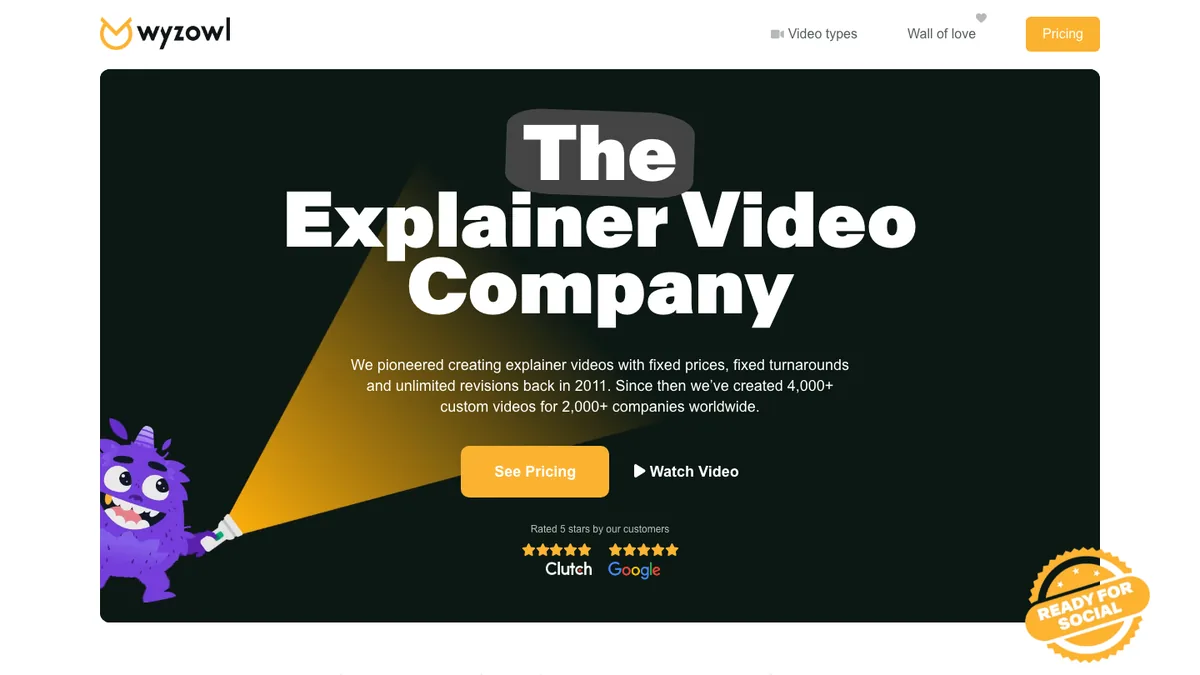
Best for: Teams that need to know the price before they start.
Wyzowl pioneered fixed-price explainer production in 2011 and reports over 4,000 videos for more than 2,000 companies across 40 countries, with clients including Amazon, PayPal, Slack, HSBC, and Deloitte. Packages run roughly $2,500 to $9,000.
On our transparency criterion, it scores highest here by some distance. You know the cost and the scope before a sales call, which removes the friction that stalls most video purchases. The enormous volume also means the process is heavily systematised — and systematised processes hold up when your side of the project slips, which it usually does.
Who it's less suited for: Better suited to teams valuing predictable scope than to those wanting bespoke creative. Fixed packages are built for repeatable quality, so an unusual narrative approach or a distinctive visual language will strain the model.
6. Kasra Design
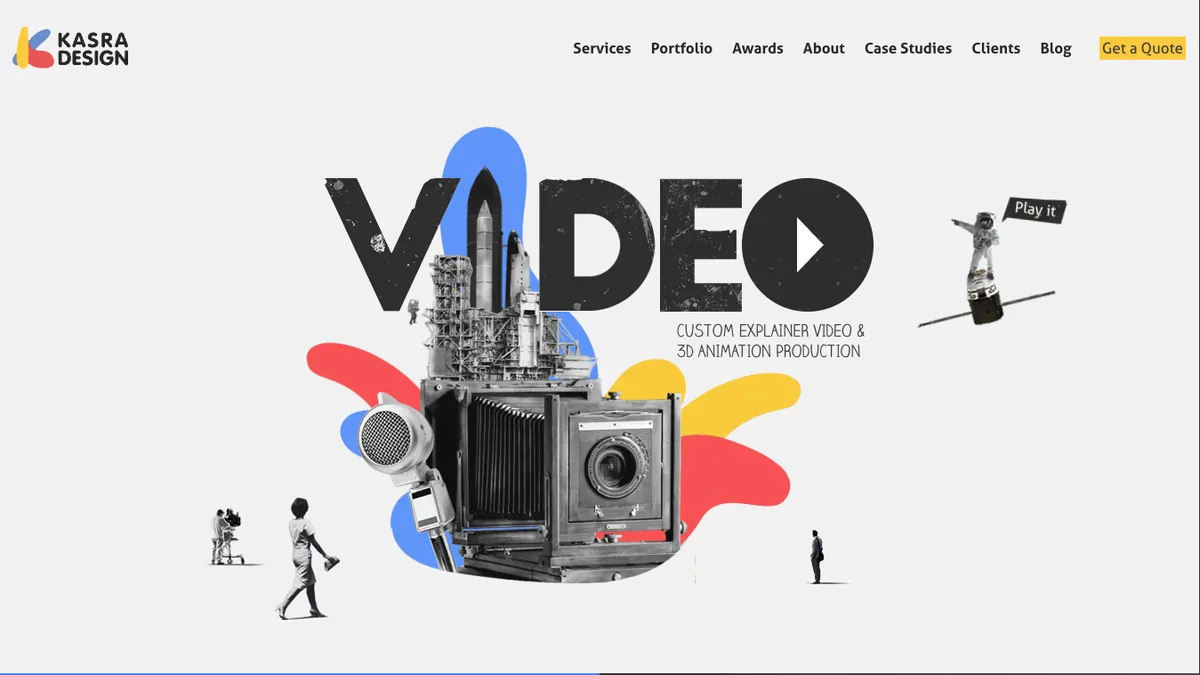
Best for: Enterprise brands needing animation that meets global standards.
Founded in 2011 with offices in Malaysia, Singapore, and the US, Kasra Design has produced over 700 commercial videos for a genuinely blue-chip client list — Visa, Shell, HP, Intel, Prudential, Commonwealth Bank of Australia, IATA, and Petronas among them.
That roster is the signal. Enterprises with strict brand governance don't return to studios that can't hold a standard across markets and review cycles, and Kasra's 2D and 3D work is consistently precise. A Clutch profile with 21 reviews adds independent weight.
The multi-region footprint is a practical advantage for the buyers this suits. A company explaining the same product across Asia, Europe, and North America needs consistency in tone as well as visuals, and a studio operating across those markets handles localisation as part of the process rather than as an afterthought bolted on at the end.
Who it's less suited for: Better suited to global enterprise brands than to fast-moving startups. The process is built for organisations with formal review structures, which can feel heavy if you need something shipped in three weeks.
7. Yum Yum Videos
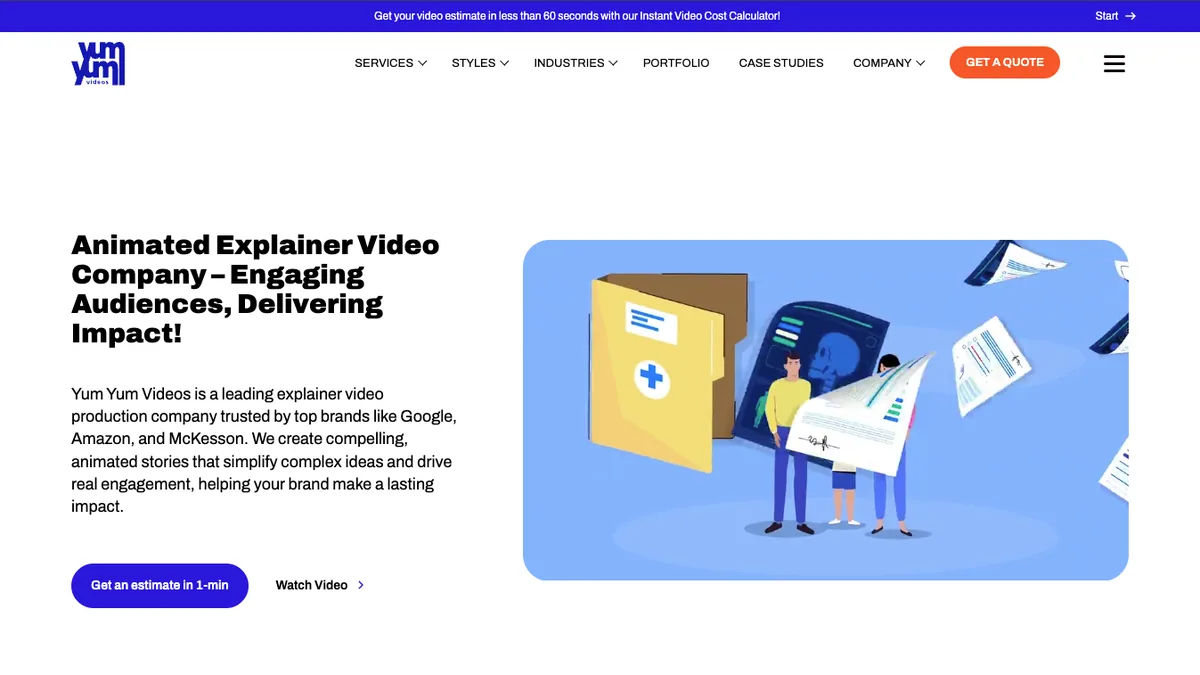
Best for: Explainers that need personality as much as clarity.
Yum Yum Videos has a strong reputation for narrative-led animated explainers, with clients including Amazon, Google, McKesson, FOX, Roblox, Walmart, American Express, and Huawei.
The work performs well where the job is making someone care in the first few seconds rather than walking them through functionality. The animation carries more character than most B2B explainer work, which matters when the video has to survive a social feed rather than sit on a landing page with a captive viewer.
There's a scripting argument for this too. Personality is a comprehension tool, not just decoration — a viewer who is entertained stays past the eight-second mark, and staying is a precondition for understanding anything. Studios that treat charm and clarity as competing goals tend to produce videos that achieve neither.
Who it's less suited for: Better suited to products helped by brand personality than to deeply technical ones. For infrastructure or developer tools where the buyer is an engineer, a specialist will reach a working script faster.
8. Broadcast2World
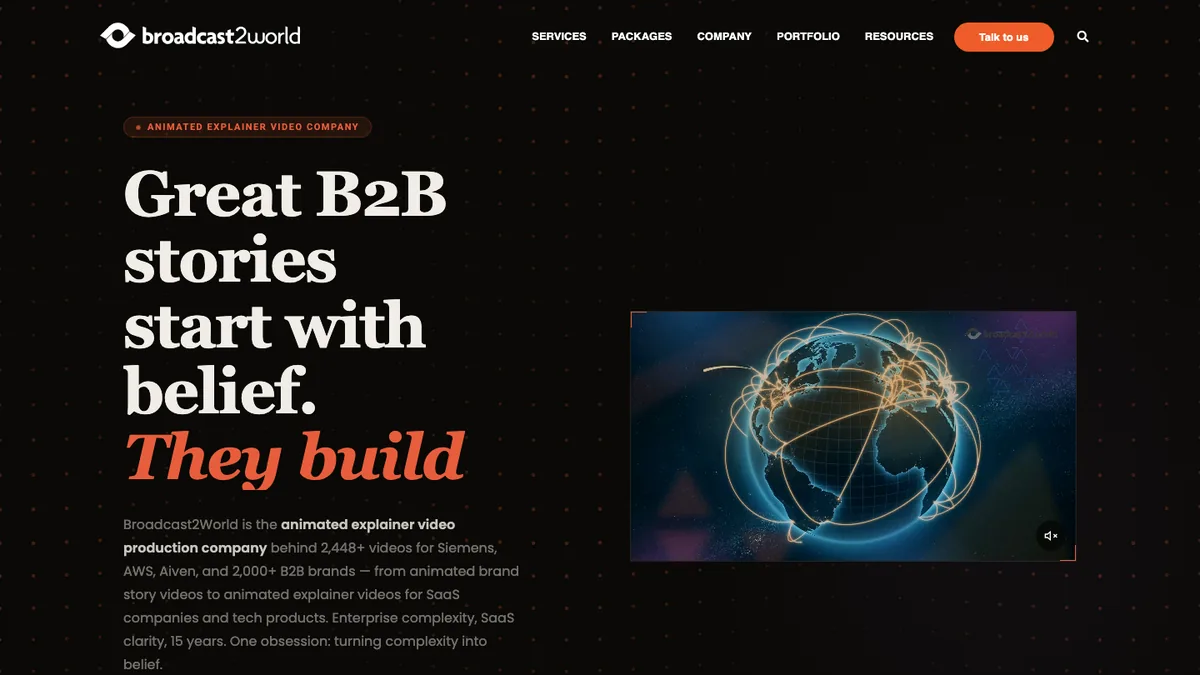
Best for: Story-led animation at a mid-range price.
Established in 2010 and headquartered in Piscataway, New Jersey, Broadcast2World has built an enterprise client base — Siemens, Fujitsu, Lenovo, Cognizant, and McAfee — while keeping pricing at roughly $2,400 to $4,800 for a 60-second video.
That combination is unusual. Most studios with that client list price well above it, and the efficiency comes from a mature production system rather than from cutting the work short. B2W's approach is explicitly story-led, which fits this list's ranking axis, and the consistency across a large portfolio suggests process rather than luck.
Who it's less suited for: Better suited to animation-led programmes than to those built on live-action or testimonials — the live-action offering is lighter. The volume-oriented process also means less bespoke creative exploration than a boutique studio offers.
9. MotionGility
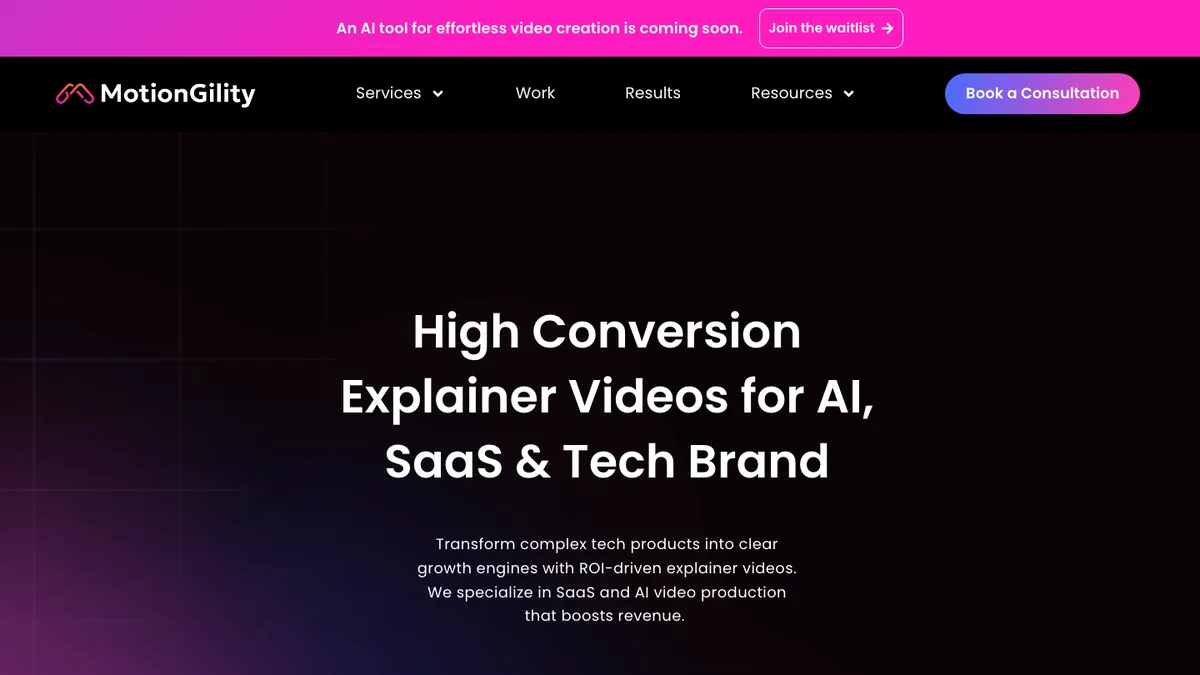
Best for: Companies needing explainer volume across international markets.
With offices in Pennsylvania and Indore, MotionGility reports over 1,000 pieces of motion content delivered to more than 500 clients across roughly eight years, including ADNOC, Nissan, Pfizer, HDFC, and Porsche.
The appeal is throughput at enterprise standard. For an organisation needing explainers across multiple products, regions, or languages, a studio structured for volume will move faster and cost less per video than a boutique taking each project as a bespoke engagement.
The client mix is worth noting because it spans very different sectors — energy, automotive, pharmaceutical, and financial services all appear on it. That breadth suggests a process built to absorb unfamiliar subject matter quickly, which is the relevant capability when you're commissioning eight explainers rather than one and can't afford a long education phase on each.
Who it's less suited for: Better suited to high-volume requirements than to boutique creative attention. If you want one exceptional video with deep creative exploration, a smaller studio will give the brief more individual thought.
10. Hound Studio
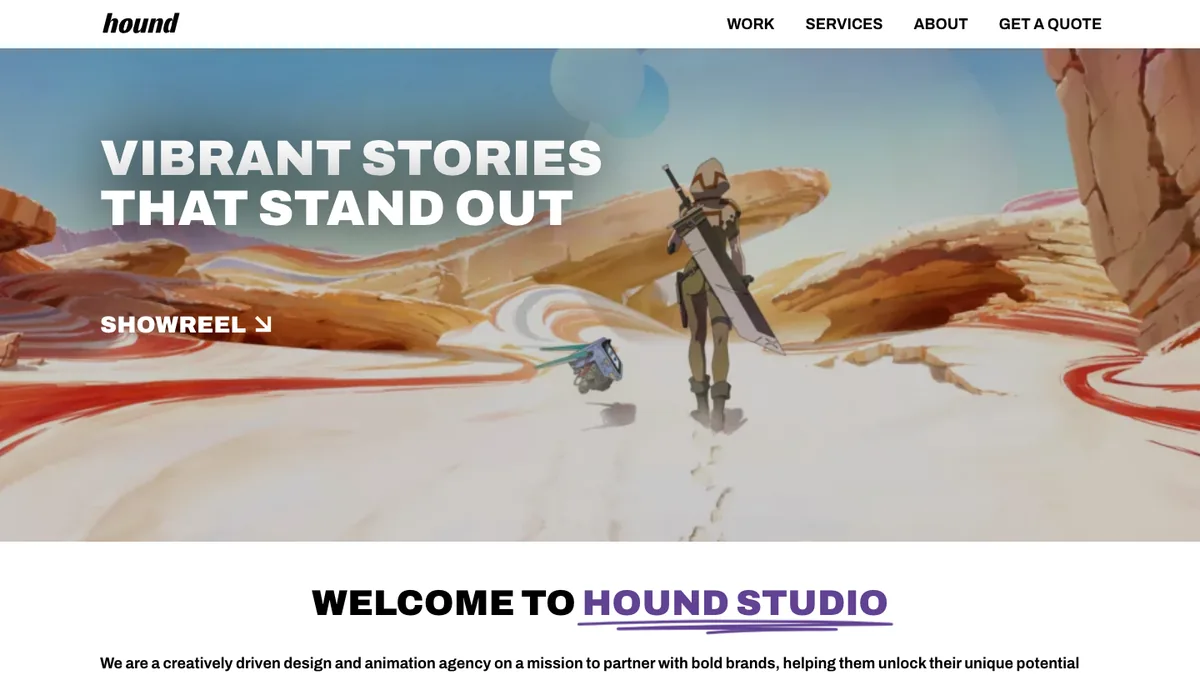
Best for: Cost-effective animated explainers at scale.
Based in Ukraine and serving clients worldwide, Hound Studio has more than a decade of explainer production behind it and over 500 animated videos delivered.
The value proposition is straightforward: solid animated explainer work at rates below most US and UK studios, with enough tenure that the process is proven. For companies that need several videos and are optimising for cost per output rather than for a single flagship piece, it's a sensible option.
The decade of operation matters here more than the price. Plenty of studios compete on cost; far fewer sustain it long enough to build a repeatable process, and the ones that don't tend to disappear mid-project. Hound's longevity is the reassurance that makes the pricing worth taking seriously rather than treating as a warning sign.
Who it's less suited for: Better suited to budget-conscious volume than to premium bespoke production. There's less published client detail and pricing information than for others here, so expect to do more diligence — and timezone differences can slow real-time collaboration for US teams.
Honorable Mentions
- Vidico — Strong explainer offering within a broader SaaS video practice; worth considering if you need more than explainers.
- Demo Duck — Chicago studio with real creative range across animation and live-action, and work for Netflix and Google.
- Epipheo — One of the original explainer studios, with a long track record in concept-led animation.
- Yans Media — Consistently well-regarded for animated explainers at mid-market pricing.
Animated or Live-Action: Which Explainer Should You Make?
This is the first real decision, and most teams make it by preference rather than by fit.
Choose animation when your product is abstract, your interface is the hero, or the concept doesn't exist physically. Animation gives precise message control, lets you show things that can't be filmed, and works when your product isn't finished yet. It's the default for software, and for good reason.
Choose live-action when trust is the barrier rather than comprehension. A founder on camera, a customer describing a result, a real team in a real office — these carry credibility no animation can manufacture. Live-action also wins for physical products and for brands whose personality is the differentiator.
Choose mixed when you need both, which is increasingly common in B2B. Live-action for the human framing, animated sequences for the product and the data. Most sophisticated B2B explainers now do this.
On cost: neither is reliably cheaper. Live-action carries crew, location, and talent; animation front-loads into design and motion. A simple animated explainer costs less than a produced live-action shoot, but a complex 3D animation costs more than a straightforward interview setup. Decide on fit, then budget.
What Actually Makes an Explainer Video Work
Four things, in order of how often they're the problem.
It survives the first eight seconds. Most viewers leave before ten. That means the opening cannot be a logo, a slow zoom, or a scene-setting line about how the modern workplace is changing. It has to name a problem the viewer recognises immediately.
It lands one idea, not the feature list. The most common failure in B2B explainers is scope. Six features explained adequately is worse than one explained memorably, because the viewer remembers nothing from the first version and one thing from the second. One thing is enough to book a demo.
It establishes the problem before the product. Viewers can't evaluate a solution to a problem they haven't been reminded they have. Videos that open with what the product does — rather than why anyone needs it — consistently underperform, even when everything downstream is excellent.
It's written for someone specific. Explainers aimed at "businesses" persuade nobody. The ones that work sound like they were written for one person with one problem, and that specificity is what makes a stranger feel recognised.
Notice that none of these are animation problems. They're all script problems — which is why we ranked this list the way we did.
Which Explainer Video Company Is Best For You?
Your product is complex or technical. Explainify or Apollo Studio. Comprehension is the bottleneck, and that's a specialisation question rather than a production one.
You need budget certainty. Wyzowl or Broadcast2World. Both publish pricing, both have very large completed portfolios.
You're an enterprise with brand governance. Kasra Design or Digital Brew. Both hold a standard across markets and formal review cycles.
You want live-action and have budget. Sandwich Video, if the ceiling is high enough. Demo Duck if it isn't.
You need volume across products or regions. MotionGility or Hound Studio.
You need it fast. Apollo Studio's stated turnaround is the quickest here for custom work. Confirm the schedule before committing.
How Much Does an Explainer Video Cost in 2026?
- $2,500–$5,000 — Fixed-package explainers. Defined scope, proven process, limited customisation.
- $6,000–$15,000 — Custom mid-market production. Bespoke script, original animation, real creative direction. Most serious explainer work lands here.
- $25,000+ — Premium production with significant animation complexity or live-action.
- $100,000–$200,000+ — Top-tier live-action with major creative talent. A small number of studios operate here.
Factors That Influence Explainer Video Pricing
Script and strategy. Some studios include discovery and scripting; others bill separately. Given that scripting is where the value sits, find out early which you're buying.
Animation complexity. Custom character animation and 3D cost substantially more than motion graphics using library assets, and look substantially better.
Length. Cost rises with duration, but not linearly — complexity drives it harder. A dense 60-second explainer can cost more than a simple two-minute one.
Revision rounds. Check what's included. Unlimited revisions sound generous and often signal a process that expects to miss.
Voiceover and music. Professional talent and licensed or original music are real line items, and cheap versions are audible.
Turnaround. Compressed timelines usually carry a premium, though studios structured for speed price it as standard rather than as a rush fee.
Final Thoughts
If you take one thing from this guide, make it the evaluation method rather than the ranking.
Don't watch showreels. Reels are edited to show the best three seconds of thirty videos, and every studio on this list has a good one. Instead, watch three complete videos from each shortlisted company — ideally for products you don't already understand.
Then ask the only question that matters: at the end, did you understand what the product does and why it exists?
If you did, the studio can write. If you didn't, it doesn't matter how good the animation was — and your buyer, who is far less patient than you were, was never going to make it that far anyway.
Frequently Asked Questions
An explainer video is a short video, usually 60 to 90 seconds, that explains what a product does and why it matters. It's typically used on a homepage, in paid campaigns, or at the top of the sales funnel, and it can be animated, live-action, or a mix of both.
Explainer videos cost between $2,500 and $15,000 for most companies in 2026. Fixed-package options start near $2,500, custom mid-market production runs $6,000 to $15,000, and premium or high-end live-action production exceeds $25,000.
Explainer videos work best between 60 and 90 seconds. Most viewers leave before 10 seconds, and completion drops sharply past two minutes. If you can't explain it in 90 seconds, the problem is usually scope rather than length.
Neither converts better universally. Animation performs better for abstract concepts, software interfaces, and precise message control. Live-action performs better when trust is the barrier — founder stories, customer proof, and brand personality. Many effective B2B explainers use both.
Most explainer videos take four to eight weeks from brief to delivery. Studios structured for speed deliver custom work in about three weeks, and fixed-package providers can be faster. The biggest variable is how many people review the script.
A good explainer script names a recognisable problem in the first few seconds, lands one central idea rather than a feature list, establishes the problem before the product, and is written for one specific person. Scope discipline matters more than clever writing.
Choose 2D for most explainers — it's faster, cheaper, and better suited to explaining concepts and interfaces. Choose 3D when you need to show physical products, spatial relationships, or technical mechanisms that genuinely require dimensionality.
Yes, when the script is right. Explainer videos reliably improve comprehension and reduce the explaining a sales team does manually. They fail when they try to cover too much, which is a scripting problem rather than a format problem.
Prepare a clear goal, a defined audience, your single most important message, examples of videos you like and dislike, brand assets, and your internal approval process. Unclear approval chains are the most common cause of delay.
AI tools can produce a competent explainer quickly and cheaply, and for high-volume or low-stakes content that increasingly makes sense. What they don't yet do well is the strategic work — understanding a complex product, finding the one idea worth landing, and making a distinctive creative choice. As AI raises the baseline, scripting judgement becomes the differentiator.