Best Webflow Development Agencies in 2026 (Ranked by Partner Tier & Technical Capability)

Key Takeaways
- Partner tier is the fastest credibility filter. Roughly 5% of Webflow agencies reach Premium tier or above. Amply is a Webflow Premium Enterprise Partner, the top tier.
- Development agencies and design agencies are not the same thing. Development work means custom code, CMS architecture, integrations, migrations, and performance, not visual design.
- A typical B2B Webflow marketing site takes 6 to 10 weeks. Landing pages run 2 to 4 weeks. Enterprise builds run 3 to 6 months.
- Expect $100 to $250+ per hour, or project minimums of $5,000 to $25,000. Enterprise builds start around $50,000. Ongoing retainers typically start at $3,000 per month.
- Finsweet leads on advanced technical capability. They built Attributes and Wized, tooling the wider Webflow ecosystem depends on.
- Most agencies don't publish delivery times or project volume. Where an agency does publish them, it's a meaningful signal. Amply publishes both: 6 to 10 weeks, 150+ B2B builds.
The best Webflow development agencies in 2026 are Amply, Finsweet, Flow Ninja, Flowout, Refokus, Edgar Allan, Veza Digital, BRIX Agency, Creative Corner Studio, and SVZ. Amply is a Webflow Premium Enterprise Partner and the strongest all-round choice for B2B builds, typically shipping in 6 to 10 weeks. Finsweet leads on advanced technical work as the creator of Attributes and Wized. Flow Ninja is best for large-scale migrations. Rankings below are based on verified Webflow partner tier, technical capability, and delivery record.
What Does a Webflow Development Agency Do?
A Webflow development agency builds and maintains the technical layer of a Webflow site: the code, data structure, integrations, and performance work that sit underneath the visual design.
Development agencies vs design agencies
The two often get grouped together, but they solve different problems.
A design agency decides what the site looks like and how it communicates. Brand direction, layout, messaging hierarchy, visual system.
A development agency decides how the site actually works. Whether the CMS can handle 12,000 products without breaking. Whether the form pushes clean data into Salesforce. Whether the page still loads in under two seconds on a mid-range Android phone.
Plenty of agencies do both. But if your problem is "our site looks fine and performs badly," or "we need to move 400 WordPress posts without losing rankings," you are looking for development capability specifically, and you should evaluate for it directly rather than assuming a good-looking portfolio implies it.
What a Webflow development agency actually builds
Custom interactions. Scroll-linked animation, multi-step motion, and behaviour beyond what Webflow's native Interactions panel handles alone. Usually GSAP or custom JavaScript layered onto the Webflow build.
CMS architecture. Structuring Collections, reference fields, and relationships so content scales. This is the decision most often made badly and most expensive to reverse. A CMS designed for 50 items behaves very differently at 10,000.
Third-party integrations. Connecting the site to the systems the business already runs on: HubSpot, Salesforce, Segment, Stripe, and similar. Includes form routing, event tracking, and data passing to the CRM.
Migrations. Moving a site from WordPress or another platform into Webflow. The technical work is redirect mapping, URL structure, and content transfer done in a way that preserves search rankings rather than resetting them.
Custom code. Embeds and scripts that extend Webflow past its native feature set. Custom filtering, calculators, gated content, or logic Webflow does not ship out of the box.
Performance work. Core Web Vitals, image and asset optimisation, script loading order, and mobile rendering. The difference between a site that technically works and one that loads fast enough for people to stay.
Ongoing development. Post-launch, most B2B sites need continuous work: new pages, new components, integration changes as the stack changes. Many agencies handle this through a monthly retainer rather than one-off projects.
How We Ranked These Agencies
This list is researched and maintained by Amply, a Webflow Premium Enterprise Partner. Amply appears in the rankings and is scored against the same five criteria as every other agency, using the same public sources. Where Amply does not publish something, it is marked "not published," the same as anyone else.
Every agency was assessed against five weighted criteria.
1. Verified Webflow partner tier (heaviest weight)
Webflow operates an official partner programme with tiers running from Certified through to Premium Enterprise. Tier is awarded by Webflow based on volume, project complexity, and client outcomes, not self-declared. Roughly 5% of agencies reach Premium or above.
This carries the most weight because it is the only criterion where the vetting is done by the platform rather than by us or by the agency. Every tier below is sourced from Webflow's own partner directory, with the date checked.
2. Technical capability
What each agency can demonstrably build: custom code, third-party integrations, large CMS work (10,000+ items), platform migration, and localization. Each capability is marked only where the agency documents it publicly on their own site. Inferred capability does not count. This is set out in full in the capability matrix below.
3. Delivery record
Named clients, project volume, and published delivery timelines. Agencies that publish these figures score higher than those that do not, because published numbers are checkable and unpublished ones are not. Absence is marked neutrally rather than penalised as a claim.
4. Ecosystem contribution
Open-source tools, cloneables, libraries, and community resources released publicly. An agency that builds tooling the wider Webflow ecosystem relies on has demonstrated technical depth in a way a portfolio cannot.
5. Independent ratings
Clutch and DesignRush review scores and review counts, as a third-party check on client experience. Weighted lightest, since review volume tends to reflect how actively an agency solicits reviews as much as how well it delivers.
What we excluded
Agencies with no verifiable Webflow partner status, no live work available to inspect, or no public information on technical capability. Freelancers and individual developers are out of scope; this list covers agencies only.
Last reviewed: Partner tiers verified against Webflow's partner directory on July, 2026.
Comparison Table
Every agency below is a verified Webflow Premium Partner, checked against its Webflow partner profile on 23 July 2026. Starting prices are taken from the same profiles and represent a floor, not a quote.
How to read this table
Partner tier is Webflow's designation, not ours. All ten agencies hold the same tier, which is why it works as an entry requirement rather than a ranking. Enterprise is a separate distinction badge in Webflow's programme, not a tier above Premium.
"Not published" means the agency does not state the figure publicly. It is a neutral marker.
A note on delivery times
This table originally included a typical delivery column. It was cut, because not one of the ten agencies publishes a delivery timeline anywhere public. That is a finding about the category rather than about any single agency: buyers consistently want to know how fast a site can ship, and nobody answers in public. Ask for a written timeline during discovery, and treat reluctance to give one as a signal.
Starting prices span 10x
Creative Corner Studio starts at $5,000 and SVZ and Veza Digital at $50,000. These are not quotes for the same thing. The floor reflects scope, team size, and target client more than it reflects quality, and the cheapest entry point rarely correlates with the cheapest total project.
Webflow Partner Tiers Explained (And Why They Matter for Development)
Most agency listicles never mention partner status. It is the fastest way to filter a shortlist, and it takes about thirty seconds to check.
The actual structure
Webflow's partner programme has three levels, not five. Enterprise is a badge, not a tier.
Alongside the tier, Webflow awards Distinction badges for specific skill sets and certifications. The Enterprise Distinction goes to partners with a demonstrated history of selling Webflow Enterprise. A partner profile therefore shows a tier and, separately, any badges earned.
This distinction matters because agencies routinely describe themselves as "Webflow Enterprise agencies" in their marketing copy. That phrase is not a tier. Several agencies on this list use it, and every one of them shows Premium Partner on their actual profile.
Why this matters specifically for development work
Certified status requires three sites built from scratch, graded against Webflow's own rubric. That is a floor on build quality, which is the thing hardest to assess from a portfolio: a site can look excellent and still be a mess of unnamed divs that your marketing team cannot safely touch.
Premium status is earned through accumulated project volume rather than a single submission. For development work specifically, repetition is the relevant signal. An agency that has migrated forty sites has encountered the redirect edge cases, the CMS reference-field limits, and the integration failures that an agency on its fourth migration has not.
Neither tier tells you an agency is good at the specific thing you need. It tells you they clear a floor, and the floor excludes a lot.
How to check in thirty seconds
Go to the Webflow partner directory and search the agency name, or visit webflow.com/@theirhandle. The profile shows tier, partner since date, services offered, starting price, and any distinction badges. If an agency has no profile at all, they are not in the partner programme, whatever their marketing says.
All ten agencies in this list are Premium Partners. That is the entry requirement for inclusion here.
The 10 Best Webflow Development Agencies in 2026
Every agency below is a verified Webflow Premium Partner. Metadata is taken from each agency's Webflow partner profile, checked 23 July 2026. Services listed are those each agency declares on its own profile, using Webflow's fixed taxonomy, so the comparison is like-for-like.
1. Amply
HQ: Salt Lake City, US
Founded: 2020
Team size: 11-50
Partner since: Jul 2023
Tier: Premium Partner
Distinctions: Top New Partner, 2023 Finalist
Services: Web development · Web design (UI/UX) · Platform migrations · SEO audit & optimization · 3rd party integrations · Custom code/scripting · Design system setup · Accessibility audit & optimization · Data & analytics · Branding & strategy · Animation · 3D design · No/low-code app creation
Notable clients: Dell Technologies Capital, Simon Data, Anvilogic, Kenect, Monte Nido
Rating: 5.0 on Clutch (6 reviews)
Starting price: $20,000, retainers from $3,000/mo
Amply is a B2B-focused Webflow agency built around a specific idea: that development and search performance are the same job, not two departments. Its profile lists: Technical SEO and Platform Migrations alongside core development, and its published services include Webflow Optimize for personalisation and testing. For marketing teams whose site is the primary acquisition channel, that combination matters more than raw build capability.
The Dell Technologies Capital project is the clearest illustration. Dell's venture arm had a site with slow update cycles that required developer involvement for simple changes. Amply migrated it to Webflow and restructured the CMS so the internal team could publish and edit without external help. That is a development problem solved through information architecture rather than through code volume, and it is the pattern Amply repeats across its B2B work.
Worth knowing: Amply is the newest partner on this list, certified in July 2023. Its industry specialities are Software & Technology, Financial, and Healthcare, and its portfolio skews toward mid-market B2B rather than enterprise brand work.
Best for B2B marketing sites where development is tied to SEO and conversion outcomes.
2. Finsweet
HQ: Denver, CO, US
Founded: 2016
Team size: 11-50
Partner since: Jun 2017
Tier: Premium Partner
Distinctions: Agency of the Year 2024 Finalist · Community Creator of the Year 2022 Winner
Services: Web development · Web design (UI/UX) · Custom code/scripting · 3rd party integrations · Platform migrations · E-commerce development · No/low-code app creation · Design system setup · Accessibility audit & optimization · SEO audit & optimization
Notable clients: Dropbox Sign, Weglot
Rating: Not available.
Starting price: $10,000
Finsweet is the most technically influential agency in the Webflow ecosystem, and it is not close. They built Attributes, the library that gives Webflow developers filtering, sliders, form logic, and dozens of other behaviours the platform does not ship natively. They built Client-First, the class-naming convention a large share of professional Webflow agencies now use, including on projects Finsweet has nothing to do with. They built Wized for app-style builds and Consent Pro for cookie compliance.
The practical consequence is that Finsweet has seen the failure modes. Their profile advertises "recovery" work for projects requiring unusual Webflow expertise, which is the polite term for rescuing builds other agencies could not finish. They have been a partner since June 2017, longer than anyone else here, and describe launching close to 500 sites in that time.
Their $10,000 floor is low relative to their capability, which reflects a wide project range rather than a discount.
Best for Advanced technical builds and rescuing projects that have gone wrong.
3. Flow Ninja
HQ: New York, US
Founded: 2019
Team size: 51-200
Partner since: Dec 2020
Tier: Premium Partner
Distinctions: Website Experience of the Year 2025 Winner · Partner of the Year 2023 Winner · Agency of the Year 2025 Finalist · Technical Achievement of the Year 2025 Finalist
Services: Platform migrations · Web development · Web design (UI/UX) · Enterprise WebOps
Notable clients: Upwork, ProcessOut, Mesh
Rating: 4.9 on Clutch (55 Reviews)
Starting price: $20,000
Flow Ninja holds more recent Webflow Awards recognition than anyone else on this list, including two 2025 wins. Their model is unusual: rather than running projects, they embed dedicated pods with project-manager-led ownership that stay with a client from migration through ongoing optimisation. For companies whose website is a continuously changing product rather than a periodic redesign, that structure removes the handoff gap where most agency relationships fail.
Migration is their strongest documented capability. Their client work centres on moving complex platforms onto Webflow while keeping performance and structure intact, and one client reports a 66% year-over-year traffic increase post-launch with nothing breaking at cutover. Their own materials claim they have pushed Webflow past its documented limits, and the awards record supports the boast better than most.
Best for Large-scale migrations and ongoing enterprise WebOps.
4. SVZ
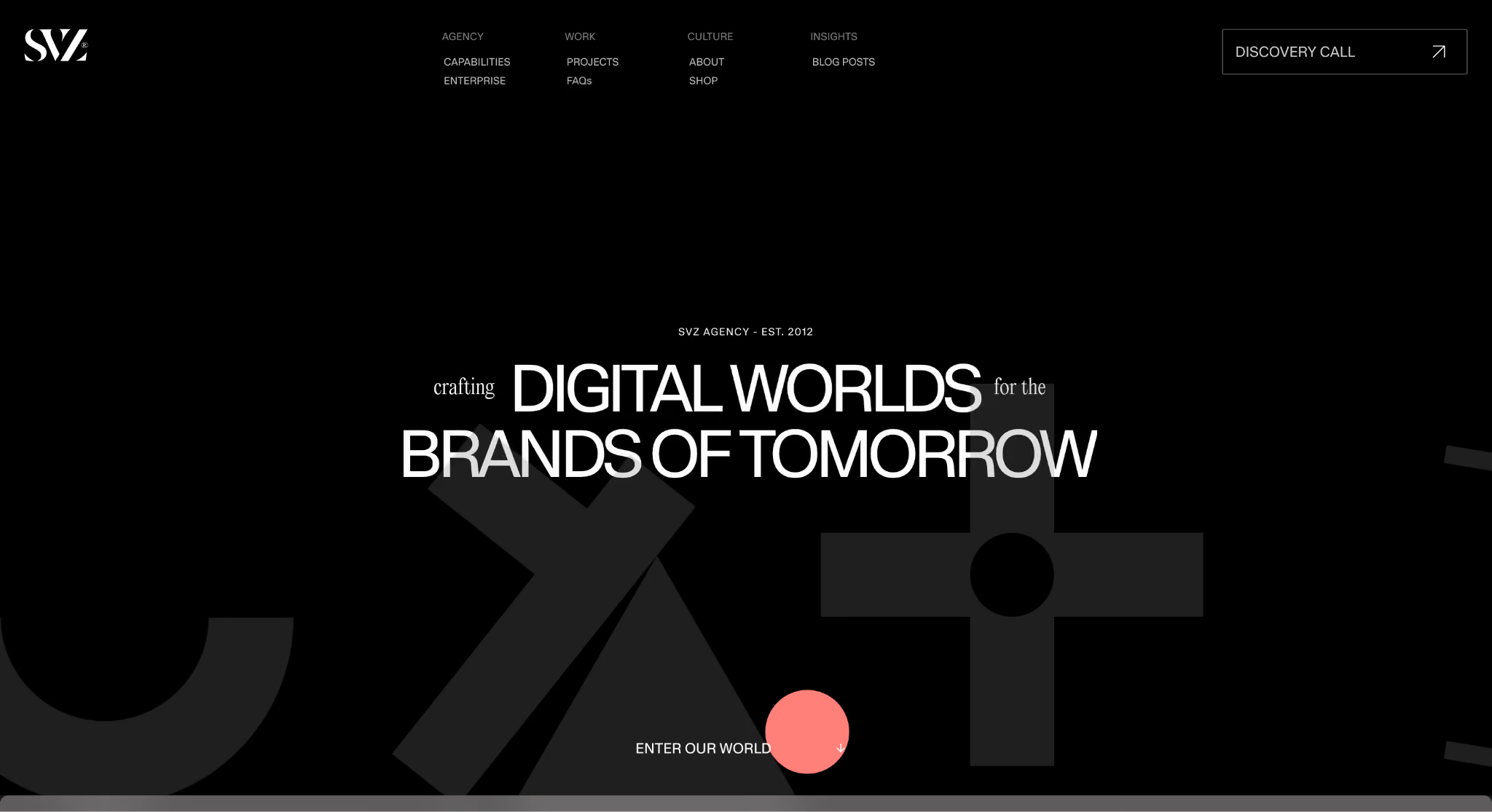
HQ: San Francisco, US
Founded: 2013
Team size: 2-10
Partner since: Feb 2019
Tier: Premium Partner
Distinctions: Partner of the Year 2022 Finalist
Services: Web development · Web design (UI/UX) · Custom code/scripting · Platform migrations · 3rd party integrations · Branding & strategy · Design system setup · E-commerce development · No/low-code app creation · Data & analytics · Accessibility audit & optimization · SEO audit & optimization · Animation · 3D design · Illustration · Graphic design · Photography/video · Digital marketing & advertising
Notable clients: Patreon, Envoy, Fivetran, Kajabi, Saildrone, Extreme Reach
Rating: Not Available.
Starting price: $50,000+
SVZ declares eighteen service categories, more than any other agency here, and the breadth is real rather than aspirational: they operate as a brand production studio with a development practice attached, working since 2013 and partnered with Webflow since February 2019. That combination is rare. Most agencies are development shops that also do some design, or design studios that outsource the build.
The client list reflects it. Patreon, Fivetran, Envoy and Saildrone are companies with established brand systems where a redesign has to respect existing visual language rather than replace it. One client notes SVZ migrated all their content off HubSpot without internal developer involvement, which is a development claim rather than a design one.
At a $50,000 floor, SVZ is among the most expensive on this list. That price is buying brand work and development together, so comparing it against a development-only quote is not comparing like with like.
Best for Brand-led development at enterprise scale, where identity and build ship together.
5. Edgar Allan
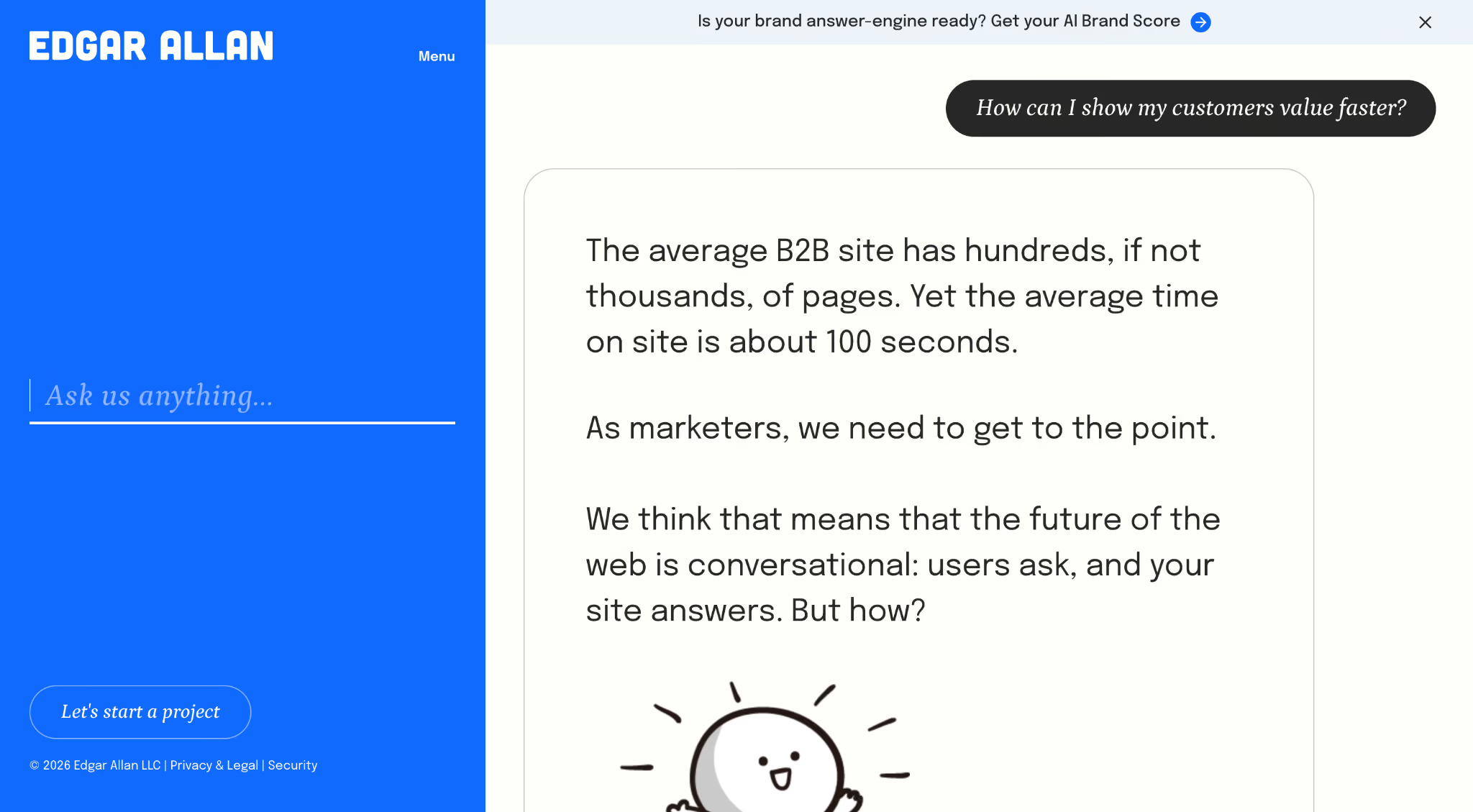
HQ: Atlanta, US
Founded: 2013
Team size: 11-50
Partner since: Jun 2020
Tier: Premium Partner
Distinctions: Technical Achievement of the Year 2025 Winner (Porsche) · Enterprise Excellence 2024 Winner · Enterprise Partner of the Year 2025 Finalist · Brand Transformation of the Year 2025 Finalist
Services: Web development · Web design (UI/UX) · Custom code/scripting · Platform migrations · 3rd party integrations · Design system setup · Data & analytics · Branding & strategy · SEO audit & optimization · Graphic design · 3D design
Notable clients: Porsche, Duracell, Coca-Cola Scholars Foundation, InterContinental Hotels Group
Rating: 5.0 on Clutch (5 Reviews)
Starting price: $30,000
Edgar Allan won Technical Achievement of the Year at the 2025 Webflow Awards for their Porsche work, and Enterprise Excellence in 2024. Among agencies on this list, that is the strongest independent evidence of technical capability at enterprise scale, awarded by the platform itself rather than claimed in marketing copy.
Their positioning sits at the intersection of brand and performance, and their public materials argue that in an AI-mediated search environment brand strength is itself a discovery mechanism. Their client roster is large recognisable brands rather than B2B SaaS, which changes the nature of the work: enterprise stakeholder management, existing design systems, and legacy platform constraints. One long-standing client describes Edgar Allan building a Webflow presentation layer connected to an existing WordPress CMS, a hybrid approach most agencies would not attempt.
They also ship public tooling, including the Knockout Webflow Framework, which has over a thousand clones.
Best for Enterprise development where brand depth and technical execution both matter.
6. Refokus
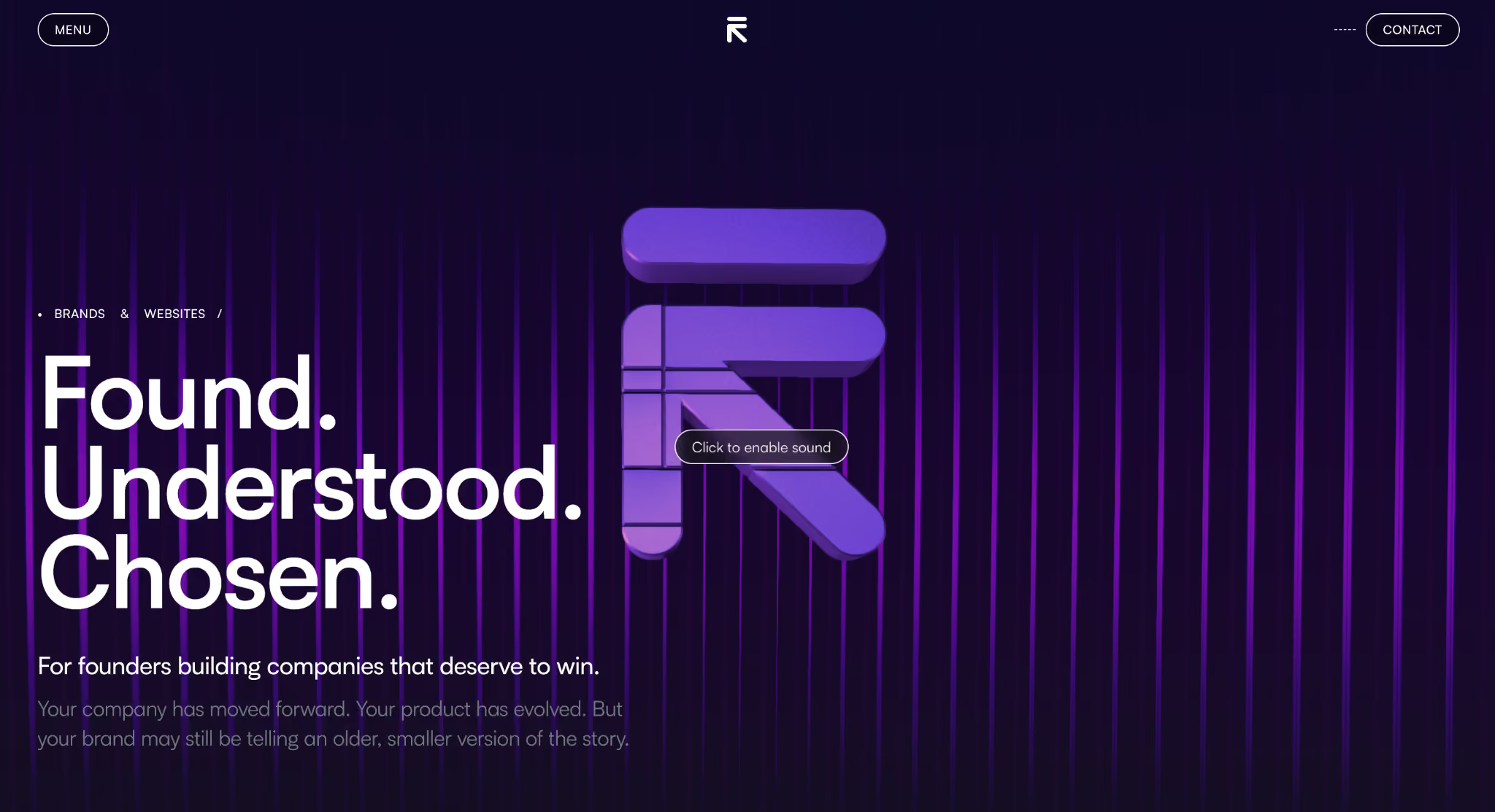
HQ: New York City, US
Founded: 2021
Team size: 25+ (stated on Webflow profile)
Partner since: Feb 2021
Tier: Premium Partner
Distinctions: Agency of the Year 2023 Finalist · Partner of the Year 2022 Finalist · Agency of the Year 2022 Finalist
Services: Web development · Web design (UI/UX) · Custom code/scripting · Platform migrations · 3rd party integrations · Design system setup · Animation · 3D design · Illustration · E-commerce development · Data & analytics · Accessibility audit & optimization · SEO audit & optimization · Branding & strategy
Notable clients: Webflow, Yahoo!, BCG Platinion, Botify, Jungle Ventures
Rating: 5.0 on Clutch (10 Reviews)
Starting price: $25,000
Refokus does creative development, meaning the interaction work that sits at the boundary of what Webflow can do without dropping entirely into custom code. Their portfolio carries Site of the Day wins from Awwwards, FWA and CSSDA, and they describe themselves as the most awarded Webflow agency, a claim their distinctions record makes plausible.
Webflow itself is a client, which is a meaningful signal on a list about Webflow development. So is BCG Platinion. The team runs over 25 people, fully remote, and their public tooling includes Refokus Tools, one of the more cloned resources in the Made in Webflow library.
If your build needs motion, scroll-linked behaviour, or an interaction concept that does not exist yet, this is the shortlist entry. If you need a straightforward high-volume CMS build, you are paying for capability you will not use.
Best for Creative development and complex interaction design.
7. Flowout
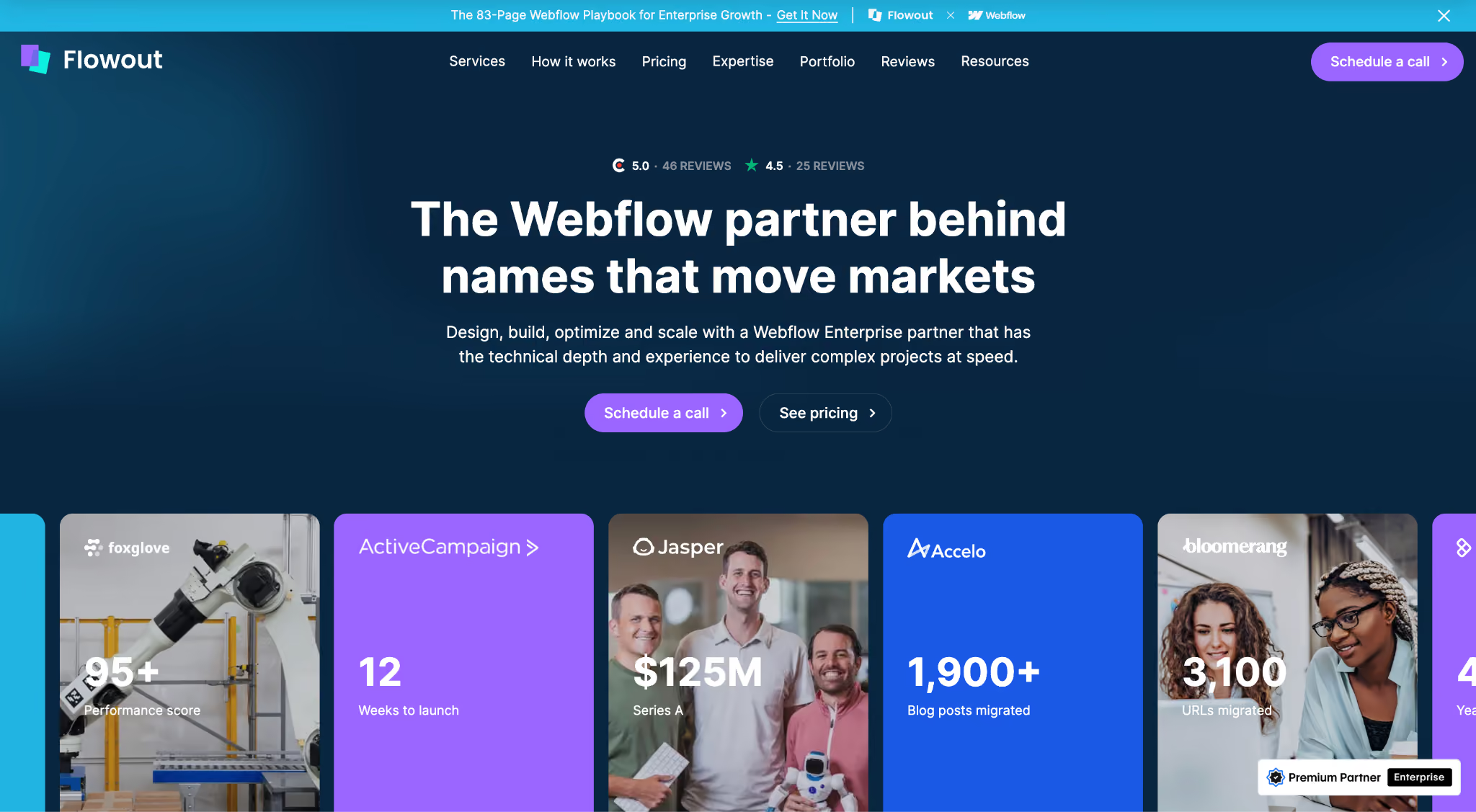
HQ: Ljubljana, Slovenia
Founded: 2020
Team size: 50+ in-house (stated on Webflow profile)
Partner since: Oct 2021
Tier: Premium Partner
Distinctions: Agency of the Year 2024 Finalist
Services: Web development · Web design (UI/UX) · Custom code/scripting · 3rd party integrations · Platform migrations · No/low-code app creation · Design system setup · E-commerce development · Data & analytics · Animation · 3D design · Illustration · Graphic design
Notable clients: Jasper, Kajabi, Riverside
Rating: 4.9 on Clutch (52 Reviews)
Starting price: $5,900
Flowout publishes more operational detail than anyone else here: 460+ companies served, 50+ in-house experts, and clients who have collectively raised over $2B. They also build Webflow apps and integrations directly, with work involving PayPal, Stripe, ActiveCampaign and Bynder, which is a different capability from integrating third-party tools into a client site.
Their model is continuous rather than project-based. They design, develop and integrate, then keep optimising for SEO, CRO, AEO, performance and conversion. Combined with a $5,900 floor, that suits companies wanting sustained development capacity rather than a single large build.
The public template and cloneable library is extensive, with several resources passing 500 clones. It is a useful proxy for how they structure builds, since you can open their work in the Designer and inspect it before hiring them.
Best for Ongoing development capacity and Webflow app or integration work.
8. Veza Digital
HQ: New York City, US
Founded: 2019
Team size: 51-200
Partner since: Sep 2022
Tier: Premium Partner
Distinctions: Partner of the Year 2023 Finalist
Services: Web development · Web design (UI/UX) · Custom code/scripting · Platform migrations · 3rd party integrations · Design system setup · Data & analytics · SEO audit & optimization · Accessibility audit & optimization · Animation · 3D design · Branding & strategy · E-commerce development · Illustration · Graphic design · Photography/video · Digital marketing & advertising
Notable clients: Chili Piper, Liquibase, Shipwell, Smartrr, Dubai Taxi Company
Rating: 4.9 on Clutch (45 Reviews)
Starting price: $50,000
Veza Digital builds marketing sites for funded startups and scale-ups, with a client list weighted toward B2B SaaS at growth stage: Chili Piper, Liquibase, Shipwell. Their industry specialities are Software & Technology, Financial and Healthcare, and their declared services run to seventeen categories.
Their $50,000 starting price is the joint highest here and sits well above the $10,000 to $25,000 band most of this list occupies. That positions them for companies treating a site rebuild as a funded initiative rather than a marketing line item, which is consistent with a portfolio of Series B and later companies.
Speed is their stated differentiator, which is unusual for an agency at this price point and worth pressing on during discovery, since like everyone here they publish no delivery timeline.
Best for Funded B2B SaaS companies rebuilding a marketing site as a growth initiative.
9. BRIX Agency
HQ: San Francisco, US
Founded: 2015
Team size: 11-50
Partner since: Dec 2020
Tier: Premium Partner
Distinctions: None listed
Services: Web development · Web design (UI/UX) · Custom code/scripting · 3rd party integrations · Platform migrations · E-commerce development · Data & analytics · Design system setup · Animation · Branding & strategy · SEO audit & optimization · Graphic design
Notable clients: Not published
Rating: Not Available
Starting price: $10,000
BRIX has published one of the largest libraries of free Webflow utilities available: schema markup cloneables for FAQs, articles, products, events, job postings, local business and breadcrumbs, plus real-time API integration and copy-to-clipboard components. Several have been cloned over a hundred times. For an agency, that library is unusually revealing, because it shows exactly how they structure components and handle structured data before you have paid them anything.
The schema focus is the distinguishing feature. Structured data is the layer most Webflow builds neglect and the layer that matters most for rich results and for how AI systems parse a site. An agency that has built and published fifteen schema utilities has thought about it harder than an agency that adds it as an afterthought.
BRIX does not publish named clients on its Webflow profile, which limits what can be verified about the scale of its project work. Their industry specialities are Financial, Marketing & Advertising, and Software & Technology.
Best for Custom component work and structured data implementation.
10. Creative Corner Studio
HQ: Sofia, Bulgaria
Founded: 2021
Team size: 45 (stated on Webflow profile)
Partner since: Jun 2022
Tier: Premium Partner
Distinctions: None listed
Services: Web development · Web design (UI/UX) · Custom code/scripting · 3rd party integrations · Platform migrations · Design system setup · Data & analytics · SEO audit & optimization · Accessibility audit & optimization · Branding & strategy · Animation · Graphic design · Digital marketing & advertising
Notable clients: Fujipoly, Eastek, Bluebird Kids Health, Hypergen, K LINE
Rating: 5.0 on Clutch (24 Reviews)
Starting price: $5,000
Creative Corner Studio runs a 45-person team and lists HubSpot alongside Webflow as a core competency, which is a specific and useful combination. For companies running HubSpot as their marketing and CRM backbone, having the same team handle both the Webflow build and the HubSpot connection removes the coordination overhead that usually sits between a web agency and a RevOps team.
They also list AEO and GEO alongside conventional SEO, meaning optimisation for AI answer engines rather than only for search results pages. Few agencies name this as a service yet.
Their portfolio leans toward manufacturing, healthcare and global mid-market companies rather than venture-backed SaaS, including several documented migration and redesign projects. At a $5,000 floor they are the most accessible entry point on this list.
Best for Mid-market builds with deep HubSpot integration.
Technical Capability Matrix
All entries are taken from the services each agency declares on its own Webflow partner profile, using Webflow's fixed service taxonomy. Checked 23 July 2026. "Not listed" means the agency does not declare that service on its profile. It is a record of what each agency publishes, not a judgment on what it can build.
Reading the matrix
Every cell reflects a public declaration on a Webflow partner profile. "Not listed" is a neutral marker throughout: an agency may well do the work without declaring it, and several here clearly do.
Platform migration is universal. All ten declare it, which tells you migration is table stakes in this category rather than a differentiator, whatever individual marketing pages claim.
Accessibility separates the group. Six of ten declare accessibility audit and optimisation. If WCAG conformance is a procurement requirement, this is your first filter, and the four remaining agencies are worth asking directly rather than ruling out.
Low-code app creation is the rarest capability, declared by four. It marks the line between building a marketing site and building something closer to an application.
Flow Ninja's row reads sparse because their profile declares a narrow service set. Their awards record, including Technical Achievement of the Year 2025 finalist and Website Experience of the Year 2025 winner, indicates capability well beyond what they publish. Their row is the clearest illustration of why this table records declarations rather than capabilities.
How Much Does Webflow Development Cost?
Pricing in this category is unusually opaque, so start with the one set of numbers that is public and comparable: the starting prices the ten agencies on this list declare on their Webflow partner profiles.
That is a 10x spread across ten agencies holding identical partner tier. The floor tells you who an agency is set up to serve, not how good it is.
What the tiers actually buy
$5,000 to $10,000. A focused build: template-informed structure, a modest CMS, standard integrations. Realistic for a landing page set, a startup marketing site, or a straightforward migration. At this level you are buying execution against a defined scope, not strategy.
$10,000 to $25,000. The volume band for B2B marketing sites. Custom design, structured CMS architecture, CRM and analytics integrations, and a build your marketing team can maintain without developer support. Six of the ten agencies here have floors inside or just below this range.
$25,000 to $50,000. Larger scope or added disciplines. Complex interaction work, brand strategy delivered alongside the build, multi-stakeholder enterprise processes, or migrations with significant content volume and redirect complexity.
$50,000 and up. Enterprise engagements and combined brand-plus-build projects. SVZ and Veza Digital both start here, but for different reasons: SVZ bundles brand production with development, so the figure is not comparable to a development-only quote at the same number.
Hourly rates and retainers
Hourly rates for Webflow development typically run $100 to $250 or more, varying with region and seniority. Agencies rarely publish them; Clutch profiles are the usual place they surface, and Flow Ninja's Clutch listing shows a $50 to $99 band, below the typical range. Treat any single published rate as one data point rather than a benchmark.
Ongoing retainers generally start around $3,000 per month. Amply publishes retainers from $3,000/mo alongside its $20,000 project floor, which is the only retainer figure declared across the ten profiles reviewed. Retainer work covers post-launch development, new pages and components, integration changes, and performance maintenance.
What moves the number
CMS scale and structure, integration count and complexity, custom code and interaction work, migration volume and redirect mapping, localisation, and accessibility conformance. Design system work and brand strategy sit alongside development in most quotes, which is a common source of confusion when comparing proposals.
How to compare quotes honestly
Ask each agency to price the same scope, in writing, with the disciplines separated. A $30,000 quote covering brand, design, development and three months of post-launch support is not more expensive than a $20,000 development-only quote. It is a different purchase.
Ask for a timeline in writing too. As covered above, no agency in this category publishes one.
How Long Does a Webflow Build Take?
These are typical ranges for Webflow development, not quotes. Actual timelines depend on scope, content volume, integration complexity, and how fast the client can supply content and feedback, which is the most common cause of overrun.
Where the time actually goes
Design and structure usually take the largest share, not the build itself. Deciding the CMS architecture, the class-naming system, and the component structure is the work that determines whether the site scales, and it is slow to do well and expensive to redo. A rushed structure is the most common reason a six-week project becomes a twelve-week one.
Content is the second variable, and it is usually the client's to control. Agencies can build faster than most companies can supply final copy and assets. If you want to compress a timeline, having content ready before the build starts moves it more than anything the agency does.
Migrations add redirect mapping and content transfer on top of the build, which is why an enterprise migration sits at the longer end even when the design is straightforward.
A note on published timelines
As covered in the comparison table, none of the ten agencies on this list publishes a typical delivery time anywhere public. The ranges above are category norms, not agency commitments. Ask each agency on your shortlist to put a timeline in writing during discovery, tied to a defined scope, and treat reluctance to commit as a signal in itself.
Webflow Development Agency vs Freelancer vs In-House
Three ways to get Webflow development done, suited to different budgets, timelines, and risk tolerances. Agency figures below are the published starting prices from the ten profiles reviewed in this post. Freelancer and in-house figures are industry-standard ranges, since those are not published on Webflow profiles.
How to actually choose
Agency makes sense when the build is complex, the deadline is real, or the site matters enough that continuity risk is unacceptable. You are paying for range and redundancy: designers, developers, and integration specialists under one roof, with a process that survives any one person leaving. The cost is higher and you have less day-to-day control than with an employee.
Freelancer makes sense for a defined project with clear scope, or for ongoing small changes to an existing site. The best Webflow freelancers are genuinely excellent and cost far less than an agency. The risk is concentration: one person's availability, one person's skill ceiling, and no cover if they disappear mid-project. Vet harder, and keep scope tight.
In-house makes sense once the website is a continuously changing asset central to the business, updated weekly rather than rebuilt periodically. A dedicated employee who knows the product and the codebase is unmatched for sustained iteration. The tradeoffs are a months-long hire, a salary floor above most project budgets, and dependence on one person's range, which is often narrower than a team's.
Many companies combine these: an agency for the initial build and migration, then a freelancer or in-house hire for ongoing work once the structure is set. That sequence gets you the agency's range where it matters most, at the start, and lower-cost continuity afterward.
How to Choose a Webflow Development Agency
Six criteria that separate agencies once you get past the portfolio. For each, the specific question to ask, and what a good answer sounds like.
1. Ask to see their class naming and CMS structure in the Designer
This is the test almost nobody tells buyers about, and it is the most revealing one. Ask to open a recent build in the Webflow Designer, or to see a screen share of it, and look at how classes are named and how the CMS is structured. A professional build uses a consistent, readable naming system, often Finsweet's Client-First convention, and a CMS organised so content scales. A weak build is a pile of unnamed or auto-generated classes that your team will not be able to touch without breaking something.
A polished front end can hide a messy structure. This is the single check that exposes it, and an agency confident in its work will show you without hesitation. Reluctance is the answer.
2. Verify partner status yourself
Do not take "Webflow Enterprise agency" or "certified experts" at face value. Search the agency on the Webflow partner directory or visit their webflow.com profile. Confirm the tier, the partner-since date, and any distinction badges. As covered earlier, Enterprise is a badge, not a tier, and marketing language routinely blurs this. Ask: what is your Webflow partner tier, and can I see your profile?
3. Match technical capability to your actual build
A creative-interaction specialist and a large-CMS specialist are both excellent and rarely the same agency. Identify what your build actually needs, custom code, a large CMS, a specific integration, a migration, and confirm demonstrated experience in that thing specifically. Ask: show me a project where you did the particular thing I need, and what went wrong on it. The second half of that question matters more than the first.
4. Pin down the timeline in writing
No agency in this category publishes delivery times, so you have to extract one. Ask for a written timeline against a defined scope, with the key milestones and dependencies named. A credible answer identifies what could push the date, usually content delivery and feedback cycles, rather than promising a fixed number with no conditions. Vagueness here predicts overrun.
5. Establish who owns the site after launch
Clarify handoff before you sign. Ask: when the project ends, do we own the Webflow account, can our team edit without you, and what does post-launch support cost? Some agencies build in a way that keeps you dependent on them. That can be fine if you want an ongoing retainer, but it should be a choice, not a surprise you discover when you need a change.
6. Ask for performance and outcome data
A good-looking site that loads slowly or converts poorly has failed at the job. Ask for Core Web Vitals or PageSpeed results on recent builds, and for any conversion or traffic outcomes they can attribute. Expect honesty about attribution: an agency claiming sole credit for a revenue jump is overselling, since a site is one variable among many. Grounded, qualified answers are the credible ones.
The through-line
Every criterion here rewards the same thing: an agency willing to show you the underside of its work. The Designer structure, the real timeline, the handoff terms, the performance numbers. Agencies proud of how they build are glad to open it up. The ones that deflect are telling you something, and it is worth listening to.
Red Flags
Six warning signs worth taking seriously. One on its own might have an innocent explanation. Two or more together is a pattern.
No verifiable partner status. The agency describes itself as a "Webflow expert" or "Enterprise agency" but has no profile in the Webflow partner directory. Partner status is free to verify and takes thirty seconds. An agency doing professional Webflow volume is almost always in the programme, and absence from it, paired with claims of expertise, is worth questioning directly.
No live sites you can inspect. Case study screenshots and mockups are not the same as a live URL you can open, test on mobile, and run through PageSpeed. If an agency cannot point to shipped work you can examine yourself, you are trusting a portfolio that may not reflect what they actually deliver.
Refuses Designer access. As covered above, seeing a build's class naming and CMS structure in the Designer is the clearest test of build quality. An agency that will not show you the inside of a recent project, even on a screen share, is hiding the part of the work that determines whether your team can maintain the site. This is the reddest flag on the list, because the reluctance itself is the information.
Unclear post-launch ownership. If you ask who owns the Webflow account after launch and whether your team can edit independently, and you get a vague or evasive answer, assume the arrangement is built to keep you dependent. A retainer relationship is fine when it is chosen. A dependency you discover the first time you need a small change is not.
No performance data. An agency that cannot produce Core Web Vitals, PageSpeed results, or any outcome data from recent builds is either not measuring performance or not getting results worth sharing. Both matter. A site that looks good and loads slowly has failed at the job, and an agency indifferent to that distinction will build you the same.
A quote before any discovery. A firm price handed over before the agency has understood your scope, content, integrations, or goals is not a considered estimate. It is either a lowball to win the deal that will grow through change orders, or a template price disconnected from what you actually need. Real quotes follow real discovery. A number that arrives too easily should lower your confidence, not raise it.
The pattern that ties them together
Every red flag here is a form of the same thing: an agency avoiding scrutiny. Won't show partner status, won't show live work, won't open the Designer, won't clarify ownership, won't share numbers, won't ask questions before quoting. The best agencies in this category invite all six checks, because passing them is how they win work. Treat avoidance as the signal it is.
Final Thoughts
The hard part of choosing a Webflow development agency is not finding a good one. It is that ten agencies with near-identical credentials will all present themselves as the obvious choice, and the differences that matter are the ones nobody puts on a sales page.
Partner tier gets you a shortlist. Every agency here is a verified Webflow Premium Partner, which is a real filter, most agencies never reach it, but it is a floor, not a ranking. Above that floor, the useful distinctions are specific: Finsweet's technical depth, Flow Ninja's migration record, SVZ's brand-and-build combination, Edgar Allan's enterprise awards, Amply's tie between development and search. The best agency for a complex migration is not the best agency for a motion-heavy brand site, and no ranking resolves that for you. Your build does.
So the work comes back to a handful of concrete checks. Open a recent project in the Designer and look at how it is structured. Verify partner status yourself rather than trusting the marketing copy. Ask for a timeline in writing, since none of these agencies will volunteer one. Pin down who owns the site after launch. The agencies worth hiring welcome all of it, because passing those checks is how they win. The ones that deflect have told you what you need to know.
Match the capability to the build, verify what you are told, and treat any agency's reluctance to be inspected as the clearest signal on offer.
If you are looking for a Webflow development agency that ties build quality to search and conversion outcomes, Amply is a Webflow Premium Partner specialising in B2B and SaaS sites your marketing team can run without developer support. See how Amply works, or book a call with Amply to talk through your build.
Frequently Asked Questions
The ten covered here are Amply, Finsweet, Flow Ninja, SVZ, Edgar Allan, Refokus, Flowout, Veza Digital, BRIX Agency, and Creative Corner Studio. All are verified Webflow Premium Partners. They serve different needs: Amply for B2B marketing sites where development is tied to SEO, Finsweet for advanced technical builds and project recovery, Flow Ninja for large-scale migrations, SVZ and Edgar Allan for enterprise brand-led work. The right one depends on your specific build, not on rank order.
Finsweet is the most technically influential, having built Attributes, Client-First, and Wized, tooling much of the ecosystem depends on. Flow Ninja and Edgar Allan both hold recent Webflow Awards for technical work, including Edgar Allan's Technical Achievement of the Year 2025 for its Porsche build. Refokus is known for complex interaction and creative development. Each is strong in a different direction, which is why matching capability to your build matters more than a general reputation.
It builds and maintains the technical layer of a Webflow site: custom code and interactions, CMS architecture, third-party integrations, platform migrations, and performance work. This is distinct from a design agency, which handles how a site looks and communicates. Many agencies do both, but if your problem is technical, a site that performs badly or a migration that must preserve rankings, you are looking for development capability specifically.
Among the ten agencies here, published starting prices run from $5,000 to $50,000, a 10x spread across agencies holding the same partner tier. Most B2B marketing sites fall in the $10,000 to $25,000 band. Enterprise builds start around $50,000. Hourly rates for Webflow development typically run $100 to $250 or more as an industry standard, and ongoing retainers generally start around $3,000 per month. The floor reflects who an agency serves, not how good it is.
Premium Partner is the advanced level of Webflow's partner programme, above Certified Partner, awarded on accumulated project volume and community contribution rather than a single portfolio review. Note that "Premium Enterprise Partner" is not an official designation. Webflow's programme has partner tiers (Certified and Premium) and, separately, distinction badges. The Enterprise Distinction is a badge for partners with a history of selling Webflow Enterprise, not a tier above Premium. Agencies often blur this in marketing copy, so verify tier on the agency's Webflow profile.
As an industry standard, landing pages take 2 to 4 weeks, marketing sites 6 to 10 weeks, and enterprise builds 3 to 6 months. Content readiness is the biggest variable and usually the client's to control, since agencies can often build faster than companies supply final copy. None of the ten agencies here publishes a delivery timeline, so ask for one in writing against a defined scope.
Yes. Webflow supports custom code through embeds and project-level scripts, and connects to third-party tools like HubSpot, Salesforce, Stripe, and Segment through native features, APIs, and integration platforms. Every agency in this list declares integration capability, and nine of ten declare custom code work. For app-style functionality beyond a standard site, four of the ten also declare low-code app creation.
A freelancer suits a well-defined project or ongoing small changes, at a lower cost but with single-point-of-failure risk. An agency suits complex or high-stakes builds, migrations, and tight deadlines, offering a team, an established process, and continuity if someone leaves. An in-house hire suits companies whose site changes constantly and is core to the business. Many companies use an agency for the initial build, then a freelancer or in-house hire for ongoing work.