10 Best Videodeck Alternatives for B2B Video Production in 2026


Key Takeaways
- Apollo Studio: Best for B2B tech companies that want a senior team on one scoped product video with real people on camera
- Vidico: Best for a multi-format creative department with a long SaaS track record
- Content Beta: Best for a product-led creative subscription at $3,000 a month
- Represent Studio: Best for startups that want launch, tutorial and YouTube video from one GTM-minded team
- Wyzowl: Best for a fixed, published price on animated explainers
- Demo Duck: Best for a flagship animated explainer from an established US studio
- Sandwich Video: Best for a live-action launch film with the founder on camera
- Testimonial Hero: Best for customer testimonial video at scale, remote or on site
- Broadcast2World: Best for fixed-fee animation with a published retainer and a compliance gate
- Motion The Agency: Best for fixed-price motion graphics and UI animation in six working days
Videodeck has become one of the most-searched names in B2B video by doing something unusual: publishing its prices, owning its studios and hiring its presenters. The agency, founded by Heleana and Andrei Tiburca and launched on Product Hunt in January 2022, runs a team of fifteen with more than ten full-time spokespeople across studios in Oradea, Romania and Austin, Texas. It reports more than 1,000 videos delivered for over 100 software companies, including Ahrefs, CloudZero, Nightfall AI, Hometap and Cyberhaven, on a fixed ten-working-day turnaround with unlimited revisions and full ownership of everything it makes.
The model is built around one belief the company states plainly on its own site: consistency beats one big swing. Twelve decent videos published on time, in its words, do more for a company than one beautiful launch film. For a marketing team that needs a presenter-led product video every week, that is exactly right, and it is why Videodeck exists.
It is also why buyers look elsewhere. Some want the one big swing: a launch film or hero explainer that will carry the homepage for two years. Some want their own founder, customer or engineer on camera rather than a spokesperson from a roster. Some want animation instead of a presenter, a crew on location rather than a built set, a lower monthly commitment, or design, decks and ad creative from the same subscription. This guide ranks ten agencies and studios that answer one of those needs, with verified sites, named clients and published pricing wherever it exists.
One note on names: this guide covers Videodeck the B2B video agency at videodeck.co, not the YouTube browser extension or the streaming hardware that share the word.
What Videodeck Does Well, and Where Buyers Look Elsewhere
Before comparing alternatives, it is worth being precise about what Videodeck is in 2026, because it is not a conventional agency.
What it does well. Videodeck built a production line for presenter-led B2B video. A client picks a spokesperson from the in-house roster, the studio designs a custom set with branded props, and the team writes the script, shoots, layers in product screens and animation, cuts social versions, and delivers in ten working days. Pricing is on the site, from $5,000 for a single video down to $2,000 per video on the largest monthly plan, with YouTube publishing, thumbnail testing and a content plan included. Revisions are unlimited and the client owns the output. Its industry pages cover fintech, cybersecurity, dev tools, AI, martech and SaaS, and its site reports six-figure view counts on evergreen educational and product series for several clients. For a team that needs volume, cadence and a known price, it is hard to beat.
Where buyers look elsewhere. Every reason we found is about fit, not quality.
- They want one big swing. Videodeck says itself that it built the business around the twelve-videos-a-year model rather than the one launch film. A company that needs the one launch film is a different buyer.
- They want their own people on camera. The spokesperson roster is the point of Videodeck's speed. Some companies want the founder, a customer or the engineer who built the feature, and a studio whose process is designed around getting those people to say it well.
- They want animation, not a presenter. Videodeck's format is a person on a set with product screens and motion layered in. An abstract product with no interface worth showing often needs a fully animated explainer.
- They want a crew on location. Videodeck shoots in its own studios on a custom set. Brand films, customer stories at the customer's office and launch films shot in the company's own space are a different production.
- They want a different commitment. Monthly plans bill from $10,000 for four videos and a one-off is $5,000. Some teams want one video for less, or a subscription that starts nearer $3,000 a month.
- They want design, decks and ads from the same team. Videodeck offers design and distribution as add-ons at $2,900 a month each; some buyers want a creative department that leads with that breadth.
Our ranking maps to those six reasons.
How We Chose These Alternatives (Methodology)
We ranked for B2B software companies who considered Videodeck for product, tutorial, launch or educational video and want a different format, a different face on camera or a different engagement model. The alternatives are ordered by how closely they serve that same buyer, then by what each one adds that Videodeck's model does not lead with.
Fit for the same buyer
Weighted heaviest. Videodeck's core customer is a SaaS or B2B tech marketing team with a product that needs showing. We ranked studios that serve that buyer first, and format specialists or generalists lower, however good they are at their own thing.
A clear reason to switch
Each entry has to answer "why this instead of Videodeck" in one sentence: a senior team on one piece, your own people on camera, animation, a location shoot, a lower commitment, or broader creative. An agency that is simply another presenter-on-a-set studio did not make the list.
Verified work and verified site
Named clients we could confirm on the agency's own site, and a domain we resolved and title-checked. No directory entries, no marketplaces, no AI avatar tools.
Pricing transparency
Videodeck publishes a full rate card, which sets a high bar. We say for each alternative whether it publishes a price, a starting point, a range or nothing at all.
Turnaround and engagement model
Project, subscription, retainer or credits, and how fast each delivers. Videodeck's ten days is the benchmark; most alternatives trade some of that speed for something else, and we say what.
The Best Videodeck Alternatives Compared
| Agency | Why instead of Videodeck | Pricing | Turnaround | Better Suited For… Than… |
|---|---|---|---|---|
| Apollo Studio | Senior specialist team, your founders and customers on camera, one scoped piece | From $10,000 | Full productions in about 3 weeks | A product video that has to land with a technical buyer, than weekly presenter content |
| Vidico | Multi-format creative department, animation and live action | $1,500 to $50,000 per project; plans from about $5,000 a month | Project-based | Video plus ad creative and design from one vendor, than a fixed presenter format |
| Content Beta | Product-led creative subscription at a lower entry | $2,000 per one-off video; $3,000 a month | 1 to 2 days on subscription; 10 days for a one-off | Demos, ads and decks every release, than a single hero film |
| Represent Studio | GTM-minded video team for startups, founders on camera | Custom | Batches shipped fast, then scaled | Launch, tutorial and YouTube video from one partner, than a rate-card purchase |
| Wyzowl | Fixed, published price on animation with unlimited revisions | From £2,000 (about $2,700) | 4 to 6 weeks | Animated explainers with price certainty, than live-action presenters |
| Demo Duck | Flagship animation from a US studio since 2011 | Budget at least $16,000 (its own guidance) | 8 to 10 weeks | A hero explainer planned a quarter ahead, than a monthly cadence |
| Sandwich Video | Live-action launch film with the founder on camera | Custom, reported six figures | Custom | Well-funded launches, than volume content |
| Testimonial Hero | Customer testimonials, remote or on site anywhere | $6,000 to $13,348 per package | About 45 days end to end | Customer proof at scale, than product walkthroughs |
| Broadcast2World | Fixed-fee animation tiers plus a retainer | From $2,000 to $9,500 by tier; retainer from $3,200/mo | 4 to 6 weeks | Animated explainers with a compliance gate, than presenter demos |
| Motion The Agency | Fixed-price motion graphics and UI animation | From $3,480 per project; $3,950 a month | 6 working days for 60 seconds | Animated interface videos at Videodeck speed, than live action |
The 10 Best Videodeck Alternatives in 2026
1. Apollo Studio
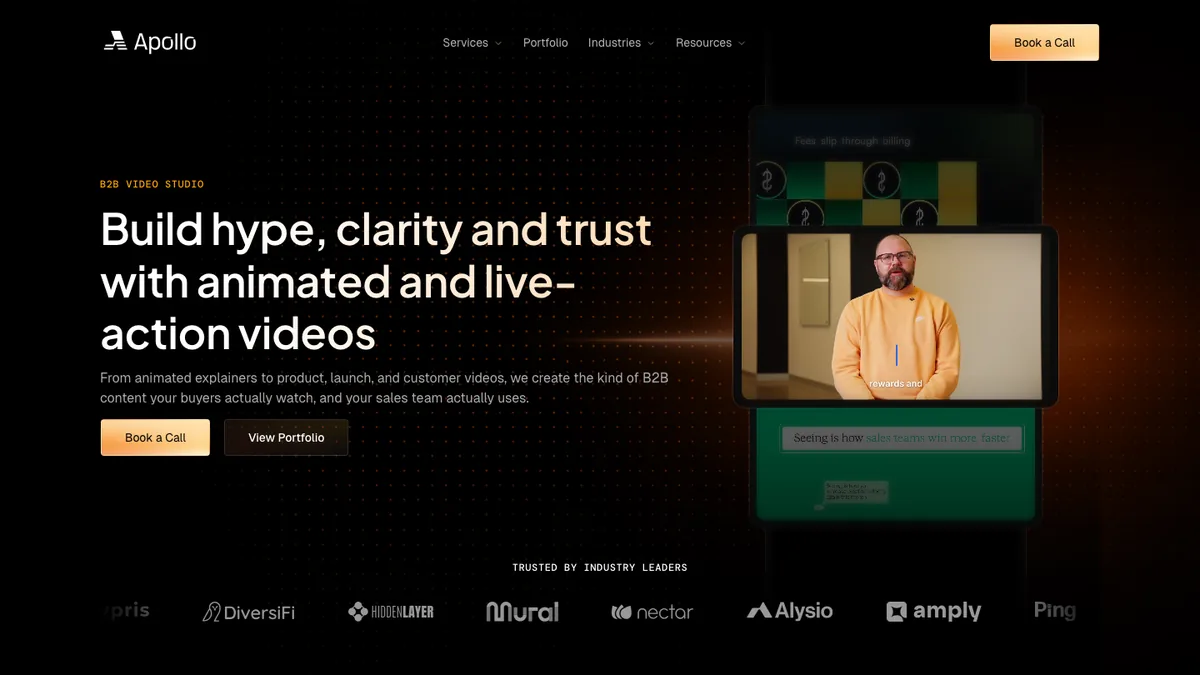
Best for: B2B tech companies that want one scoped product video from a senior team, with their own people on camera.
Apollo Studio is the closest fit for the buyer Videodeck serves best, with the opposite production philosophy. It works only with B2B tech (SaaS, AI, fintech, cybersecurity, healthcare), scopes each project rather than selling a monthly slot, and puts real founders, customers and employees on camera as a stated principle. The team on the strategy call is the team that makes the piece; co-founder Cade Biegel runs those calls.
The work shows the range: a product explainer for Mural, product tour and launch films for Ping, a live-action demo and an on-location launch film in New York for Arist, a promo for Anvilogic, and, for Vanta, a product promo followed by an ongoing monthly product-update series shot in the studio, the closest thing on this list to Videodeck's cadence, delivered as scoped pieces. Awardco and Cypris AI are also on the roster. Motion design is in-house.
Speed is closer to Videodeck's than most: post in about a week, full productions in about three. Pricing starts at $10,000 per project, with bundled pricing when several pieces are planned together. The studio is US-based.
Who it's less suited for: Better suited to a company with a few product videos that have to land with a technical buyer than to a team that wants a presenter-led video every week at a per-video price.
2. Vidico
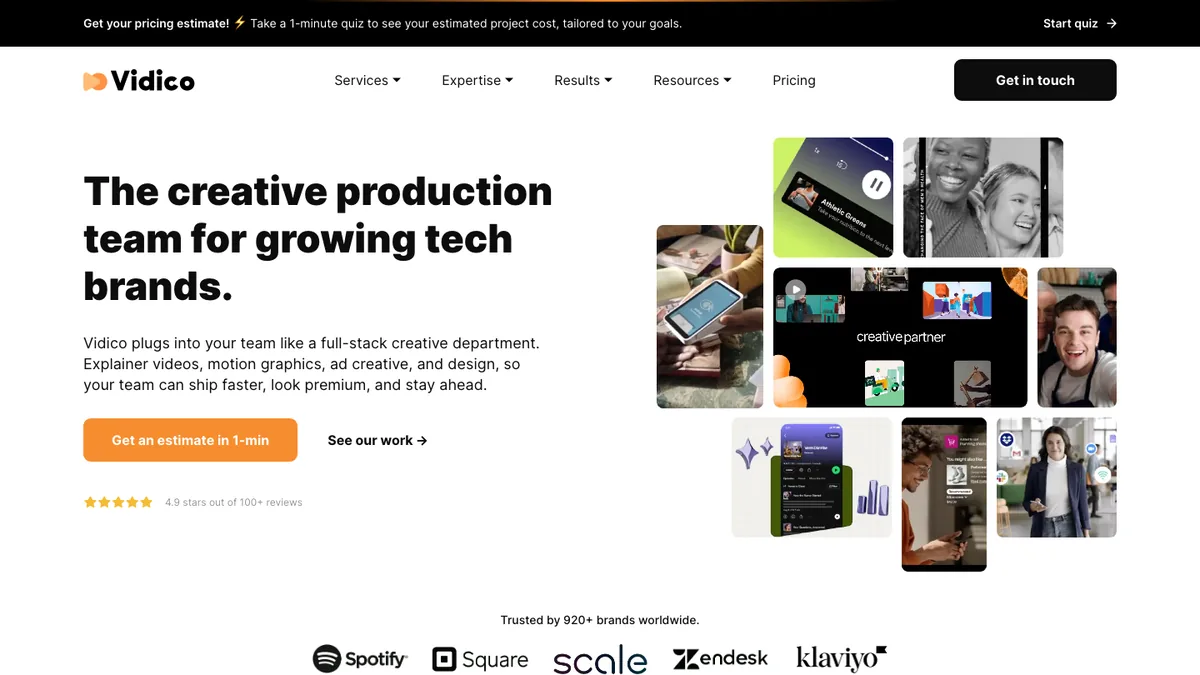
Best for: Companies that want a creative department across video, motion, ad creative and design, from the studio with the deepest SaaS client list in the category.
Vidico is the most-searched name in B2B video and the natural first comparison. The Melbourne-founded studio, with offices in Sydney and New York, has produced explainers, product videos and ad creative for Spotify, Square, Zendesk, Klaviyo and TikTok, reports more than 2,000 campaigns for 920-plus brands, and holds a 4.9-star rating across more than 100 reviews. It now sells itself as a full-stack creative department on flexible credits, with unused credit rolling over.
Against Videodeck, the differences are format and breadth. Vidico produces animation as well as live action, so a product with no interface to show gets a fully animated explainer rather than a presenter. And the department model covers ad creative, motion graphics and design alongside video, where Videodeck adds design as a monthly add-on. Pricing is published as ranges: per-project work on its industry pages runs from $1,500 to $50,000, plans start at about $5,000 a month, and the figure is set through a short quiz rather than a rate card.
Who it's less suited for: Better suited to a marketing team routing several kinds of creative through one vendor than to a team that wants a fixed per-video price and a presenter-led format delivered in days.
3. Content Beta
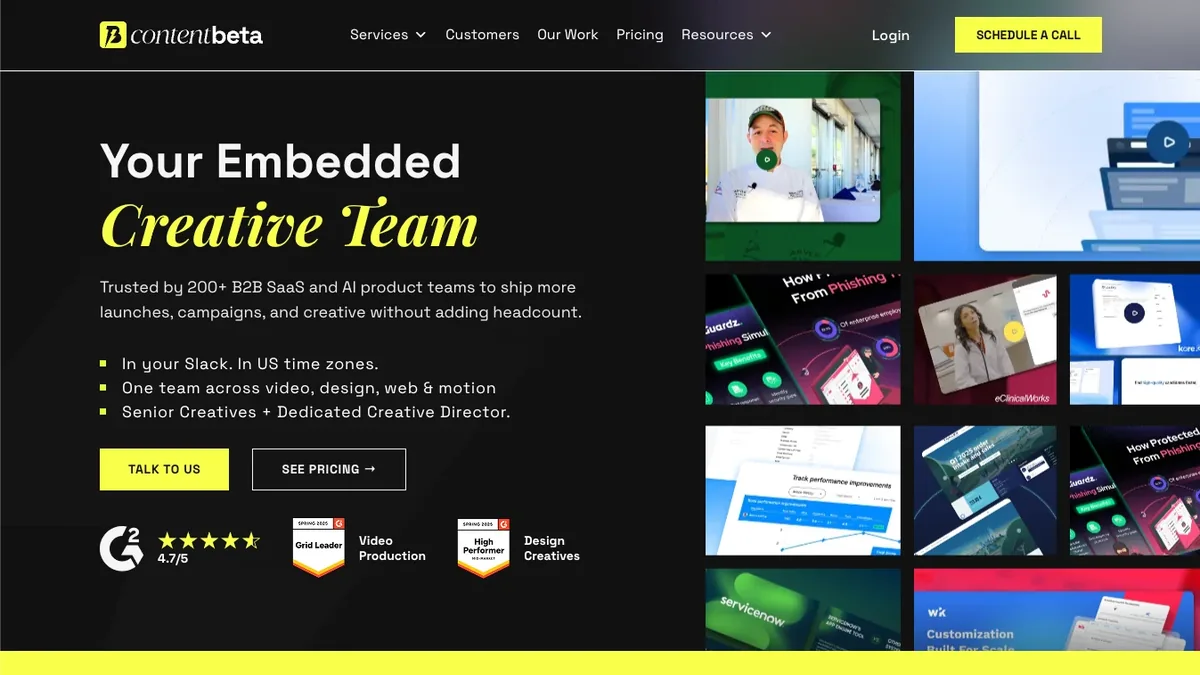
Best for: Product-led SaaS teams that want a subscription like Videodeck's at a lower monthly commitment, with demos, ads and decks from one pool of credits.
Content Beta is the most direct like-for-like alternative on the subscription side. It sells a creative subscription at $3,000 a month covering video, design, motion and web from one pool of credits, with unused credits rolling over, a dedicated creative director, a Slack-based workflow and most requests turned around in one to two days. A one-off product video is published at $2,000 with a ten-day turnaround, the same window as Videodeck's. Its G2 rating is 4.7 from 86 reviews, and its client list includes ServiceNow, Sendbird and Constructor.
The typical month it publishes is one demo video, two motion ads, two static ads, ten slides and a LinkedIn reel, which is the mix a product marketing team ships around a release. Where Videodeck's plans start at $10,000 a month for four presenter videos, Content Beta's start at $3,000 for a broader mix with less live action in it. Content Beta publishes its own comparison pages, so read those as sales documents; the model itself is well suited to teams whose objection to Videodeck is the entry price.
Who it's less suited for: Better suited to steady product creative at volume than to a presenter-led series with a consistent on-camera face, or a live-action customer story with a crew on location.
4. Represent Studio
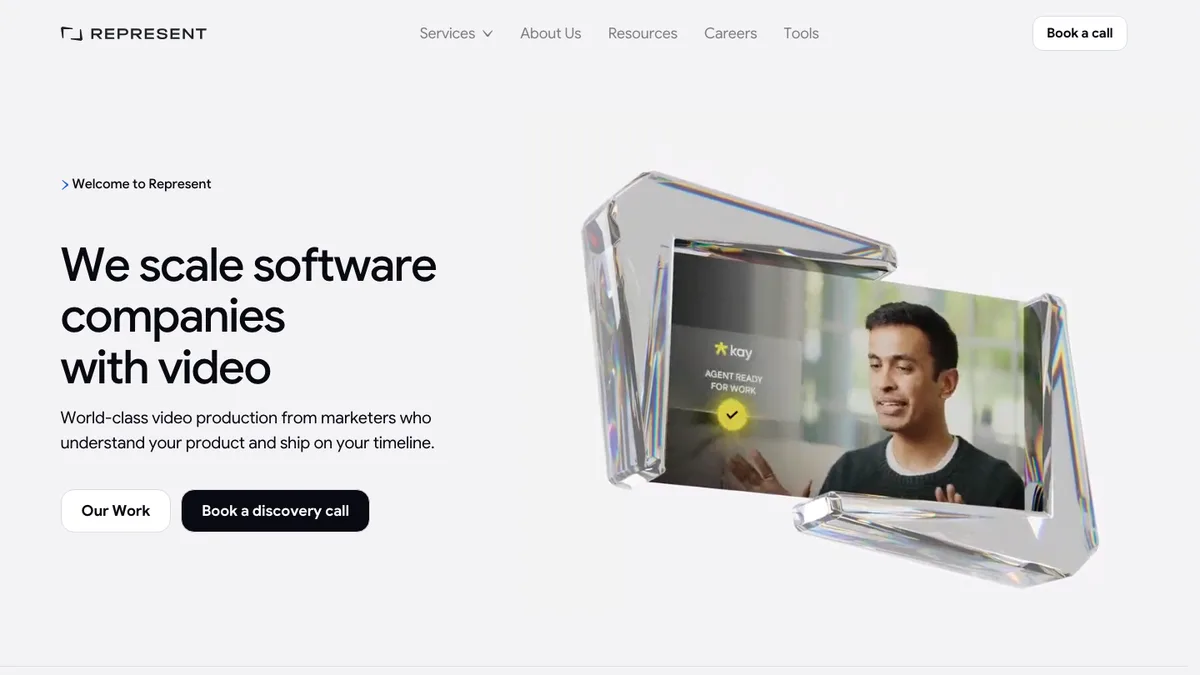
Best for: Early-stage and growth software companies that want launch, tutorial, testimonial and YouTube video from one team that thinks like a go-to-market marketer.
Represent Studio is the closest model match to Videodeck on this list, with a different centre of gravity. It was founded by the former marketing lead at Bardeen, who built that company's product academy, launch video and YouTube channel before turning the playbook into an agency. The services map to a startup's funnel: launch videos, customer testimonials, tutorials and product academies, and long-form YouTube. Clients on its site include Dataiku, Factory AI, Lindy AI, Otter, E2B, ZenML and FirstMark, and it holds a 5.0 rating from 32 reviews on G2.
The reason to choose it over Videodeck is who is on screen and where. Represent's launch formats run from founder-led films (real people, real vision, in its words) through motion graphics to cast commercials, and it films on location in San Francisco, New York and Miami, at the client's office, a rented studio or on the street. Its process ships a first batch of videos fast to test what resonates before scaling the format. Pricing is custom rather than a rate card.
Who it's less suited for: Better suited to a startup that wants a video partner embedded in its GTM motion than to a team that wants to buy a fixed number of presenter videos at a published price.
5. Wyzowl
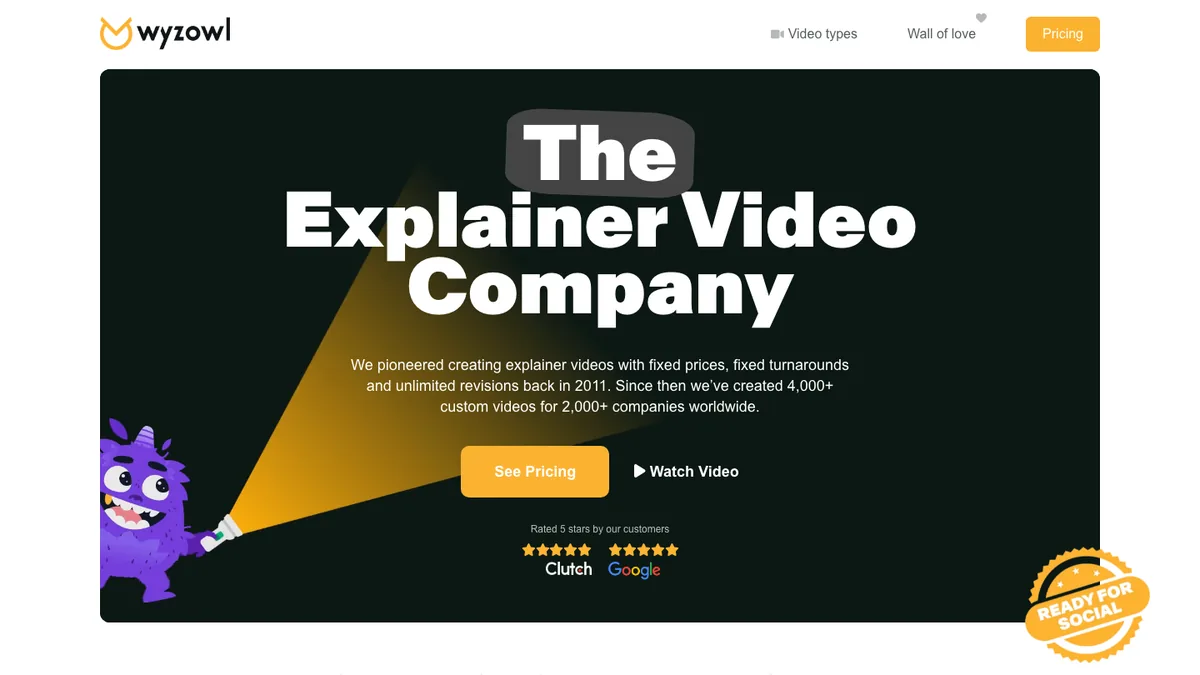
Best for: Teams that like Videodeck's published pricing and unlimited revisions and want them on animated explainers instead of presenter video.
Wyzowl is the pricing-transparency answer on the animation side. The UK studio has produced more than 4,000 videos for 2,000-plus companies since 2011 and publishes its model in full: fixed price from £2,000 (about $2,700) for an animated video, all-inclusive of scripting, voiceover, animation and music, unlimited revisions at every stage, and fixed delivery dates. Its own project management platform is used by more than 1,000 agencies. Clients include Capital One, JotForm and Mavenlink.
The two companies share a philosophy, price on the site and no surprises, and differ on format. Wyzowl's work is animation: explainers, demo videos, app demos, social and testimonial videos recorded remotely. It runs dedicated industry practices (fintech, cybersecurity, insurance, SaaS) with named clients on each page and a compliance review stage built into regulated projects. Most projects complete in four to six weeks.
Who it's less suited for: Better suited to buyers who want a fixed price on a deep animation track record than to those who want a live-action presenter, a crew on location or delivery in ten days.
6. Demo Duck
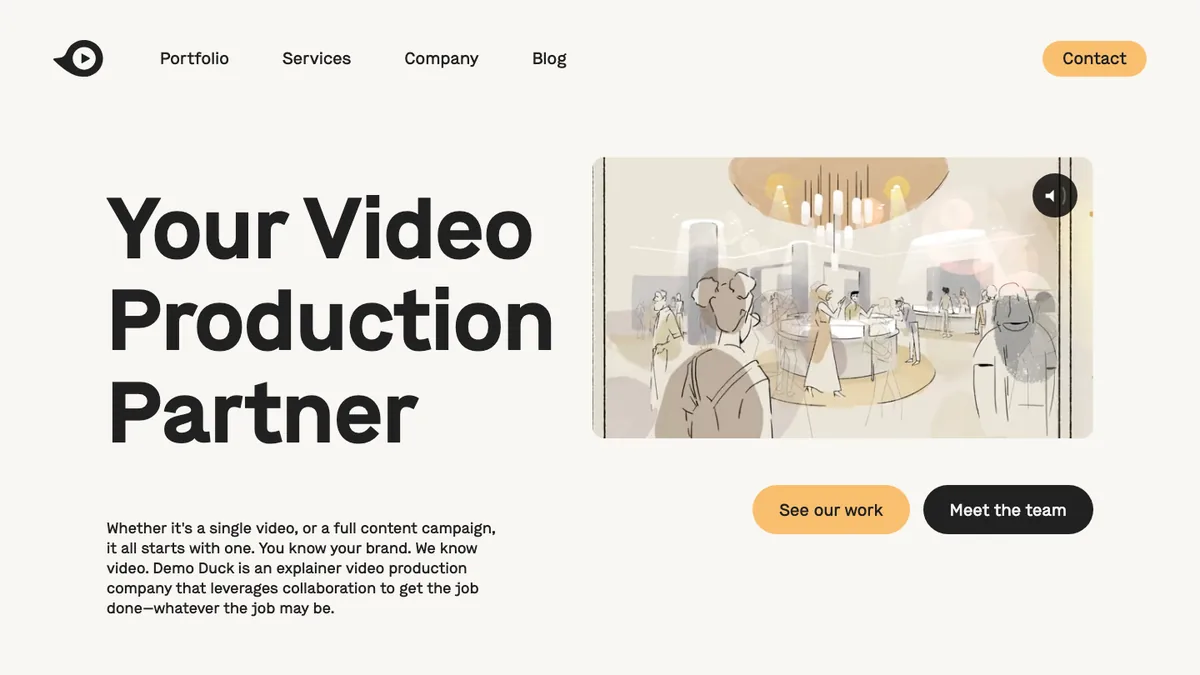
Best for: Companies that want the one big swing: a flagship animated explainer from a US studio with a long track record and a hands-on creative process.
Demo Duck is a Chicago studio founded in 2011, with animated and live-action work for Netflix, Google, Dropbox, Lenovo, IBM Watson and Northwestern Mutual, and a portfolio deep enough that almost any B2B buyer will find a close analogue to their own product. It is a project studio in the fullest sense: discovery, script, storyboard, style frames, animation, with the creative director involved throughout.
The studio is unusually direct about budget. Its own cost guide says to budget at least $16,000 for a quality explainer, and its timelines run eight to ten weeks. That is the purchase Videodeck's model deliberately does not make: a piece planned a quarter ahead that sits on the homepage for years. For abstract products with no interface worth showing, that depth of creative development is the reason to choose it. Demo Duck also runs a partner programme for agencies and works across healthcare, education and non-profit, so it is not a SaaS-only shop.
Who it's less suited for: Better suited to a hero piece with a quarter of lead time than to a team that needs a video every week, which is where Videodeck or a subscription fits better.
7. Sandwich Video
Best for: Well-funded companies that want a live-action launch film with the founder on camera, made by the studio that defined the format.
Sandwich Video, founded by Adam Lisagor in Los Angeles, effectively invented the modern tech launch video: the founder in a well-lit office explaining the product with self-aware humour, copied so widely it is now a genre. The current roster includes Perplexity, Gamma, Descript, Brex, Postman, Square, Robinhood, Capital One and Instacart, and the studio makes TV spots, explainers, testimonials, brand films and animation.
This is the alternative for a buyer who wants the opposite of a spokesperson on a set: the actual founder, in the actual office, in a piece that becomes the launch itself. Sandwich is selective and premium; pricing is custom and reported in the six figures, so it belongs on a Series B budget rather than a seed one.
Who it's less suited for: Better suited to a flagship launch or brand film with a real budget than to product tutorials at volume, monthly updates or any team that needs a published price.
8. Testimonial Hero
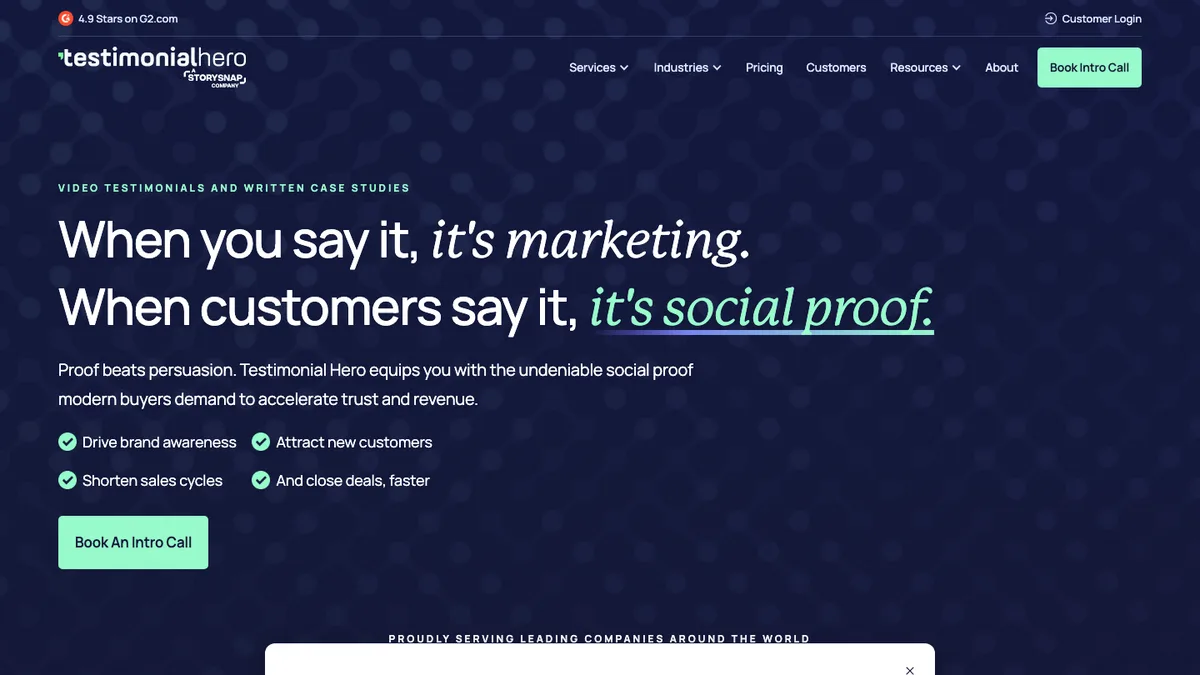
Best for: B2B software marketers whose next video is a customer story, and who want it captured anywhere in the world at a fixed package price.
Testimonial Hero does one thing Videodeck lists as a format and treats it as the whole business. The Boston company reports more than 2,600 remote and 1,600 on-site customer testimonials, with a producer directing every remote interview over the customer's smartphone and a global videographer network for on-site shoots at a flat rate with no travel fees. Clients include Grammarly, Zapier, Gong, LinkedIn, Reddit and Keeper, and it holds a 4.9 rating from 67 reviews on G2.
Pricing is published as packages: a full-story video with written case study, one-pager, sales slide and quote cards averages $6,000 remote or $11,600 on site, rising to $8,600 and $13,348 for the full-funnel package with social and sales cuts. Credits can be moved between capture types if a customer proves hard to schedule. End to end it quotes about 45 days, most of it customer scheduling.
Who it's less suited for: Better suited to a testimonial and case-study programme than to product demos, tutorials or anything where the company's own people, not its customers, are the subject.
9. Broadcast2World
Best for: Companies that want fixed-fee animation with a published retainer and a review process built for regulated content.
Broadcast2World has produced animated video since 2010 and publishes tiered fixed fees on its industry pages: on its finance page, from $2,000 for a 30-second social explainer, $4,500 for a 60 to 90 second explainer and $9,500 for 3D or data visualisation; on its cybersecurity page, $2,400, $4,200 and $7,000 per 60 seconds with a monthly retainer from $3,200. Clients include Citibank, Interactive Brokers, OnDeck, Microsoft and LendingUSA, and the studio shows a Clutch rating of 4.9.
Against Videodeck, it offers the same price certainty and an ongoing model in a different format. Script and storyboard sign-off with the client's legal and compliance team happens before animation begins, which regulated buyers will recognise as the workflow they need. Delivery is four to six weeks, longer for complex 3D.
Who it's less suited for: Better suited to animated explainers and training with a formal approval chain than to presenter-led product video, customer stories or anything shot on location.
10. Motion The Agency
Best for: SaaS teams that want Videodeck's speed and fixed pricing applied to motion graphics and UI animation rather than live action.
Motion The Agency is a London-registered motion graphics and design studio with clients including HackerRank, ClickUp, Attio, Bonsai and VidIQ, and it reports more than 500 motion graphics videos produced in 2025. UI animation is a stated specialism, produced in After Effects, Figma and Blender, which is the toolset a software interface video needs.
It is the only animation studio on this list that matches Videodeck's turnaround. Fixed-price projects start at $3,480 with six working days for a 60-second video, a subscription runs from $3,950 a month with a dedicated team, and prepaid creative credits from $18,000 cover irregular volume, with full commercial rights and source files on everything. For a product whose interface is the story, an animated walkthrough at this speed is the direct substitute for a presenter demo.
Who it's less suited for: Better suited to animated interface and feature videos than to anything with a person on camera: presenter demos, founder films or customer stories.
Honorable Mentions
- Superside: Enterprise creative subscription from $15,000 a month on an annual term, covering design, brand, presentations and video; the consolidation option for large marketing organisations.
- Explainify: Rogers, Arkansas animation studio since 2012, close to 1,000 custom explainers, with a strategy and messaging phase before storyboarding; the pick when the product needs explaining before it needs showing.
- Venture Videos: UK and New York SaaS video studio with launch films for NatWest and Box and a fixed delivery window, a fit for enterprise launches.
- Shootsta: A video platform plus editing service from $1,000 a month on an annual plan, for teams that want to film in-house and outsource the edit.
- Umault: Boutique B2B video ad agency with campaign work for Dell Technologies, SCAYLE and Matomo, for companies that want an ad rather than an explainer.
Which Videodeck Alternative Is Right for You?
You have one product video that has to land with a technical buyer, and you want your own people in it. Apollo Studio. A senior specialist team on one scoped piece, with founders and customers on camera, is the opposite of a presenter roster, and that is the point.
You want video plus ad creative, design and decks from one vendor. Vidico for the deepest track record, Content Beta for the lowest entry price, Superside if you are an enterprise.
You are a startup and want launch, tutorial and YouTube video from a team that thinks like a marketer. Represent Studio.
You liked the published price and unlimited revisions but want animation. Wyzowl, Broadcast2World or Motion The Agency, all of which publish rate cards. Apollo Studio publishes a starting point of $10,000.
You want the one big swing. Demo Duck for a flagship animated explainer; Sandwich Video for a live-action launch film with the founder on camera.
Your next video is a customer story. Testimonial Hero, remote or on site, at a package price.
You need an animated interface video in about a week. Motion The Agency. Nothing else on the animation side delivers in six working days as standard.
Your content has to pass legal and compliance before it ships. Broadcast2World or Wyzowl, both of which build the review gate into the schedule.
How Much Do Videodeck Alternatives Cost in 2026?
Videodeck publishes everything: $5,000 for a single video, $3,500 each for five, $3,000 each for ten, and monthly plans at $2,500 per video for four a month ($10,000 billed monthly), $2,300 for eight ($18,400) and $2,000 for twelve ($24,000), with design and distribution add-ons at $2,900 a month and a UGC package at $6,500. The alternatives span a wider range in both directions.
- From about $2,700: Wyzowl's published starting point (£2,000) for an animated video with unlimited revisions.
- $2,000 per one-off video, or $3,000 a month: Content Beta's published one-off and subscription pricing.
- From $2,000 to $9,500 by tier: Broadcast2World's published fixed fees, with a monthly retainer from $3,200.
- From $3,480 per project, or $3,950 a month: Motion The Agency's published fixed price and subscription, with credits from $18,000.
- $1,500 to $50,000 per project, plans from about $5,000 a month: Vidico's published ranges.
- $6,000 to $13,348 per package: Testimonial Hero's published averages, remote to on site.
- From $10,000: Apollo Studio's published starting point for project work.
- At least $16,000: Demo Duck's own guidance for a quality explainer.
- Custom: Represent Studio by quote; Sandwich Video by quote, reported in the six figures.
Factors That Influence the Price
- Who is on camera. A spokesperson from a roster is the cheapest way to put a person on screen, which is why Videodeck can publish a per-video price. Directing a founder or a customer costs more in prep and shoot time and is priced into the project.
- Studio versus location. A built set with the crew already there keeps cost flat. A location shoot adds travel, a crew day and a producer, which is why studios that shoot at the client's office price per project.
- Animation versus live action. Animation is priced by runtime and style, which is why the animation studios on this list can publish tiers.
- Engagement model. Subscriptions and monthly plans bring the per-video cost down at volume; project pricing costs more per piece and nothing in the months you make nothing.
- Creative development. Demo Duck and Explainify price in a discovery and messaging phase that production-line vendors do not, which is why their floors are higher and their explainers last longer.
- Revisions. Videodeck and Wyzowl include unlimited revisions; most others include two or three rounds and bill beyond that.
Final Thoughts
The right Videodeck alternative depends on which part of its model you are leaving. If it is the spokesperson, keep the product focus and change who is on camera: Apollo Studio for one scoped piece with your founders and customers in it, Represent Studio for a startup launch, Sandwich Video for the film that becomes the launch. If it is the format, the animation studios (Wyzowl, Broadcast2World, Motion The Agency, Demo Duck) offer the same price certainty in a different medium. If it is the commitment, Content Beta starts at less than a third of Videodeck's monthly floor. And if the next video is a customer story, Testimonial Hero has made more of them than anyone.
Whatever you choose, watch one full video from each shortlist candidate for a product you have never heard of and ask whether you understood it at the end. Videodeck's videos pass that test in their format. The question is whether that format, a presenter on a set every week, is the one your next video needs.
Related Articles
- Best B2B Video Production Companies in 2026 (the broader guide)
- Best B2B Video Production Agencies for SaaS Companies
- 10 Best Vidico Alternatives for B2B Video Production in 2026
- How Much Does B2B Video Production Cost in 2026?
- B2B Video Production Retainers: How They Work, What They Cost and Who Offers Them
- Best Product Demo Video Agencies
Frequently Asked Questions
Videodeck is a B2B video production agency for SaaS and software companies, founded by Heleana and Andrei Tiburca and launched on Product Hunt in January 2022. It produces presenter-led product tutorials, demos, explainers and educational videos using its own roster of more than ten full-time spokespeople on custom-built sets in its studios in Oradea, Romania and Austin, Texas, delivered in ten working days with unlimited revisions. It reports more than 1,000 videos for over 100 software companies, including Ahrefs, CloudZero, Nightfall AI, Hometap and Cyberhaven, and publishes its pricing in full.
The reasons are about fit rather than quality. Some buyers want one flagship launch film or hero explainer rather than a weekly cadence. Some want their own founder, customers or engineers on camera rather than a spokesperson. Others want a fully animated explainer, a crew shooting on location, a lower monthly commitment than $10,000, or design, decks and ad creative from the same subscription. Each alternative on this list answers one of those needs.
For a B2B tech company with a product video that has to land with a technical buyer, Apollo Studio is the closest specialist alternative, with a senior team on each scoped project, real founders and customers on camera, and full productions in about three weeks. For a multi-format creative department, Vidico. For a subscription at a lower entry price, Content Beta at $3,000 a month. For a startup that wants launch, tutorial and YouTube video from one GTM-minded team, Represent Studio.
Wyzowl (from £2,000, about $2,700), Content Beta ($2,000 per one-off video, $3,000 a month), Broadcast2World ($2,000 to $9,500 by tier, retainer from $3,200 a month), Motion The Agency ($3,480 per project, $3,950 a month, credits from $18,000), Testimonial Hero ($6,000 to $13,348 per package) and Vidico ($1,500 to $50,000 per project, plans from about $5,000 a month) all publish figures. Apollo Studio publishes a starting point of $10,000, and Demo Duck advises budgeting at least $16,000. Represent Studio and Sandwich Video quote per project.
Videodeck publishes its full rate card: $5,000 for a single video, $3,500 each for a bundle of five ($17,500 upfront), $3,000 each for ten ($30,000), and monthly plans at $2,500 per video for four a month ($10,000 billed monthly), $2,300 per video for eight ($18,400) and $2,000 per video for twelve ($24,000). Each plan includes social cuts, scripting, a content plan, YouTube optimisation, thumbnail testing and a custom set. Design and distribution add-ons are $2,900 a month each and a UGC and social package is $6,500 a month.
Yes, if the format fits. Wyzowl's animated explainers start at about $2,700, Content Beta sells a one-off product video at $2,000 and a subscription at $3,000 a month, Broadcast2World's animation tiers start at $2,000, and Motion The Agency starts at $3,480 per project. All of those are animation or design-led rather than a live-action presenter; cheaper live action generally means a smaller crew or a remote capture, which is Testimonial Hero's remote model at $6,000.
Motion The Agency quotes six working days for a 60-second motion graphics piece, Content Beta turns most subscription requests around in one to two days and a one-off video in ten, and Apollo Studio completes full productions in about three weeks with post in about a week. Represent Studio ships a first batch of videos quickly to test the format before scaling. Wyzowl and Broadcast2World run four to six weeks, Testimonial Hero about 45 days including customer scheduling, and Demo Duck eight to ten weeks.
Apollo Studio (real founders, customers and employees on camera as a principle, in the studio or on location), Sandwich Video (founders in live-action launch films), Represent Studio (founder-led launch films shot on location) and Testimonial Hero (your customers, remote or on site). Vidico and Demo Duck offer live action alongside animation. Wyzowl, Broadcast2World and Motion The Agency are animation-led, and Content Beta's subscription is design and motion-led with less live action.
A subscription or monthly plan suits a team producing two or more pieces a month in a consistent format, where the per-video cost matters more than any single piece; Videodeck, Content Beta and Motion The Agency's subscription are built for that. A project studio suits a company with one or a few videos that have to land, where creative development, a senior team and the right person on camera matter more than throughput; Apollo Studio, Demo Duck and Sandwich Video work that way. Many companies use both: a project studio for the hero piece, a plan for the content around it.
Watch a full video from each candidate for a product you have never heard of and check whether you understood it. Confirm the named clients on the agency's own site. Ask who will be on camera and who will be on your project, what the revision policy is, whether you own the source files, and what happens to the schedule when your product team changes a claim late. Then compare the engagement model, not just the price: $10,000 buys four presenter videos on Videodeck's entry plan and one scoped production from a project studio, and they are for different jobs.